How Should a Bank Match Customer Names Across Spelling Variants, Transliteration and Compound Surnames in 2026?

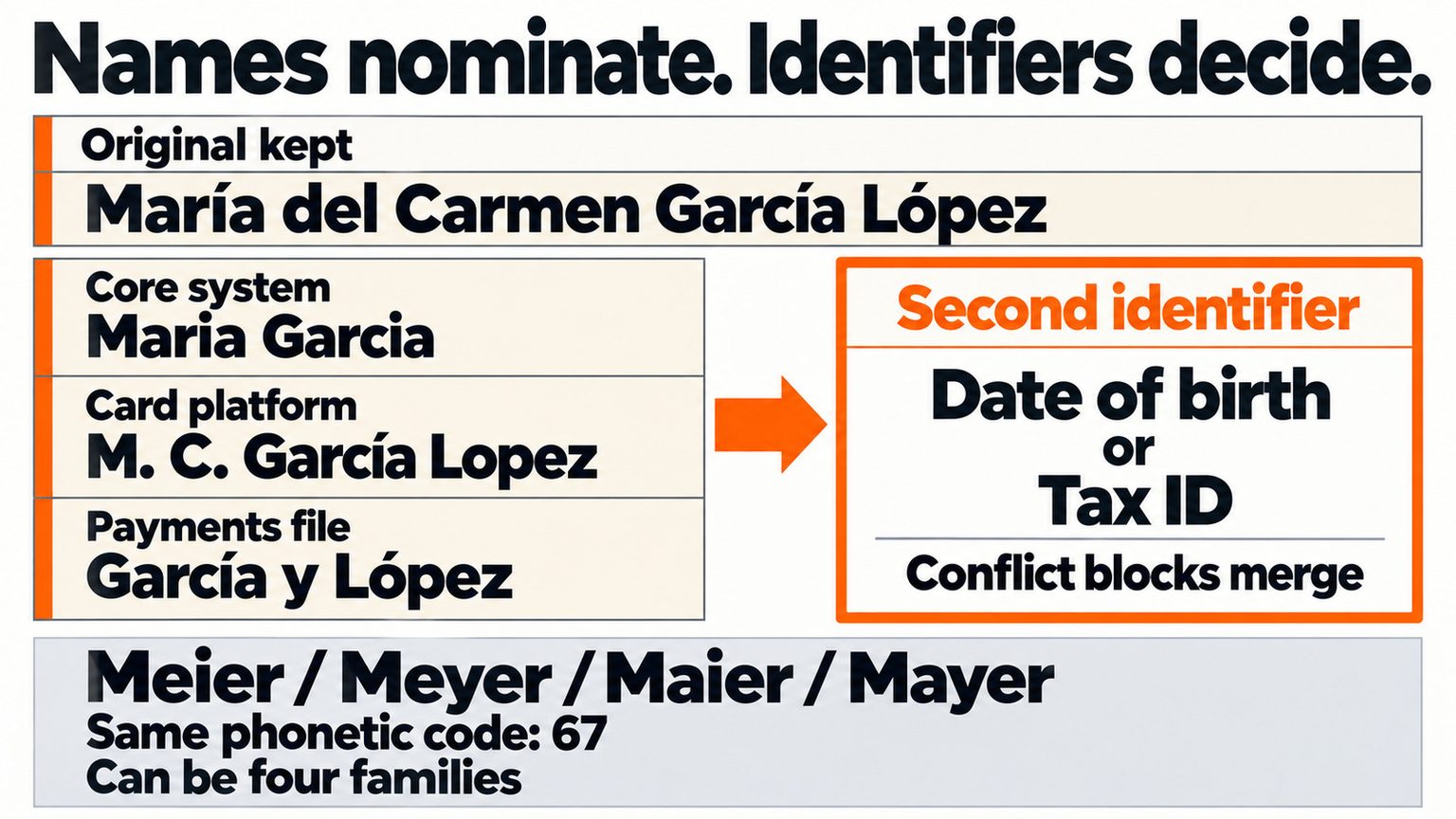
TL;DR: A bank should match customer names by variant class, not with one fuzzy score. Keep the name as supplied, split it into parts, store transliterated and folded forms beside the original, and compare each part with the method that fits it. For KYC and customer-data teams: a name nominates a match, and another identifier decides it.
Book a Demo · Try Tilores Studio (Free)
On this page
- How should a bank match customer names across spellings, scripts and surnames?
- Why must the original spelling survive every transformation?
- Why should a name be split into parts before it is compared?
- Which comparison method fits which variant class?
- Why should a name never decide a merge on its own?
- When does a name have to stand on its own?
- How should a bank test name matching before it signs?
- Frequently asked questions
- Sources
María del Carmen García López, a fictional customer, applies for a current account. Your core system already holds her as Maria Garcia, the card platform as M. C. García Lopez and the payments file as García y López. The deduplication run links none of them, so someone asks for the fuzzy-matching threshold to be loosened.
Loosen it far enough to catch her and the run starts to join people who only sound alike. Under the Cologne phonetic code, built for German names, Meier, Meyer, Maier and Mayer all become 67, which can be four different families. One looser score trades missed links for false merges.
We think that trade is avoidable. Name variants fall into distinct classes, each with its own fix, and a name should only ever nominate a match. A date of birth, a tax ID or an address history decides it.
How should a bank match customer names across spellings, scripts and surnames?
Treat each kind of variation as its own problem. Store the name as supplied, split it into parts, keep transliterated and folded forms in derived fields beside the original, compare each part with the method that fits its class, and leave the final decision to an identifier that is not the name.
The drift is large. In a US Census Bureau undercount study that William Winkler reports, 25 percent of first names and 15 percent of last names did not agree character by character among pairs that were true matches. That is a US population file, not bank data, but it shows the scale before a second script or a double surname enters.
It is also not one problem. Eight classes cause most of the drift, and a fix for one can break another, so we keep them apart. All names in the table are fictional.
| Variant class | Fictional example | What goes wrong | First treatment | Risk to control |
|---|---|---|---|---|
| 1. Encoding and diacritics | Müller stored as one character or as u plus a combining mark; also Muller and Mueller | Identical on screen, different bytes; the umlaut is dropped or spelled out | One Unicode normal form on the way in, plus a folded comparison field | Folding must never overwrite the original |
| 2. Letters with no base letter | Weiß and Weiss; Yılmaz and Yilmaz | Folding leaves ß and ı alone, so Weiß and Weiss stay two edits apart | An explicit, versioned replacement in its own comparison field | Test the replacement on labelled pairs; never apply it to identifiers |
| 3. Transliteration between scripts | Юлія Гриценко, Юлия Гриценко, Yuliia Hrytsenko, Yuliya Gritsenko | Each language has its own letter table | Transliterate by the record’s language, keep the native spelling, compare both | Romanisation cannot be reversed reliably |
| 4. Spelling variants inside one script | Mohammed, Muhammad, Mohamed; Meier, Meyer, Maier, Mayer | Short vowels and local conventions vary | Phonetic code or edit distance, always beside a second field | Phonetic codes collide across different families |
| 5. Compound and multiple surnames | García López, García y López, Arnheim-Bauer, Arnheim Bauer | Parts are dropped, or joined by a hyphen, a space or a connector | Split into family name and second family name; use token rules | A shared surname part is weak evidence on its own |
| 6. Name order and particles | van der Berg, Joost and Joost van der Berg | The family name is not always the last word | Read a comma as family name first; keep particles with the family name | Particle lists differ by language |
| 7. Initials, abbreviations and nicknames | M. C. García; Kate and Catherine | Tokens are missing or replaced by an alias | Use an alias list only beside stronger evidence | Short names need a stricter edit limit |
| 8. Changed names | Catherine Brandt, later Catherine Okafor | No string comparison bridges a new surname | Link through other identifiers: date of birth, tax ID, address history | The other identifiers must not conflict |
Only class 1 is purely mechanical. The Unicode standard treats a precomposed ü and u plus a combining diaeresis as canonically equivalent, yet they are different byte sequences, so one defined normal form on the way in settles it. Every other class needs a decision, and the first one is what to keep.
Why must the original spelling survive every transformation?
The original must survive because some fixes cannot be undone. Transliteration is the clearest case, since each standard uses its own letter table. The BGN/PCGN tables published by the US National Geospatial-Intelligence Agency romanise г as g in the Russian table and as h in the Ukrainian table, so Гриценко is Gritsenko read as Russian and Hrytsenko read as Ukrainian.
The given name splits too: Юлия is Yuliya in the Russian table and Юлія is Yuliia in the Ukrainian one, which also warns that it is not recommended for reverse transliteration. A pipeline that replaces the native spelling with one Latin form has thrown away the evidence it needs to check its own guess.
Watchlist publishers already keep both forms. The UK Sanctions List format records a primary name, spelling variations of that name, and a separate non-Latin script version with its script and language. OpenSanctions, the open sanctions and PEP data source, transliterates only where the result is reliable and otherwise compares names in the native script.
We built our name normaliser on the same principle. Version 2, released on 14 September 2026, transliterates names written in Cyrillic, Greek, Armenian, Georgian, Arabic, Persian, Urdu, Hebrew, Hangul, kana, Chinese Han, Devanagari or Bengali script into Latin in firstName and lastName, and keeps the original in firstNameNative and lastNameNative, as our reference lists and transformer reference set out. It reads the record’s language, or its country when no language is given, to choose the table.
The limits matter too. Arabic and Hebrew do not write short vowels, and Japanese kanji have no reading of their own, so a small list maps the common name tokens and anything else falls back to the letters. Spelling variants stay as written: ahmed and ahmad reach the comparison layer as two strings, which is why we compare the native outputs as well. Keeping the original settles what to store. The next question is what to compare, and a full name is the wrong unit.
New posts on entity resolution, identity data and AI. No spam, unsubscribe any time.
Why should a name be split into parts before it is compared?
A name should be split because many customers carry more than one family name, and the parts travel between systems on their own. Spanish civil registry law has parents agree the order of their respective first surnames and allows de, y or i between them, as Article 49 of Ley 20/2011 sets out. One person can therefore appear as García López, García y López or plain García.
Germany added a variant on 1 May 2025. Married couples can now choose a double name built from both family names, and children can receive a double birth name, as the Federal Ministry of Justice explains with the examples Arnheim-Bauer and Bauer-Arnheim. The Civil Code makes the hyphen the default and lets the spouses declare otherwise, so Arnheim-Bauer and Arnheim Bauer can both be lawful spellings of one name.
In the UK, HM Passport Office accepts a marriage or civil partnership certificate for a new double-barrelled name, so a passport can change before the bank’s records do.
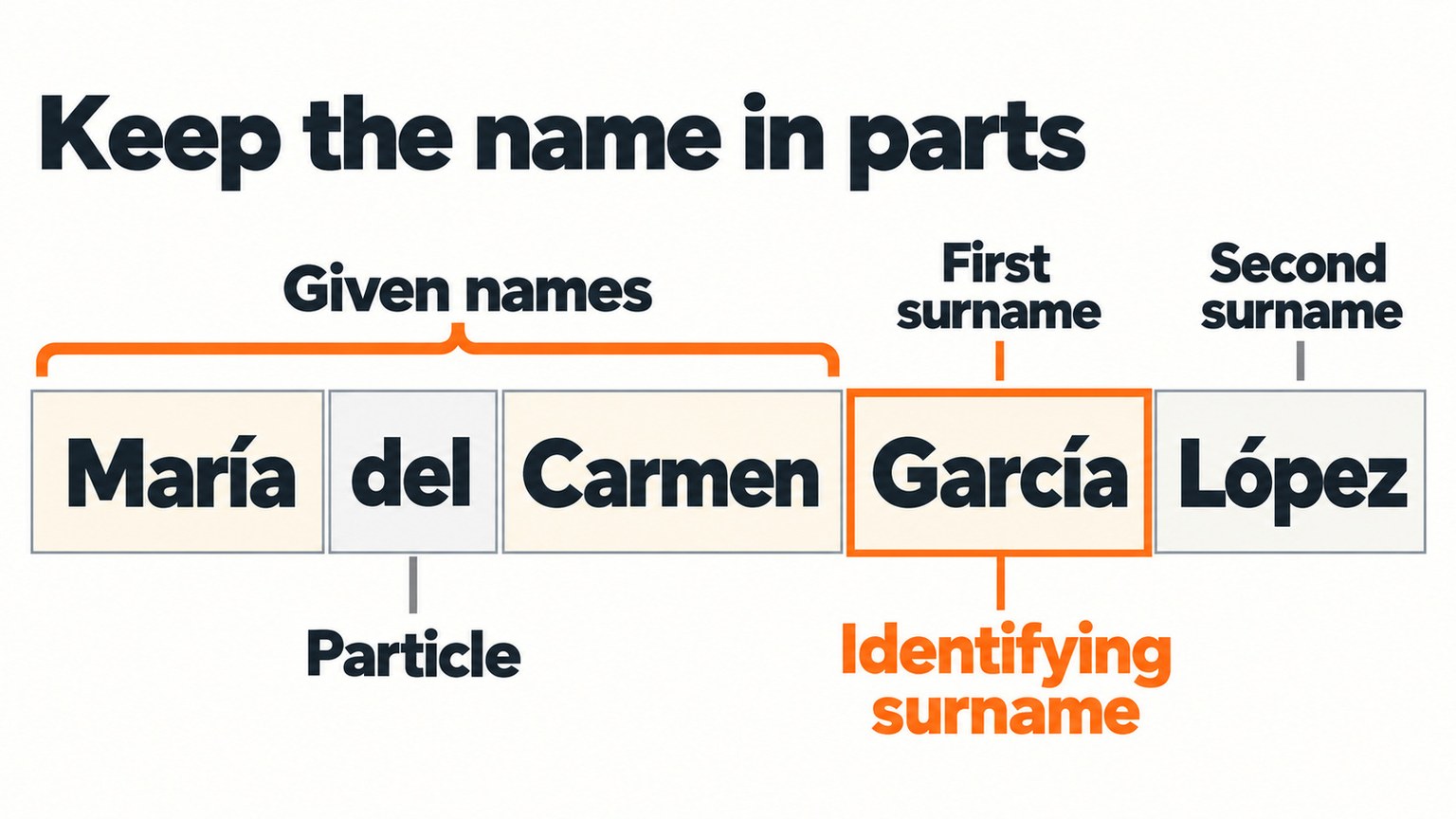
Compared as one string, García López fails against García, and Arnheim-Bauer against Arnheim Bauer. Split into parts, each has a smaller, cleaner target. Our normaliser splits a name into titles, given names, middle names, family name, second family name and suffix, using reference lists scoped by country and language. It puts a Spanish name’s identifying surname in lastName and the other in secondaryLastName, and reverses the roles for a Portuguese name, so the identifying surname carries the match and the second one supports it.
The same parser keeps particles with the family name, reads a comma as family name first and removes apostrophes, so van der Berg, Joost lines up with Joost van der Berg, and O’Brien with OBrien. Where the number of parts still differs, a token rule closes the gap. Our minimum-matches strategy needs a set number of matching tokens in any order, so with two required, John Smith matches John Smith-Doe and Smith John.
One limit applies: a value with a single word fills neither name part, because nothing tells a given name alone from a family name alone. With the parts in place, the remaining question is which comparison to run on each.
Which comparison method fits which variant class?
Match each class with the method built for it, accepting that each method collides somewhere else. Peter Christen’s comparison of personal-name matching techniques on four large name data sets found no clear best technique, so we choose the method by class and test it on the bank’s own pairs.
Where do phonetic codes help, and where do they collide?
Phonetic codes catch spellings that sound alike, and they cost little to compute. The Cologne phonetic code, built for German, gives Müller, Mueller and Muller the same code, 657. The cheapness is also the risk from the opening: Meier, Meyer, Maier and Mayer all encode to 67, and Schmidt, Schmitt and Schmid to 862, although each spelling can belong to a different family. A phonetic match is a candidate for the next layer, not a decision.
How much edit distance should a name get?
Edit distance counts single-character changes, so it suits typing errors. A name needs a strict limit, because one edit is a large share of a short name. Our default dynamic text distance allows no edits below four characters and one edit from four characters up, which keeps Mia and Moe apart.
This is also why derived fields come before comparison. Spelling out an umlaut costs two edits, Müller to Mueller, which is outside that limit. Fold diacritics to their base letter first and it costs one, inside the limit. Weiß and Weiss stay two edits apart even after folding, because ß has no base letter, so that class needs an explicit replacement, ß to ss, before the comparison runs.
When is a nickname list safe to use?
Our nickname comparer looks names up in an alias list, so Mike matches Michael. One nickname can stand for many names, so it should run only next to stricter evidence. Kate and Catherine is a fair link when family name and date of birth agree, and a poor one when the first name is all that agrees.
Every one of these methods produces false candidates somewhere. That is acceptable on one condition: something other than the name makes the final call.
Why should a name never decide a merge on its own?
A name should never decide a merge because the closest name match still cannot tell apart two people who share a name, and only a second identifier can. A consistency rule turns that into a veto. Our consistency rules check the incoming record against every record already in the candidate entity, and if one conflicts, that entity is not a candidate, as our guide to same-name customers shows.
The identifiers decide in the other direction too. When Catherine Brandt becomes Catherine Okafor, no string comparison bridges the new surname, and a matching date of birth, tax ID or address history makes the link. Whether the name decides or only nominates is what separates the three setups banks usually run.
| Setup | What happens | Where it fits | Where it falls short |
|---|---|---|---|
| One cleaned name, compared for equality | Each name is reduced to one Latin string and compared for equality | Fast and easy to explain when sources share one convention | Misses most classes above, and the cleaning discards the original |
| One phonetic code or fuzzy score per name | Each name becomes a code or a similarity score; a close enough result matches | Cheap; good for spellings that sound alike | Merges different families that sound alike; blind to order, scripts and compound surnames |
| Parts, derived fields and layered comparison (our approach) | We keep the original, parse the name, add derived fields, compare by class and let a consistency rule veto | Fits customers who span scripts, surname conventions and several legacy systems | Needs rules, reference lists and a labelled test set; a single-word value fills neither name part |
In what order should the matching layers run, step by step?
The order matters more than any single method, and no step touches the original.
- Store the name as supplied. Write the original value, source system, record ID and ingestion time before any transformation. We normalise and persist ingested data and retain the originals, so a reviewer can always see what a source sent.
- Parse the name into parts. Split titles, given names, family name, second family name and suffix; read a comma as family name first and keep particles with the family name.
- Transliterate and fold into derived fields. Apply one Unicode normal form, transliterate by the record’s language, fold diacritics and add explicit replacements such as ß to ss, each as a separate versioned field.
- Compare each part with the method that fits its class. Use exact comparison on trusted parts, phonetic codes or edit distance on spelling variants, token rules on order and compound surnames, and alias lists only beside stronger evidence.
- Let a consistency rule veto the merge. Block a link when a date of birth or tax ID conflicts, however close the names look.
- Route uncertain pairs to review and log the rule. Send pairs between the auto-merge and auto-reject thresholds to a steward, and record the rule that created every link. Every match is stored as a graph edge that records the rule behind it, and our review-queue guide covers the queue itself.
When does a name have to stand on its own?
A name has to stand on its own in watchlist screening, which is a different job from merging customers. Screening against sanctions lists, PEP lists and adverse media compares a name with a list entry or a news report, often with few other fields to veto with. It is built to raise an alert on a possible match, and analysts want every relevant alert with as little false-positive noise as possible, as OpenSanctions describes. That tolerance would be wrong for merging two customers.
Our entity resolution sits next to a bank’s screening process and does not replace it. We hand screening one resolved customer profile with the original names, the derived variants and the rule trail, so the screening team can search every spelling a customer has used. The lists and thresholds stay with the bank’s screening controls, often fed by open data such as OpenSanctions. If the task is to check a single name against a list with nothing else known, a screening engine is the right tool, and we hand it clean input.
Adverse media is the hardest case, because the name arrives in news prose, so the variant list on the profile gives the team more to search with. And where a bank’s own records hold no second identifier at all, no setup can decide whether two same-name records are one person. Those pairs belong in review, not in an automatic merge.
How should a bank test name matching before it signs?
A bank should test name matching class by class, on its own data. Build a labelled set for each variant class instead of one pooled set, so a gain in umlaut handling cannot hide a loss in transliteration.
As an illustration with labelled assumptions: eight classes, 100 labelled pairs per class, 30 seconds to decide each pair, and two reviewers who judge every pair independently. That is 8 × 100 = 800 pairs. At 30 seconds each, 800 × 30 = 24,000 seconds, or about 6.7 hours per reviewer and 13.3 reviewer hours in total. These are planning numbers, not our performance figures, so replace them with your own review times.
Add a regression set of near neighbours: Meier and Meyer in one postcode, a parent and child who share a name, two customers with the same double surname. Report precision and recall for each class, and re-run the set whenever a rule, reference list or transformer version changes, because a change in a name output changes the matching keys.
You can try the first layers on your own file before talking to any vendor. Our Tilores Studio runs entity resolution locally on up to 100,000 records, free, and our free fuzzy matching tools compare two strings across every algorithm side by side. Our guide to German name and address normalisation covers the address half of the same problem.
Then write the eight classes into the PoC test plan, agree who labels which pairs, as our guide to agreeing matching rules with a vendor before a PoC sets out, and ask every vendor, us included, for results class by class. A single overall accuracy figure is where a loosened threshold hides.
Frequently asked questions
Should a bank transliterate every name into Latin before matching?
No. Transliterate into a derived field and keep the native spelling. Romanisation cannot be reversed reliably, and for some scripts it loses precision, so we compare the native outputs as well.
Does a phonetic match prove that two names belong to one customer?
No. A phonetic code puts names that sound alike into one bucket, and different families fall into the same bucket. Treat the match as a candidate and confirm it with other fields.
How should a bank match a two-surname Spanish name against a record with one surname?
Compare the identifying family name first. Our parser keeps it in lastName and the other surname in secondaryLastName, so a one-surname record can still reach the full name, and the second surname adds confidence when both records hold it.
Does our name normaliser read names written in Arabic script?
Yes, with a stated limit. We transliterate the name to Latin and keep the native spelling in separate outputs. Arabic does not write short vowels, so a small list maps common name tokens such as محمد to mohammed, and anything else falls back to the letters.
Can a name match alone merge two customers?
No. A strong name match is evidence, and a consistency rule on a field such as date of birth or tax ID can still block the merge. We apply that check against every record in the candidate entity.
Sources
- Transformer Reference: Normalize Name (version 2), Tilores documentation.
- Text Comparison Reference, Tilores documentation.
- Matcher Reference, Tilores documentation.
- Reference Lists, Tilores documentation.
- Consistency, Tilores documentation.
- Release Notes, version 0.97.0 (14 September 2026), Tilores documentation.
- How German Banks Should Normalise Names and Addresses Before Entity Resolution, Tilores.
- Can Entity Resolution Tell Two Customers With the Same Name Apart? Consistency Rules for Banks, Tilores.
- Entity Resolution Review Queues: How to Design Human Decisions for Ambiguous Matches in 2026, Tilores.
- How a Bank and Its Entity Resolution Vendor Agree on Matching Rules Before a PoC, Tilores.
- Fuzzy Matching Algorithms: Free Online Tester, Tilores.
- Overview of Record Linkage and Current Research Directions, William E. Winkler, US Census Bureau Research Report Series, Statistics #2006-2.
- A comparison of personal name matching: techniques and practical issues, Peter Christen, Australian National University, 2006.
- Unicode Normalization Forms (UAX #15), Unicode Consortium.
- Romanization of Russian: BGN/PCGN 1947 System, US National Geospatial-Intelligence Agency.
- Romanization of Ukrainian: BGN/PCGN 2019 Agreement, US National Geospatial-Intelligence Agency.
- Format guide for the UK Sanctions List, GOV.UK.
- Rosetta, not Roulette: Improving sanctions screening results with our new logic-v2 matcher, OpenSanctions.
- Ley 20/2011, de 21 de julio, del Registro Civil, Article 49, Boletín Oficial del Estado.
- Neues Namensrecht gilt ab dem 1. Mai: Echte Doppelnamen für Ehepaare und Kinder, Bundesministerium der Justiz und für Verbraucherschutz, 29 April 2025.
- Bürgerliches Gesetzbuch, § 1355 Ehename, Bundesministerium der Justiz.
- Change your name or personal details on your passport: marriage and civil partnership, GOV.UK.
- ColognePhonetic (Apache Commons Codec API), The Apache Software Foundation.
See what resolved entity data does for your business — and your AI.