
How a new approach to finding duplicate companies reduces costs and improves accuracy
The Hidden Problem Costing Your Business
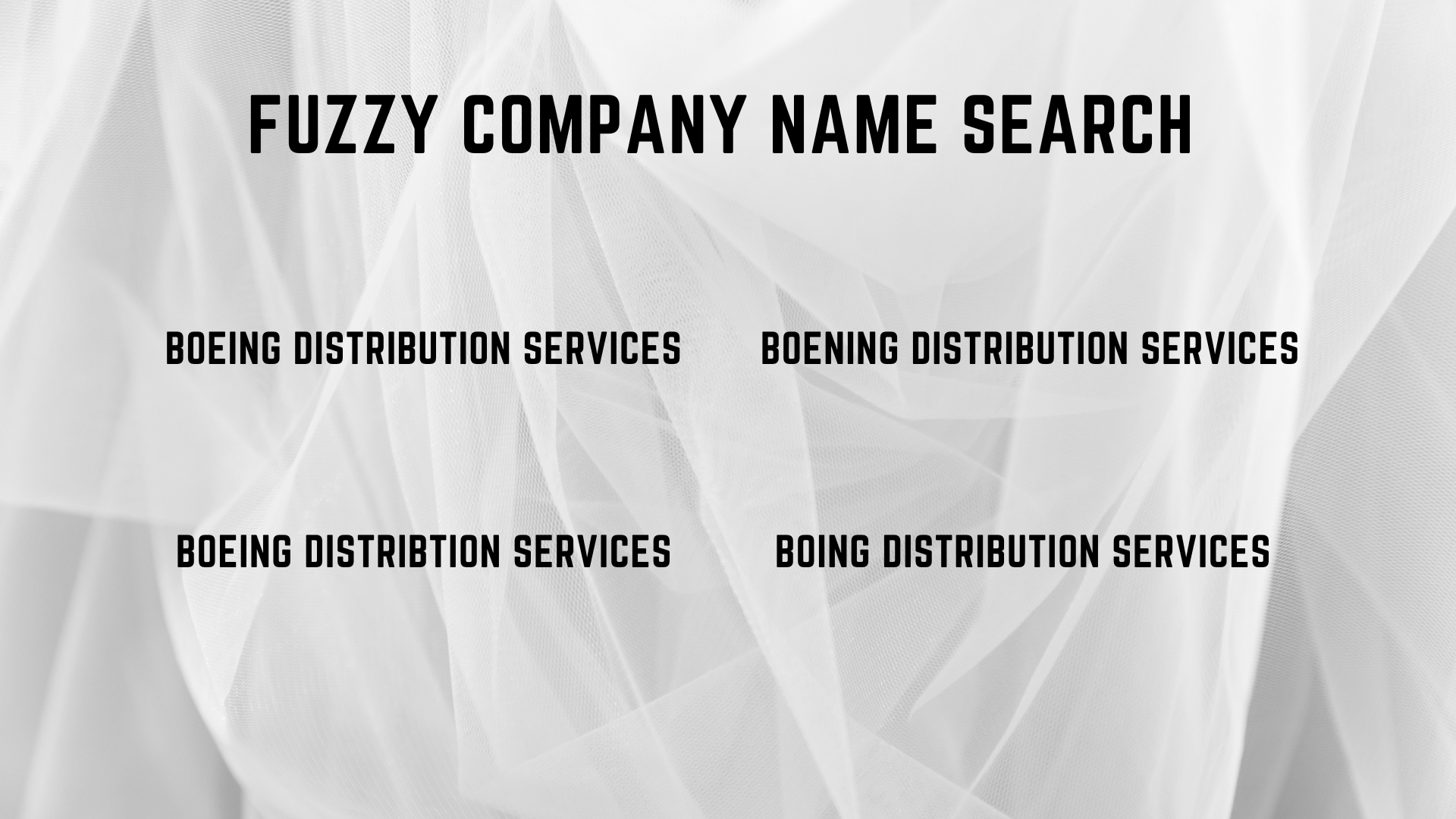
Imagine you're trying to clean up your customer database and you discover these entries:
-
Boeing Distribution Services
-
Boening Distribution Services
-
Boeing Distribtion Services
-
Boing Distribution Services
To a human, these are obviously the same company with various typos. But to most computer systems, they look like four completely different businesses. This creates real problems:
For Sales Teams: You might think you have four potential customers when you really have one existing client. This leads to wasted outreach efforts and confused prospects who get multiple calls from your company.
For Financial Analysis: Your revenue reports show sales to four different companies instead of recognizing your true relationship with one major client. This skews your understanding of customer concentration and relationship value.
For Compliance: Anti-money laundering and know-your-customer processes require accurate company identification. Missing connections between related entities creates compliance risks and audit problems.
For Data Integration: When merging databases from acquisitions or connecting with partner systems, duplicate companies multiply, making your data increasingly unreliable over time.
How Company Matching Systems Work Today
Most business systems that try to solve this problem work in two steps:
-
Find Possible Matches: The system looks through your database to find companies that might be the same
-
Confirm the Match: It compares the candidates more carefully to decide if they're actually duplicates
The challenge has always been the first step. With millions of company records, how do you quickly find potential matches without checking every single combination?
The traditional approach breaks company names into small pieces and indexes those pieces. For "Boeing Distribution," it might create indexes for "Boei," "oein," "eing," "Dist," "istr," and so on.
This approach has worked for smaller databases, but creates serious problems as your business grows.
The Expensive Problems with Traditional Methods
Problem 1: Common Words Slow Everything Down
Words like "Corporation," "Services," "International," and "Solutions" appear in thousands of company names. Every time someone searches for a company with these common words, the system has to compare against thousands of potential matches.
This is like trying to find someone named "Smith" in a phone book by first collecting everyone with "Smith" in their name, then checking each one individually. With popular words, you end up checking far too many irrelevant matches.
Problem 2: Database Costs Spiral Out of Control
Each company name generates dozens of database entries for indexing. A single company like "Boeing Distribution Services Corporation" might create 25 separate index entries.
For businesses using cloud databases that charge per operation:
-
Adding one company: 25 database write operations
-
Searching for matches: Multiple database read operations across many indexes
-
Scale to 500,000 companies: Over 5 million index entries to maintain
This translates directly to higher monthly database bills and slower system performance.
Problem 3: You Hit Database Limits
Many business database systems have limits on how much data can be stored in a single index. Common words like "Corporation" or "Services" can max out these limits when you have enough companies in your system.
When you hit these limits, you face bad choices:
-
Split indexes (adding complexity and slowing searches)
-
Remove some companies from indexes (missing potential matches)
-
Change your matching strategy (catching fewer typos)
Problem 4: Simple Typos Break the System
When someone types "Boening" instead of "Boeing," traditional systems often miss the connection entirely. The character-based approach can't bridge common typos like swapped letters, especially in shorter company names.
A Smarter Approach: Learning from Your Data
The breakthrough solution works differently. Instead of breaking names into arbitrary character pieces, it studies your actual data to understand what kinds of typos and variations really happen in business names.
How It Learns
The system analyzes your existing database to discover patterns:
Common Letter Swaps: It finds that people often type "d" instead of "t" (and vice versa) in company names. It discovers that "er" and "re" get swapped frequently at the end of words.
Typical Typos: It identifies which letters are commonly dropped (vowels in the middle of words) and which get added (like plural "s" endings).
Industry-Specific Patterns: It adapts to your business domain. Technology companies have different typo patterns than pharmaceutical companies or construction firms.
How It Works Better
Instead of creating indexes for random character sequences, the system
-
Generates Smart Variations: For "Boeing," it creates variations like "Boening," "Boieng," and "Boing" based on real typo patterns it learned from your data.
-
Groups by Sound: It indexes the phonetic encoding of the original value.
-
Stays Current: The system can reanalyze your data periodically to discover new patterns as your database grows and changes.
The Business Impact
Organizations using this approach see significant improvements:
Reduced Operating Costs
Database Operations: Instead of 5 million index entries, the same dataset requires only 500,000 entries—a 90% reduction in database costs.
System Performance: Searches complete faster because there are fewer irrelevant matches to check. Instead of comparing against 25,000 candidates, you might compare against only 500.
Maintenance Overhead: Less complex indexing means fewer system administration tasks and lower technical maintenance costs.
Better Data Quality
Improved Coverage: The system catches 5% more duplicate companies compared to traditional methods, without creating more false positives.
Handles Real Typos: It finds matches that traditional systems miss, like "Boeing" and "Boening," because it understands actual typo patterns rather than arbitrary character combinations.
Scalable Growth: As your database grows, performance remains stable instead of degrading.
Practical Business Benefits
For Sales: Better lead qualification because you can accurately identify existing customers, regardless of how their names were entered in different systems.
For Finance: More accurate customer analysis and revenue reporting because related entities are properly connected.
For Compliance: Better risk assessment because you can identify all variations of company names that might appear on watch lists or in regulatory databases.
For Data Integration: Smoother mergers and acquisitions because duplicate identification works reliably even with large, messy datasets.
What This Means for Your Business
If your organization deals with large amounts of company data—whether you're in financial services, logistics, manufacturing, or any B2B industry—this technology can deliver immediate value:
For Technology Leaders: You can implement more reliable data matching without worrying about database size limits or escalating cloud costs.
For Data Teams: You get better duplicate detection that requires less manual cleanup and produces more trustworthy analytics.
For Business Users: You can trust that your CRM, ERP, and analytical reports accurately reflect your business relationships without artificial duplicates skewing the numbers.
For Compliance Teams: You can confidently screen against regulatory databases knowing that name variations won't cause you to miss important matches.
The Competitive Advantage
Companies that solve the entity resolution challenge gain a significant advantage. Clean, accurately matched data enables:
- Better customer relationship management
- More accurate business intelligence and forecasting
- Reduced operational overhead from manual data cleanup
- Faster integration of new data sources
- More reliable compliance and risk management
The organizations that solve this first—with technology that can handle real-world scale and complexity—position themselves to make better decisions based on more accurate data.
Looking Forward
As business databases continue to grow and data sources multiply, the ability to accurately identify and match entities becomes increasingly critical. Traditional approaches that worked for smaller datasets become expensive bottlenecks at enterprise scale.
The variation-based approach represents a fundamental shift toward data-driven solutions that learn and adapt rather than relying on rigid rules. This makes systems more effective while reducing operational costs—a combination that's essential for businesses dealing with large-scale data challenges.
For organizations evaluating entity resolution solutions, the key questions are no longer just about accuracy, but about scalability, adaptability, and total cost of ownership. The most advanced systems learn from your specific data patterns and grow more effective over time, rather than becoming more expensive and complex as your business scales.
