SAP Buys Reltio, Salesforce Buys Informatica: Why Big Tech Is Betting on Data Quality for AI

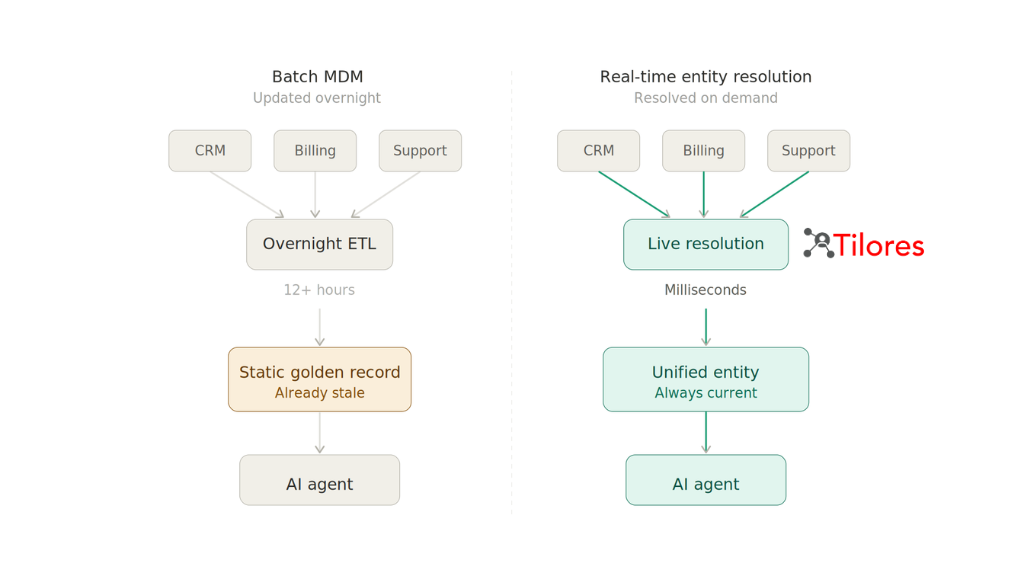
TL;DR: TL;DR: SAP acquired Reltio and Salesforce acquired Informatica because they have made the same bet: AI readiness is about data, not models. Both buy master data management (MDM) and data-quality capability to control the data layer that feeds their AI agents. But the engine underneath every MDM platform is entity resolution, the matching that decides which records are the same entity, and for agentic AI that resolution has to happen in real time, across every system, not in an overnight batch.
The two deals at a glance
Both acquisitions pull data-quality and MDM capability into a platform giant’s stack to feed its AI agents. Status and dates below are confirmed against the acquirers’ own announcements (see Where these deals stand (2026)).
| Acquirer | Target | What it adds | Status (2026) |
|---|---|---|---|
| SAP | Reltio | Master data management for SAP and non-SAP data; strengthens SAP Business Data Cloud and the Suite-First, AI-First strategy | Announced 27 March 2026; completed 7 May 2026 |
| Salesforce | Informatica | Data integration, governance, data quality, metadata management and MDM for the Data Cloud foundation under Agentforce | Completed 18 November 2025 |
On this page
- The two deals at a glance
- The MDM acquisition wave
- The question these deals don’t answer
- Entity resolution: the engine at the heart of MDM
- Why real-time matters for agentic AI
- What this means for the market
- Where Tilores fits
- The bottom line
- Where these deals stand (2026)
- FAQ
Two of the largest enterprise software companies in the world have now made the same bet: the future of AI depends on clean, connected data.
SAP’s announced acquisition of Reltio - a leading master data management (MDM) platform - comes hot on the heels of Salesforce’s purchase of Informatica. The message from both deals is unmistakable. AI readiness isn’t about models. It’s about data.
As SAP’s COO put it, the goal is to make enterprise data “fully AI-ready” - unified, cleansed, and harmonized across SAP and non-SAP sources. That framing is exactly right. Without trusted data, agentic AI is just a hallucination engine with enterprise pricing.
But these acquisitions also raise important questions about what “AI-ready data” actually means in practice - and whether traditional MDM is sufficient to get there.
The MDM acquisition wave
Let’s start with what these deals signal.
Both SAP and Salesforce are platform companies. Their core business is getting enterprises to run as much as possible on their stack. Acquiring MDM capabilities is a natural extension of that strategy: if you control the data layer, you control the AI layer.
For SAP, Reltio strengthens its Business Data Cloud and supports its “Suite-First, AI-First” strategy. For Salesforce, Informatica brings decades of data integration and governance expertise into the Data Cloud ecosystem.
These are smart moves. Both companies recognise that their AI products - whether it’s SAP’s Joule or Salesforce’s Agentforce - are only as good as the data they reason over. Garbage in, garbage out isn’t just a cliché anymore. It’s a business risk that scales with every AI agent you deploy.
The question these deals don’t answer
Here’s the thing about traditional MDM: it was designed for a world where data quality was a governance problem. You’d run a batch process overnight, match and merge records, produce a golden record, and publish it to downstream systems. The cycle time was hours or days. That was fine when the consumers of that data were dashboards and quarterly reports.
But AI agents don’t check a dashboard once a week. They make decisions in real time - approving a claim, flagging a transaction, routing a customer query. They need to know who they’re dealing with right now, not who the overnight batch job thinks they were dealing with twelve hours ago.
This is the gap that entity resolution fills.
Entity resolution: the engine at the heart of MDM
Here’s something that often gets lost in the MDM conversation: entity resolution isn’t an alternative to master data management. It’s the core capability that makes MDM work in the first place.
Every MDM platform - Reltio, Informatica, and the rest - relies on entity resolution under the hood. It’s the process that takes fragmented, messy, siloed data and determines - often probabilistically - that “John Smith” in your CRM, “J. Smith” in your billing system, and “Jonathan Smith” in your support tickets are all the same person. Without entity resolution, there’s no golden record to govern. There’s no “single source of truth.” There’s just a collection of unlinked data sitting in separate systems.
MDM adds a governance layer on top: data stewardship, validation workflows, publishing to downstream systems, enforcing standards. That governance layer matters. But the intelligence underneath - the matching, linking, and deduplication that actually connects your data - that’s entity resolution.
This distinction matters because it opens up an important question: do you always need the full MDM stack, or do you sometimes just need the engine?
In practice, we’ve seen organisations evaluate full MDM platforms like Reltio and Informatica and ultimately choose a dedicated entity resolution layer instead. Not because MDM isn’t valuable, but because their primary problem wasn’t governance - it was the matching itself. They needed to connect records across systems quickly, accurately, and at scale, without the overhead of a full MDM deployment. And they needed it to happen in real time, not overnight.
New posts on entity resolution, identity data and AI. No spam, unsubscribe any time.
Why real-time matters for agentic AI
Consider a few scenarios where batch MDM falls short:
Fraud detection. A fraudster opens accounts across three different channels in the space of an hour. A batch MDM process won’t link those accounts until the overnight run. By then, the damage is done. Real-time entity resolution connects those records as they arrive, flagging the pattern immediately.
Insurance claims. A claimant submits through multiple channels or entities. Without real-time resolution, each submission is processed independently - potentially resulting in duplicate payouts. Resolving identity at the point of ingestion prevents this.
Customer experience. An AI agent handling a support query needs to know a customer’s full history - across every touchpoint, every product, every interaction - right now. Not after the next ETL cycle.
In each case, the AI agent needs a living, constantly resolving view of the world. Not a static snapshot from last night’s batch run.
What this means for the market
The SAP/Reltio and Salesforce/Informatica acquisitions will inevitably pull these MDM capabilities deeper into their respective platform ecosystems. That’s great if you’re an all-SAP or all-Salesforce shop. The integration will be tight, the data flows will be native, and the AI features will light up faster.
But most enterprises don’t run a single stack. They have SAP for ERP, Salesforce for CRM, a separate billing platform, legacy systems, third-party data sources, and a constellation of SaaS tools that each hold a piece of the customer picture.
For those organisations - which is most organisations - the entity resolution layer needs to be platform-agnostic. It needs to sit across all of those systems, resolving identity in real time regardless of where the data lives. And it needs to do this via API, at the speed an AI agent requires.
Where Tilores fits
This is the problem we built Tilores to solve.
Tilores is a real-time entity resolution engine - the same core capability that powers every MDM platform, but purpose-built for the speed and flexibility that AI-driven applications demand. For some organisations, Tilores complements an existing MDM deployment by providing a real-time resolution layer that their MDM can’t. For others, it replaces the MDM entirely - because entity resolution was the capability they actually needed, and the governance overhead wasn’t worth it.
We’ve been chosen over both large MDM platforms in competitive evaluations - not because we do more, but because we do the essential thing faster, with less complexity.
A few things make our approach different:
Real-time, not batch. Tilores resolves entities at API speed - milliseconds, not hours. When a new record arrives, it’s immediately matched and linked against your existing data. Your AI agents always reason over the most current view of reality.
Platform-agnostic. Tilores works across SAP, Salesforce, and everything else. It doesn’t care where your data lives - it connects records across any source, any format, any silo.
Built for scale. Our engine has been proven at scale - resolving billions of records into unique profiles in production deployments. It handles the volume and velocity that enterprise AI demands.
API-first. Tilores is designed to be embedded into your existing workflows and applications. There’s no heavy migration, no rip-and-replace. You connect your data sources, define your matching rules, and start resolving.
The bottom line
The SAP and Salesforce acquisitions validate something we’ve been saying for a while: data quality is the foundation of enterprise AI. Without clean, connected, trustworthy data, AI agents can’t make good decisions.
But “AI-ready data” isn’t just about governance and golden records. It’s about the ability to answer the question “who is this, really?” - in real time, across every system, at the moment a decision needs to be made.
That’s entity resolution. And it’s never been more important.
If you’re exploring how real-time entity resolution can make your data AI-ready, we’d love to show you what Tilores can do. Get in touch.
See what resolved entity data does for your business — and your AI.
Where these deals stand (2026)
Both acquisitions are now confirmed against the acquirers’ own official announcements. The dates and framing below are drawn from primary sources; the analysis above is preserved as written.
- SAP and Reltio. SAP announced its agreement to acquire Reltio on 27 March 2026, with Muhammad Alam of the SAP Executive Board stating that “AI cannot reach its full potential when data is fragmented across business units, platforms and domains without connection or context” (SAP News Center, 27 March 2026). SAP then announced it had completed the acquisition on 7 May 2026, framing it as helping customers make SAP and non-SAP enterprise data AI-ready and strengthening SAP Business Data Cloud.
- Salesforce and Informatica. Salesforce completed its acquisition of Informatica on 18 November 2025. The deal brings Informatica’s data catalog, integration, governance, data quality, metadata management and MDM into Salesforce as a unified data foundation for Agentforce (Informatica newsroom, 18 November 2025). Marc Benioff put the rationale plainly: “You have to get your data right to get your AI right,” adding that without clean, connected, trusted data “there is no intelligence, only hallucination.”
- Same thesis, confirmed. Both acquirers describe the same problem this article describes: fragmented enterprise data has to be unified and resolved before AI agents can reason over it. The open question the deals leave, as covered above, is whether the resolution underneath happens in real time across every system, or in a batch inside one vendor’s stack.
See it on your own data: book a demo for a walkthrough on your records, or get the evaluation build to try resolved entity data locally.
FAQ
Why are SAP and Salesforce buying MDM and data-quality companies?
Because AI readiness isn’t about models, it’s about data. Both companies recognise that their AI products, whether SAP’s Joule or Salesforce’s Agentforce, are only as good as the data they reason over. SAP acquired Reltio to make SAP and non-SAP data AI-ready and strengthen its Business Data Cloud, and Salesforce acquired Informatica to bring data integration, governance, quality and MDM into the Data Cloud foundation for Agentforce. If you control the data layer, you control the AI layer.
Has SAP completed the Reltio acquisition, and has Salesforce completed the Informatica acquisition?
Yes to both. SAP announced its agreement to acquire Reltio on 27 March 2026 and announced completion of the acquisition on 7 May 2026. Salesforce completed its acquisition of Informatica earlier, on 18 November 2025. Both deals are framed by the acquirers around making fragmented enterprise data AI-ready.
What is entity resolution, and how does it relate to master data management (MDM)?
Entity resolution is the process that takes fragmented, messy, siloed data and determines, often probabilistically, that records like “John Smith”, “J. Smith” and “Jonathan Smith” are all the same person. It is not an alternative to MDM; it is the core capability that makes MDM work. Every MDM platform relies on entity resolution under the hood, and MDM adds a governance layer (stewardship, validation, publishing, standards) on top of it. Without entity resolution there is no golden record to govern.
Why does real-time entity resolution matter for agentic AI?
AI agents make decisions in real time, approving a claim, flagging a transaction, routing a customer query, so they need to know who they’re dealing with right now, not who an overnight batch job thought they were dealing with hours ago. In fraud detection, insurance claims and customer experience, batch MDM links records too late. Real-time entity resolution connects records as they arrive, giving agents a living, constantly resolving view of the world rather than a static snapshot.
Do you always need a full MDM platform, or just entity resolution?
It depends on whether your primary problem is governance or matching. Some organisations evaluate full MDM platforms and choose a dedicated entity resolution layer instead, because they need to connect records across systems quickly, accurately and at scale in real time, without the overhead of a full MDM deployment. For others, a real-time resolution layer complements an existing MDM that can’t resolve identity fast enough. Tilores is a real-time, platform-agnostic, API-first entity resolution engine that can do either.
See what resolved entity data does for your business — and your AI.