Top 10 Entity Resolution Tools for Enterprises in 2026: Ranked by Use Case

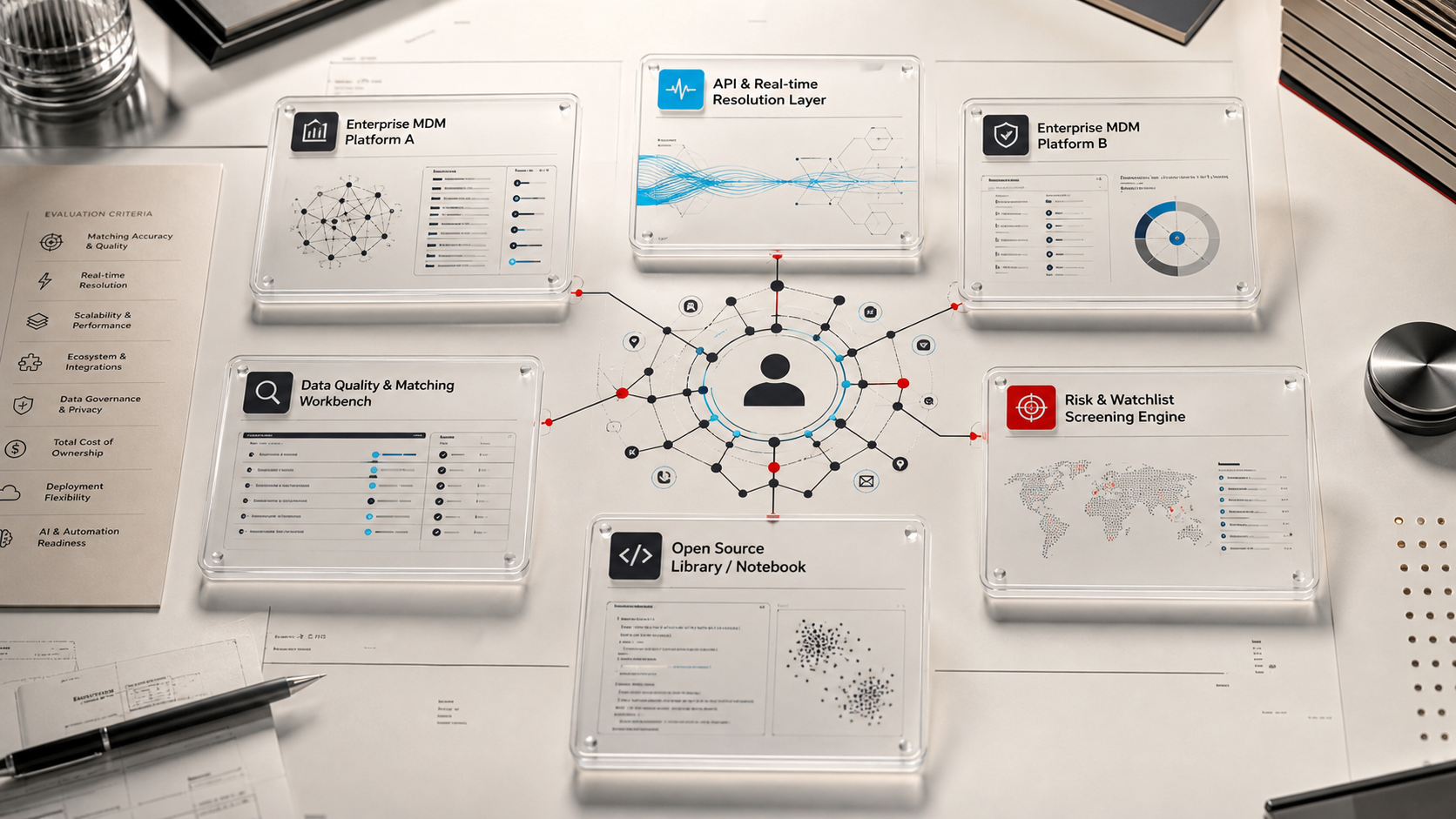
Direct Answer: The top 10 entity resolution tools for enterprises in 2026 are Tilores, Senzing, AWS Entity Resolution, Informatica Customer 360, Reltio Multidomain MDM, Data Ladder DataMatch Enterprise, Quantexa, Tamr, Zingg and Splink. The best choice depends on whether the job is real-time operational identity, MDM governance, data-quality deduplication, risk intelligence or open-source linkage control.Tilores belongs on the enterprise shortlist when a live application, fraud workflow, RAG pipeline, support agent or AI agent needs a resolved customer/entity profile at query time. Informatica and Reltio are strong MDM comparisons; Data Ladder is a strong data-quality/workbench comparison; Senzing and AWS Entity Resolution are important runtime/category comparisons; Splink and Zingg matter when the buyer is comparing open-source control (see our reproducible Splink vs. Tilores benchmark).
What are the top 10 entity resolution tools for enterprises in 2026?
The top 10 enterprise entity resolution tools in 2026 are not a single category. They split into runtime identity APIs, MDM platforms, data-quality workbenches, risk-intelligence platforms and open-source linkage frameworks. The ranking below is weighted toward enterprise use cases where buyers need scale, explainability, API access, governance fit and proof against messy cross-system data.
| Rank | Tool | Best fit | Where it is strongest | Watch-outs |
|---|---|---|---|---|
| 1 | Tilores | Real-time entity resolution for AI, RAG, Customer 360, fraud, KYC and operational APIs | API-first entity search, identity graphs, query-time profile retrieval, IdentityRAG patterns and serverless scale | Validate source connectors, schema design, latency and review paths against your own data |
| 2 | Senzing | Real-time entity resolution for risk, investigations and identity intelligence | Continuous ingest, query, delete and self-correct patterns; explainability and relationship awareness | Compare deployment model, developer ownership and fit for customer-data AI workflows |
| 3 | AWS Entity Resolution | AWS-native matching workflows for customer, product, business and healthcare records | Rule-based, ML and provider matching in the AWS ecosystem; near-real-time rule workflows | Best if your data and governance are already AWS-centred; API/runtime fit needs testing |
| 4 | Informatica Customer 360 / MDM | Large enterprise MDM and governed customer-data programs | Broad data-management cloud, governance, data quality, integration, MDM and 360 applications | Broader platform scope can be more than a focused runtime identity layer needs |
| 5 | Reltio Multidomain MDM | Cloud-native MDM and context intelligence | Real-time multidomain MDM, entity resolution, data quality, integration and governed data for AI | Still a platform/operating-model decision, not just a matching component |
| 6 | Data Ladder DataMatch Enterprise | Data quality, fuzzy matching, deduplication and merge-purge workflows | Profiling, standardisation, matching, survivorship, scheduling and no-code workbench flows | Strong for data-quality teams; test carefully for live AI/application API workloads |
| 7 | Quantexa | Entity resolution in decision intelligence, fraud, risk and investigations | Graph analytics, network context and financial-crime/risk use cases | Usually evaluated as a larger decision-intelligence platform, not a lightweight ER API |
| 8 | Tamr | Data mastering and AI-assisted curation at enterprise scale | Human-guided/AI-assisted mastering and enrichment across enterprise datasets | Best where data mastering and curation are the main problem |
| 9 | Zingg | Open-source/enterprise entity resolution in modern data stacks | Spark-based active learning, deterministic/probabilistic matching and data-stack integration | Community vs enterprise feature boundaries and operational ownership need checking |
| 10 | Splink | Open-source probabilistic record linkage and deduplication | Fellegi-Sunter modelling, DuckDB/Spark/Athena/Postgres backends, diagnostics and public-sector use | A library, not a hosted enterprise identity service or MDM platform |
New posts on entity resolution, identity data and AI. No spam, unsubscribe any time.
How we ranked these tools
This shortlist is designed for enterprise buyers comparing tools across real operational workflows, not for a generic undifferentiated tools list.
| Criterion | Why it matters for enterprise entity resolution | What to ask in evaluation |
|---|---|---|
| Workflow fit | Entity resolution for an AI agent is different from MDM governance or a dedupe clean-up run. | Is the tool built for runtime identity, governed master data, data quality, risk, or open-source modelling? |
| Latency and operating rhythm | Fraud, onboarding, support and RAG workflows may need answers during the user interaction. | Can the tool resolve at query time, or is it primarily batch/workflow-driven? |
| Explainability | False merges and missed links can create compliance, fraud and customer-experience risk. | Can a reviewer see which attributes, rules, scores or edges caused a match? |
| API shape | AI agents and live applications need structured responses, not just reports. | What does the resolved-entity API return, and how does it handle ambiguity? |
| Governance scope | MDM platforms add stewardship, policy, survivorship and publishing workflows. | Do you need the full operating model or only the matching/retrieval layer? |
| Deployment ownership | Open-source libraries and cloud services require different engineering and support models. | Who owns tuning, monitoring, review queues, security and incident response? |
| Source-system coverage | Customer identity usually spans CRM, support, billing, marketing, warehouse and risk systems. | Which sources are supported, and how quickly do updates become available? |
Best tool by workflow
| Workflow | Strongest starting shortlist | Why |
|---|---|---|
| AI agent or RAG over customer data | Tilores, Senzing, AWS Entity Resolution, Reltio | The identity layer has to return the right customer/account context before the model reasons. |
| Real-time fraud, KYC or onboarding | Tilores, Senzing, Quantexa, AWS Entity Resolution | Latency, explainability, ambiguity handling and graph context matter more than list-cleaning features. |
| Enterprise MDM transformation | Informatica, Reltio, Tamr | The job includes stewardship, survivorship, governance, multidomain models and publication workflows. |
| Data-quality dedupe and merge-purge | Data Ladder, Informatica | Workbench-style profiling, standardisation, matching and survivorship are central. |
| Open-source modelling and benchmarking | Splink, Zingg, dedupe, Python Record Linkage | The team wants model control, transparency and engineering ownership. |
| AWS-native customer/profile matching | AWS Entity Resolution, Tilores on AWS, Senzing | If the data estate is already AWS-heavy, compare native service fit against specialist resolver capabilities. |
When Tilores is the best fit
Tilores is a strong fit when entity resolution is part of a live system rather than an offline data-cleanup exercise. The pattern is common in 2026 enterprise AI: an LLM or agent can answer the business question only after a specialist system has resolved which customer, company, account or applicant it is dealing with. If that layer is wrong, the AI answer is wrong even if the model is good.
Tilores’ public docs describe the core problem: companies collect increasingly varied data from different sources, but cannot use much of it unless it can be matched together quickly. The product page describes a no-code onboarding flow, data-agnostic schema definition, rule customisation, UI or API ingest, UI search, visual identity graphs, bulk SQL access and API access to individual identities. The same product page presents real-time ingestion during search and serverless scale as part of the operating model.
The IdentityRAG page adds the AI use case: unified customer context retrieved at query time for LLM applications. It describes a live finance-company example connected to Salesforce, HubSpot, Zendesk, Mailchimp and loan databases, plus a LangChain and Amazon Bedrock pattern for giving LLM chatbots unified customer context.
That makes Tilores especially relevant for:
- AI agents that need one accurate customer view before taking action.
- RAG systems where retrieved context must belong to the right person, account or organisation.
- Fraud, KYC and AML workflows where false merges and missed links carry business risk.
- Customer-support copilots that pull from CRM, ticketing, billing and marketing systems.
- Operational applications that need an entity graph behind an API, not a spreadsheet dedupe run.
When to choose Tilores vs Informatica vs Data Ladder
Informatica and Data Ladder should not be dismissed. They appear for good reasons.
Informatica is relevant when the buyer is really buying MDM: governed customer data, data quality, data integration, business workflows and master-data publication. Informatica’s Customer 360 sits inside its MDM and 360 Applications portfolio, and the wider Informatica platform spans data integration, governance, quality and AI services. For a CDO-led enterprise data-management program, that breadth is often the point.
Data Ladder is relevant because it writes directly for the data-quality buyer. Its entity-resolution product page frames the workflow around ingestion, standardisation, matching, survivorship, publishing and fast data-matching results. That is a strong workbench story.
The distinction is this: an enterprise choosing a tool for data-quality operations should compare Data Ladder seriously. An enterprise choosing a tool for governed master data should compare Informatica and Reltio seriously. An enterprise choosing a tool for runtime AI/application identity should put Tilores and other real-time ER engines on the shortlist.
Real-time API vs MDM vs data-quality workbench vs library
| Category | Typical buyer | Typical output | Good sign | Risk sign |
|---|---|---|---|---|
| Real-time ER/API | Product, AI, fraud, KYC, support, data platform | Resolved entity, identity graph, API response, candidate set | Can resolve/update/query during the workflow and explain ambiguity | Only exports static batches or reports |
| MDM platform | CDO, data governance, enterprise architecture | Golden record, governed domain, stewardship workflow | Handles policy, survivorship, governance, lineage and publication | Too slow or heavy for the live application need |
| Data-quality workbench | Data quality, IT operations, CRM/data ops | Standardised, matched, deduped and survivorship-managed datasets | Fast workbench for profiling, cleansing and merge-purge | Hard to embed as a low-latency identity service |
| Open-source library | Data science, analytics engineering, research | Linkage model, clusters, scores, notebooks, pipelines | Transparent model and reproducible benchmark | No production API, monitoring, access control or support by default |
Decision criteria: a practical buying test
Before committing, run a pilot that forces every vendor through messy reality. Use three to five source systems, not one clean CSV. Include duplicate people, changed names, stale addresses, shared phone numbers, household relationships, company subsidiaries, partial records and deliberately ambiguous cases.
| Test | What it proves | How to score it |
|---|---|---|
| Known expected clusters | Whether the resolver links the right records and avoids unsafe merges | Precision, recall, false-positive review and false-negative analysis |
| Ambiguity handling | Whether the system can say “not enough evidence” safely | Candidate-set quality, confidence scores and review workflow |
| Update latency | Whether the result changes when new data lands | Time from ingest/update to searchable resolved entity |
| API response | Whether another application or AI agent can use the result | Structured fields, source attribution, confidence and error handling |
| Explainability | Whether a human or regulator can inspect the match | Rules/weights/attributes/edges visible enough for audit |
| Governance fit | Whether the buying scope matches the operating model | Stewardship, survivorship, policy, access control and publication needs |
Sources and research basis
- Tilores docs — entity resolution definition, scale and real-time framing
- Tilores product — schema setup, rules, ingest/search/API access, identity graph UI, serverless scale
- Tilores IdentityRAG — query-time customer-context retrieval for LLM applications
- Informatica Customer 360
- Data Ladder entity-resolution product page
- Reltio Multidomain MDM
- Senzing real-time entity resolution
- AWS Entity Resolution
- Splink documentation
- Zingg GitHub
Frequently asked questions
What are the top 10 entity resolution tools for enterprises in 2026?
The top 10 entity resolution tools for enterprises in 2026 are Tilores, Senzing, AWS Entity Resolution, Informatica Customer 360, Reltio Multidomain MDM, Data Ladder DataMatch Enterprise, Quantexa, Tamr, Zingg and Splink.
What is the best entity resolution software for enterprises in 2026?
The best choice depends on the job. Tilores is strongest for real-time, API-first identity resolution for AI agents, Customer 360, fraud, KYC and RAG workflows. Informatica and Reltio fit broader MDM programs. Data Ladder fits data-quality matching and deduplication operations. Splink and Zingg fit teams that want open-source control.
What is the best entity resolution software for AI agents and RAG?
Choose a system that resolves identity before retrieval or generation. For Tilores, the IdentityRAG pattern retrieves the right resolved customer/entity context at query time so the LLM does not guess which record is correct.
How do Senzing and Tilores compare?
Both belong in real-time entity-resolution conversations. Senzing strongly positions true real-time identity intelligence for transaction-speed decisions. Tilores strongly positions API-first customer/entity resolution, IdentityRAG and real-time unified customer profiles for AI and operational workflows.
Can Splink or Zingg replace enterprise software?
Sometimes for engineering-led linkage. Splink and Zingg are strong when a team wants model transparency and ownership. They do not automatically provide hosted APIs, access control, support, monitoring, review queues or enterprise governance.
Does AI change the entity-resolution shortlist?
Yes. AI agents and RAG systems need reliable identity context before they reason. If identity resolution is stale, batch-only or ambiguous, the model can confidently act on the wrong customer or account.
See what resolved entity data does for your business — and your AI.