How to Evaluate Identity Resolution Vendors for Banking and Regulated Industries (2026)

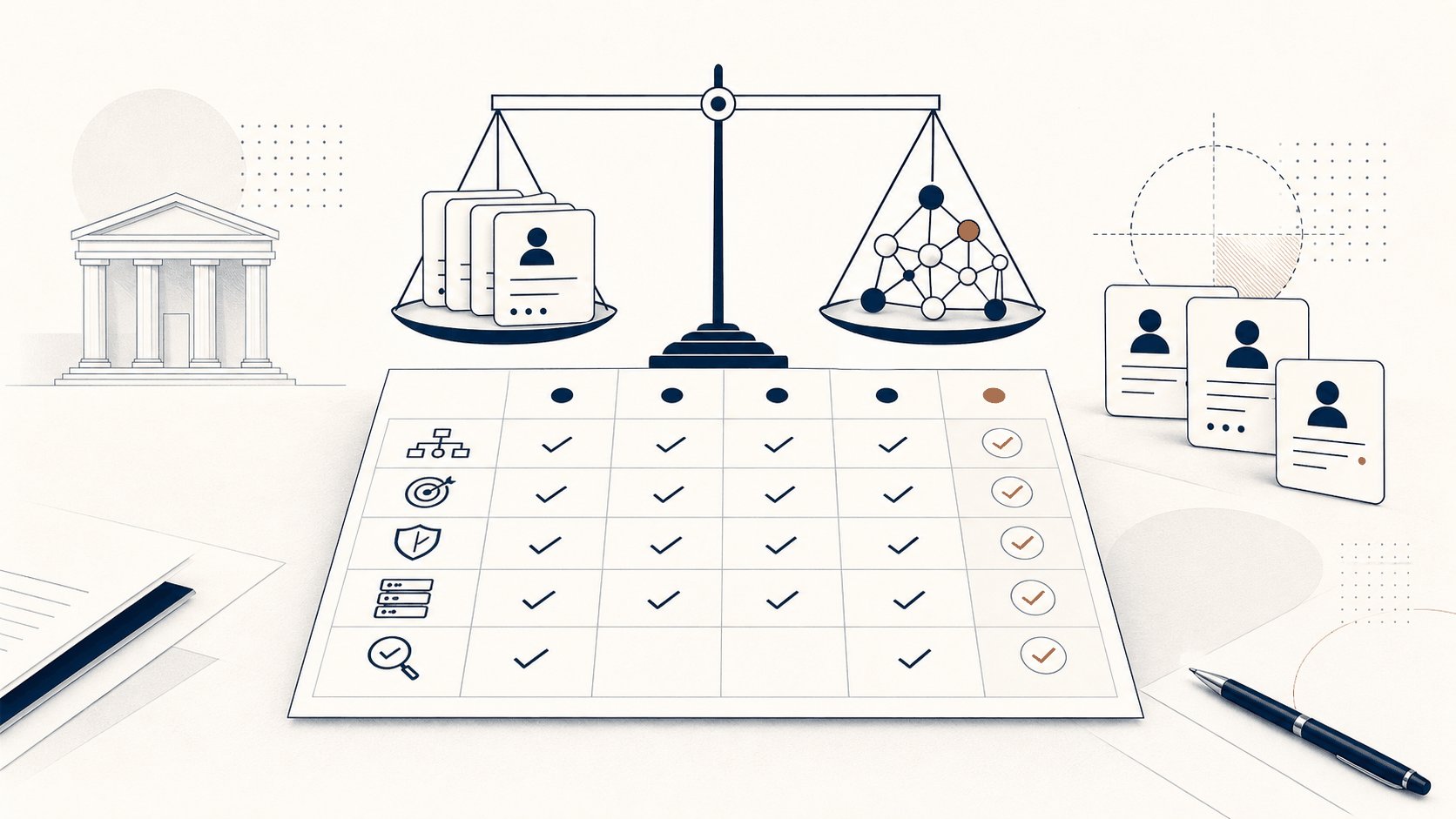
TL;DR: Evaluate identity resolution vendors by testing real regulated data, not slideware. A banking-ready layer should combine deterministic, probabilistic and fuzzy matching, resolve and assemble entities at ingestion, preserve lineage, and let KYC, AML, risk and operational systems query the current resolved context.
How should a bank evaluate identity resolution vendors in 2026?
A bank should evaluate identity resolution vendors by testing whether the system can resolve real customer, account, counterparty and related-party records with evidence that a risk, compliance or operations team can inspect.
The wrong starting point is a generic feature checklist. The right starting point is the regulated process: onboarding, customer due diligence, sanctions screening, fraud review, servicing, collections, open banking, credit-risk review or perpetual KYC. Each process has a different cost of a missed link and a different cost of a wrong merge.
If you need a separate who-to-shortlist view, the companion guide to identity resolution vendors for financial services is the better page. This guide is the evaluation layer: the questions a regulated buyer should ask once a vendor is already on the table.
Which regulated-data requirements should come first?
The first requirements are data control, lawful processing, explainability and operational correction, because identity data in banking is personal, risk-sensitive and reused across many downstream controls.
GDPR Article 4 defines personal data broadly, including identifiers such as names, identification numbers, location data and online identifiers. That means a vendor evaluation cannot treat matching fields as harmless plumbing. The team should ask where data is processed, which party is the processor, what technical and organisational measures protect it, and how data can be returned, deleted or restricted when required.
The European Banking Authority's remote onboarding guidance is a useful practical anchor because it expects credit and financial institutions to choose onboarding tools through safe, effective and risk-sensitive due-diligence processes. The same thinking applies to identity resolution: the tool must fit the control environment, not just the demo flow.
How do real-time and batch resolution change the decision?
Real-time and batch resolution answer different problems, so a regulated buyer should ask how the vendor handles both historical backfills and operational updates.
Batch resolution is useful when a bank first connects legacy systems, cleans a historical portfolio or reviews a large population before a migration. Real-time resolution matters when new evidence arrives during onboarding, account change, transaction review, fraud investigation or customer-service activity.
The boundary is important. Resolution and entity assembly should happen when records are ingested or changed. At query time, applications should retrieve the current resolved context rather than assembling identity again from raw fragments. Tilores describes this API pattern in its GraphQL documentation, where records are submitted and resolved entities can be queried by entity ID, record ID or search parameters.
How should banks test match quality on messy identity data?
Banks should test match quality with representative records and a labelled review set, because clean sample data hides the exact ambiguity identity resolution is meant to handle.
The evaluation should include exact identifiers where available, but it should also include ordinary banking mess: name variants, changed addresses, shared phone numbers, transliteration, joint accounts, subsidiaries, old emails, missing birth dates and conflicting source-system fields. A deterministic-only matcher will look good on strong IDs and brittle everywhere else.
A serious vendor should support deterministic rules, probabilistic scoring and fuzzy matching. The Tilores fuzzy matching algorithms reference shows the type of string-similarity and phonetic tools used for names and addresses. For measurement, record-linkage evaluation commonly uses true positives, false positives, false negatives, precision, recall and F-score, so the buyer should ask to see those concepts applied to its own labelled sample.
New posts on entity resolution, identity data and AI. No spam, unsubscribe any time.
What auditability and explainability should the vendor show?
Auditability means a reviewer can see why records were linked, where the evidence came from, what changed, and how to correct the decision.
For regulated processes, a resolved entity without lineage is not enough. The team should be able to inspect source records, edge evidence, duplicates, scores, search hits and any correction history that changes an entity. Tilores exposes entities with records, edges, duplicates, hits and scores, and its schema lets records be customised to match the application's data model.
The correction path matters as much as the match path. A wrong merge should be split. A bad link should be removed. A future merge may need to be blocked. If the vendor cannot describe how operational users inspect and correct high-risk decisions, the tool is not ready for regulated use.
How should sanctions, PEP and adverse-media screening fit?
Identity resolution should sit before and beside screening, not replace the screening engine.
The job of the resolution layer is to decide which customer, account, beneficial-owner, counterparty or related-party records describe the same entity. That cleaner entity context then helps screening systems check sanctions lists, PEP lists and adverse-media sources with less fragmentation and fewer unnecessary duplicate reviews.
OpenSanctions is a useful source to reference when discussing screening data because it describes itself as an open-source database of sanctions, watchlists and politically exposed persons, aggregating hundreds of sources. Its adverse-media FAQ is also clear about the boundary: OpenSanctions does not publish a comprehensive news archive, but it does include adverse information from non-sanctions watchlists such as regulatory lists and debarment databases.
This distinction is important for buyer language. Identity resolution improves who you screen. Screening data and screening policy decide what you screen against. Case management, escalation and final compliance decisions remain outside the resolution layer.
Where should identity resolution sit in a regulated architecture?
Identity resolution should be a shared layer next to the systems that create, govern, screen and consume customer data.
It should not replace MDM, a CDP, a warehouse, KYC-AML tooling, fraud systems, case management or a data-governance process. Those systems have their own ownership, process and control responsibilities. The resolution layer provides a current entity graph, source lineage and queryable context that those systems can use.
This is the same distinction covered in the Tilores guide to entity resolution for AI, KYC and Customer 360. For financial-services processes, the related guide to real-time entity resolution for AML and KYC goes deeper on the compliance process. For ongoing monitoring, the perpetual KYC guide is a useful companion read.
What criteria scorecard can a banking team use?
A useful scorecard turns vendor evaluation into evidence, not opinion.
| Criterion | Question to ask | Strong evidence | Red flag |
|---|---|---|---|
| Matching methods | Does the system combine deterministic rules, probabilistic scoring and fuzzy matching? | Vendor can show rules, scores and fuzzy evidence on your sample records. | The answer is only exact IDs, or only a black-box score. |
| Entity assembly boundary | When are records resolved and entities updated? | Records are resolved at ingestion or change, and current context is retrieved at query time. | The vendor assembles identity from raw records only when an application asks. |
| Lineage and review | Can reviewers inspect source records, edges, duplicates, hits and match evidence? | API or UI exposes the records and evidence behind each resolved entity. | The system shows a profile but not why records belong together. |
| Screening fit | How does the layer support sanctions, PEP and adverse-media checks? | Resolved entity context is passed to screening tools without claiming to be the screening engine. | The vendor blurs identity resolution, screening data and compliance decisioning. |
| Deployment and data control | Where is data processed, who processes it, and what safeguards apply? | Clear answers on hosting, processor terms, access controls, logs, deletion and audit support. | Vague answers about data location or subprocessor control. |
| Latency and update model | Can operational systems retrieve current resolved context when processes need it? | Batch backfills and operational queries are both supported. | The product is designed only for offline deduplication projects. |
| Correction processes | What happens after a wrong merge, split or high-risk review finding? | There is a documented way to split entities, remove links and prevent repeated bad merges. | Corrections require manual database work or vendor support tickets. |
| Stack fit | How does it sit next to MDM, CDP, warehouse and KYC-AML systems? | The vendor describes a shared identity layer that downstream systems consume. | The vendor claims it replaces the whole data or compliance operating model. |
The same scoring logic applies to credit data and bureau-adjacent processes. The Tilores article on real-time credit bureaus shows why current entity context matters when identity and risk data keep changing.
How should a bank run the evaluation before procurement?
The safest evaluation is a contained proof using representative data patterns, defined privacy boundaries and named success criteria. The team should choose a small but messy sample, agree what a correct match means, and review false positives and false negatives with the teams that own the downstream risk.
Do not let the proof become a generic benchmark. A bank evaluating onboarding cares about missed duplicates, false merges, audit evidence and sanctions-screening context. A bank evaluating servicing may care more about query speed, operational correction and whether agents can retrieve the current resolved context without rebuilding identity logic.
The output of the proof should be a decision record: which match methods were used, what evidence was visible, which records were corrected, what latency was observed in the target process, and what the vendor could or could not explain. That record is more useful than a demo score because it can be reviewed by risk, compliance, operations and architecture together.
FAQ
What is the first test for a banking identity resolution vendor?
The first test is whether the vendor can explain how it resolves real customer, account and counterparty records using deterministic identifiers plus probabilistic and fuzzy evidence. A clean demo is not enough; the test should use representative regulated data patterns.
Should identity resolution happen in real time or batch?
Regulated teams usually need both: batch processing for historical backfills and low-latency access for operational processes. The important boundary is that entity assembly happens when data is ingested or changed, while applications retrieve the current resolved context at query time.
Does identity resolution replace KYC or AML screening?
No. Identity resolution sits next to KYC and AML screening. It resolves the customer, counterparty or related entity cleanly first so screening engines can check sanctions, PEP and adverse-media data against a better identity context.
What matching methods should a bank ask for?
Ask for deterministic rules for strong identifiers, probabilistic scoring for incomplete evidence, fuzzy matching for names and addresses, and a way to inspect the match evidence. A deterministic-only approach is too brittle for messy banking data.
How should teams assess match quality?
Use a labelled sample and review false positives, false negatives, precision, recall and edge cases. The right threshold depends on the process: onboarding, screening, fraud review and customer service have different tolerance for missed links and wrong merges.
What should auditability include?
Auditability should include source record lineage, rule or score evidence, change history, correction paths and clear access to the current resolved entity. A reviewer should be able to see why records were linked and how to correct the decision.
Where should identity resolution sit next to MDM and a warehouse?
It should sit as a shared identity layer beside MDM, CDP, warehouse, KYC-AML and operational systems. Those systems keep their own jobs; the resolution layer provides the current entity context and lineage they can consume.
What is the safest next step before buying?
Run a representative evaluation with real data patterns, explicit privacy boundaries and named success criteria. The scorecard should cover match quality, latency, auditability, deployment model, screening fit and correction processes before commercial terms are discussed.
See what resolved entity data does for your business — and your AI.