Keeping an Identity Graph Accurate as Customer Data Changes: Which Links Should Move When a Bank Customer's Details Change? (2026)


TL;DR: Handle each change by type. Real-life changes and new records add evidence. Corrections trigger a check of the links that relied on the old value. Removals take links away. At Tilores, we update records in place and publish merges and splits when the event stream is configured.
Book a Demo · Try Tilores Studio (Free)
On this page
- Why does an identity graph drift after the one-off clean-up?
- What kinds of change reach a bank’s customer master every day?
- What may each kind of change do to a record link?
- Why must the whole entity be re-checked, and not only the changed record?
- How do downstream systems learn what changed?
- How do we handle each kind of change at Tilores?
- Which three tests show whether a platform keeps the graph accurate?
- Frequently asked questions
- Sources
Two customer records were merged in 2021 because they agreed on name, address and date of birth. Today a branch corrects the date of birth on one of them. Nothing about the customer’s life changed, yet the evidence behind the 2021 merge has gone. If the platform treats that correction like any other update, the merge stands on a fact that was never true.
This work begins once a bank’s one-off clean-up is signed off. Every day customers marry, move, close accounts or ask for corrections, and each change can move a link. A graph keeps its accuracy only if every change arrives as a typed event and the whole entity it touches is checked again. New evidence and real-life changes add to an entity. A correction to an identifying fact can split one. A removal must take a record out without letting it re-merge what it held apart.
Why does an identity graph drift after the one-off clean-up?
An identity graph drifts because the clean-up resolved a snapshot, and the data under that snapshot keeps moving. The first project most banks fund is a one-off deduplication of the back book before a migration. The need it uncovers is continuous: the morning after go-live, new applications, address changes and corrections start to arrive, and none of them existed when the original project ran.
The law already assumes the continuous version. UK GDPR Article 5(1)(d) requires personal data to be “accurate and, where necessary, kept up to date”. Money laundering rules say the same. Regulation 28(11) of the Money Laundering Regulations 2017 requires ongoing monitoring, including “keeping the documents or information obtained for the purpose of applying customer due diligence measures up-to-date”. A profile that was accurate in March can still need updates by November.
Drift also reaches screening. Sanctions, PEP and adverse media checks run against the resolved customer, and lists such as the OpenSanctions PEP datasets change on their own schedule. A link that should have been cut carries one person’s PEP status onto another person. A link that should have formed leaves a second account outside the screening result of the first.
The architecture that keeps a graph maintainable is in how to design an identity graph that stays accurate. The signals that show drift are in how to monitor entity resolution accuracy after deployment. The question that follows is smaller and more practical: when one change arrives, what may it do to the links?
What kinds of change reach a bank’s customer master every day?
Four kinds of change reach a customer master, and in a change-data feed they look almost the same. Research on incremental record linkage, such as Gruenheid, Dong and Srivastava’s VLDB 2014 paper, models updates as inserts, deletes and changes. For a bank, “change” has to be split in two, because a marriage and a typing error mean opposite things for a link.
- Real-life change. A customer marries and takes a new surname, moves house or gets a new mobile number. The old value was true. It is now history, and it is still evidence that older records belong to this person.
- Correction. A branch fixes a date of birth keyed wrongly at onboarding, or a transposed digit in a tax ID. A customer may ask for it under the right to rectification in UK GDPR Article 16. The old value was never true, so it should stop counting as evidence for anything.
- New evidence. An application for a new product, a mobile app registration or a record from an acquired loan book. Each adds a record that may join an entity or connect two.
- Removal. A record may leave after the bank approves erasure under UK GDPR Article 17 or at the end of a retention period. Retiring a source can also remove records, subject to the bank’s retention duties. When a record leaves, every link it carried goes with it.
The difficulty is that a marriage and a typo both arrive as the same kind of field update: a new surname or a new date of birth. The type is known only at the source: the change-of-name form with a marriage certificate, the branch correction screen, the erasure workflow. So the first practical step is to tag each change with its reason where it is captured, and carry that tag into matching. Read the type wrongly and the graph merges or unmerges the wrong records. A corrected date of birth handled like a real-life change still counts as evidence, so the merge it supported stands. A new married name handled like a correction stops the old surname counting, so a customer can be split from their own history.
New posts on entity resolution, identity data and AI. No spam, unsubscribe any time.
What may each kind of change do to a record link?
Each kind of change has one permitted effect on links: real-life changes and new evidence may add, corrections must re-check and may split, and removals take links away. Entity-level consistency rules act as the brake on all four.
A change-type policy for a bank customer master
| Change | What it may do to links | What stops a wrong result |
|---|---|---|
| Real-life change | Add evidence; earlier values stay matchable | Keep previous names and addresses as history fields |
| Correction | Re-check links the old value supported; split if unsupported | Consistency rule on date of birth and tax ID |
| New evidence | Add a record; may merge two entities | Consistency rules; weak links go to review |
| Removal | Remove the record’s links; split if it was a bridge | Connection ban after a split; a recorded steward decision otherwise |
A real-life change should add and never replace. If the source system overwrites a maiden name, the old surname disappears from the record, and older records that only knew that surname may lose their path to the customer. Sending earlier names and addresses in history fields keeps them matchable while the current value drives correspondence.
A correction works the other way. The wrong value has to stop counting, and every link that rested on it has to be tested again. A consistency rule makes this concrete: if two dates of birth may not coexist in one entity, and the platform applies that rule to updates, the corrected record cannot stay with a record that holds the other date. While the bank checks which value is right, the ICO’s guidance on rectification recommends restricting processing of the disputed data. For a customer master, that means a steward decides before the correction reaches matching.
Removal has two effects that are easy to miss. If the removed record was the only link between two groups of records, the entity splits. And if the removed record held a conflicting tax ID that kept two entities apart, its departure lifts the block, so the next submission can join them. Where a steward has established that two people are different, record that decision where it does not depend on the deleted record: in your steward log, and as a consistency rule on an identifier the remaining records still carry. In our engine, a connection ban covers only parts split from one entity.
A marketing profile platform can live with looser links, because a stale link there usually costs a misdirected email. In a bank, a wrong link places one customer’s balances, screening results and correspondence inside another customer’s profile, which we explain in whether a wrong customer match is a reportable GDPR incident. That is why the stricter policy is worth its cost, and it does cost something: more splits, more review cases and more events for downstream systems to absorb.
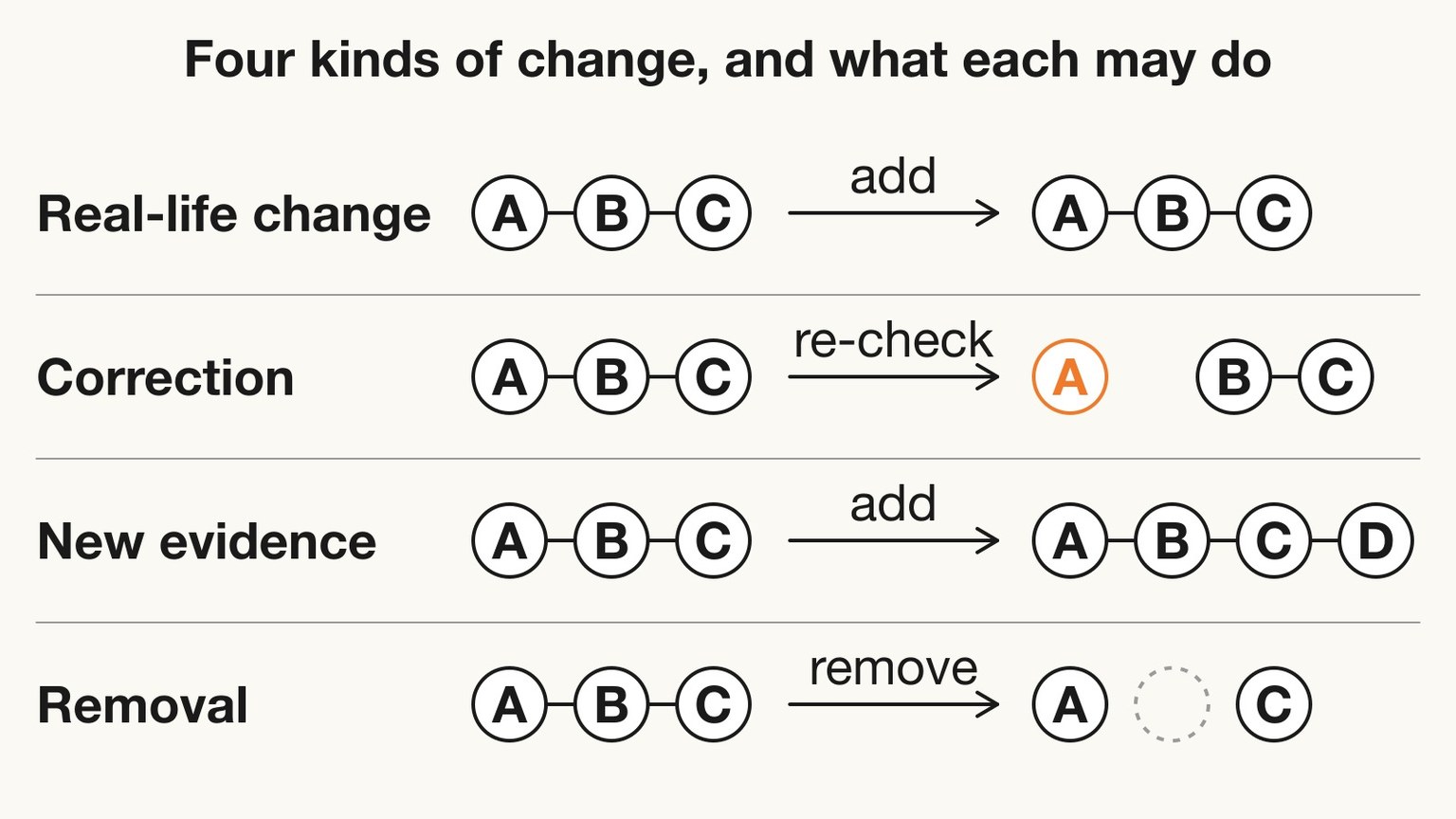
The same small group of records meets four kinds of change. Only corrections and removals can part it, which is why those two need a check of the whole entity.
Why must the whole entity be re-checked, and not only the changed record?
The whole entity has to be re-checked because an entity is a chain of links, and one change can remove the only link that holds two parts of the chain together. Our engine, like any that clusters by transitive closure, treats an entity as a connected component of the graph. If A links to B and B links to C, the graph groups all three in one entity, even when A and C share nothing. The clustering literature calls this partitioning by transitive closure, and Hassanzadeh and colleagues’ VLDB 2009 evaluation shows the trade it makes: it gives high recall at the cost of precision.
Take a worked example. Record A is a current account from 2021 and record B a credit card from the same year; they merged on name, address and date of birth. Record C is a mobile app registration from 2024 that linked to B on email and phone. Now the branch corrects the date of birth on A. A matcher that checks only the changed record looks for new candidates for A and finds the same entity. The A to B link survives, although its evidence is gone. Re-checking the entity removes that link, A leaves, and B and C stay together on their own evidence.
Now change the example. Suppose the card closed years ago and B reaches the end of its retention period. B was the only path between A and C, so removing it splits the entity, even if A and C are the same person. That split is the accurate result: the graph no longer holds evidence that joins them. If a steward knows they are one customer, the right fix is a manual link with a recorded reason, not a looser rule.
Gruenheid, Dong and Srivastava describe the same gap in their work on incremental record linkage. Placing each new record into an existing cluster or a new one is fast, but it cannot fix earlier mistakes. Their method uses the evidence in each update to merge and split the clusters connected to the changed records, and to move records between them. A platform that cannot split on update can only ever add mistakes.
How do downstream systems learn what changed?
A bank can use a change event to update its CRM, screening engine and warehouse. A correction produces a split only if it leaves no link between parts of the entity. Consumers can use the resulting entity IDs and changed record membership to refresh the affected records. At Tilores, we publish merge and split events through AWS SQS or Kinesis when the entity event stream is configured (API reference). The event can help the bank notify recipients about a rectification or erasure. Under UK GDPR Article 19, the controller is responsible for those notifications unless they would be impossible or require disproportionate effort.
We set out the contract for consumers in how to handle entity merges, splits and stable IDs downstream. One point belongs here. Keep the change reason from the source beside the event in your own log, so a consumer can tell a split caused by a correction from a split caused by an erasure. The first may need a screening re-run; the second may need data deleted downstream as well.
How do we handle each kind of change at Tilores?
We treat every change as a change to the graph: we update the record in place, split the entity when a change cuts its only link, and publish the result as an event when the stream is configured. Every edge we store carries its reason, in the form record-id:other-record-id:label. The label is the matching rule that fired, STATIC for records submitted together, or MANUAL for a link a reviewer made. The label tells you what linked those records (rules configuration).
- Corrections and real-life changes. You send the record again with the same record ID through our GraphQL
submitmutation, and we update it where record updates are enabled, as they are in our public SaaS. The same record update re-links existing records after a rule change. With thesingle_assembly_updatedeployment setting, an update is a single operation: the record leaves an entity it contradicts and is linked again under the current rules. When an update splits an entity, the larger part keeps its ID. Without it, an update adds the new record version before it removes the old one, and a version that contradicts the consistency rules can still be merged. The setting is off by default while we check it for side effects, so switch it on before you run the first test below (release notes). - Removals. The
disassemblemutation removes records or edges. If a record or edge is the only link between two parts of an entity, the entity splits. WithcreateConnectionBan, the parts cannot merge again while the ban stands, and any record that would merge them is dropped, so we recommend it only where a steward has established two different people (API reference). - The brake. A consistency rule checks a new record against every record of a candidate entity, and if one record fails, the whole entity is not a match (consistency). It adds comparisons on very large entities, so we keep it for the identifiers that must agree, such as date of birth and tax ID. We help you configure these rules on a pilot extract. Our article on consistency rules for banks shows how.
- Stewards. Once review is enabled in the deployment and the rule configuration, weak links go to a review queue, and with the defer strategy the records stay apart until a reviewer decides. Rejecting an existing link removes the edge. Records split only if no other path connects them. If the link was deferred and never added, we record the decision. A verdict still holds when a decided record is submitted again, and a manual link a reviewer creates survives updates to its records (review).
- Before you delete. Our what-if filters show which links remain when you omit records by date or source (API reference).
- Downstream. Once configured, our entity event stream publishes create, update, merge, split and delete events through AWS SQS or Kinesis. The GraphQL API can read an SQS stream if enabled. Use it only as the sole consumer of that queue (API reference).
Some decisions stay with the bank. You decide which source is authoritative for a correction, you tag each change with its reason, and your stewards decide disputed cases. You also decide whether erasure applies. The right to erasure does not apply where processing is necessary to comply with a legal obligation, as the ICO guidance on erasure explains. Regulation 40 of the Money Laundering Regulations 2017 generally requires due diligence records to be kept for five years after a business relationship ends. Notifying recipients under Article 19 stays your duty; our events give you the facts to do it.
Which three tests show whether a platform keeps the graph accurate?
Three changes, run on a copy of your own data, show whether any platform keeps a graph accurate as customer data changes. Adopt the policy in the table first, so you know what result each test should give.
- Correct a date of birth on a merged pair. Choose a correction that creates a conflict under the bank’s date-of-birth rule and leaves no other path between the records. Expect a split, the resulting entity IDs and membership changes in the configured event stream, and no rejoin while the conflict remains.
- Delete a bridge record. The entity should split into two, the platform should tell you so, and nothing should re-merge on a later submission unless new evidence supports it.
- Change a married name. The entity should stay whole, the maiden name should still match older records, and the next record that arrives under the maiden name should join the same customer, not create a duplicate.
A platform that passes all three treats change as evidence, not as an overwrite. With Tilores Studio, we let you run our matching engine locally on up to 100,000 of your own records for free, and we can run the three tests with you on a pilot extract.
Frequently asked questions
Which platforms keep an identity graph accurate as customer data changes?
Platforms that re-check the whole entity a change touches, can split as well as merge, block wrong merges with entity-level consistency rules and publish each change as an event. In Tilores, updates arrive through our GraphQL API, removals and updates can split an entity, consistency rules apply to updates once single_assembly_update is on, and a configured stream publishes merges and splits.
Should a married name replace the old surname in the customer master?
Not in the matching data. The current surname drives correspondence, but the earlier surname is still true history and links older records to the same customer. Send previous names in a history field so both stay matchable.
How often should a bank re-match its whole customer base?
Not on a calendar. With change-aware re-resolution, each change re-checks the entity it touches. A full re-link is needed after a rule change, and our record updates re-link existing records under the new rules.
Can a split be reversed?
Yes. A reviewer can create a manual link between two records in a review case, and that link survives later updates to the records. A connection ban that keeps two entities apart can be lifted with a separate mutation.
Sources
- UK GDPR Article 5: principles relating to processing of personal data, The National Archives.
- UK GDPR Article 16: right to rectification, The National Archives.
- UK GDPR Article 17: right to erasure, The National Archives.
- UK GDPR Article 19: notification obligation regarding rectification or erasure of personal data or restriction of processing, The National Archives.
- The Money Laundering, Terrorist Financing and Transfer of Funds (Information on the Payer) Regulations 2017, regulation 28, The National Archives.
- The Money Laundering, Terrorist Financing and Transfer of Funds (Information on the Payer) Regulations 2017, regulation 40, The National Archives.
- Right to rectification, Information Commissioner’s Office.
- Right to erasure, Information Commissioner’s Office.
- Incremental Record Linkage (Gruenheid, Dong and Srivastava), Proceedings of the VLDB Endowment, Vol. 7, No. 9, 2014, VLDB Endowment.
- Framework for Evaluating Clustering Algorithms in Duplicate Detection (Hassanzadeh, Chiang, Lee and Miller), VLDB 2009, VLDB Endowment.
- Politically Exposed Persons datasets, OpenSanctions.
- API Reference, Tilores.
- Rules Configuration, Tilores.
- Consistency, Tilores.
- Review, Tilores.
- Release Notes, Tilores.
- How to Design an Identity Graph That Stays Accurate: 6 Architecture Decisions for 2026, Tilores.
- How to Monitor Entity Resolution Accuracy After Deployment: 7 Metrics for 2026, Tilores.
- How to Handle Entity Merges, Splits and Stable IDs Downstream (2026), Tilores.
- Can Entity Resolution Tell Two Customers With the Same Name Apart? Consistency Rules for Banks, Tilores.
- Is a Wrong Customer Match a Reportable GDPR Incident, and What Must a Bank Document?, Tilores.
- Download Tilores Studio, Tilores.
See what resolved entity data does for your business — and your AI.