US political money is easy to total
and hard to attribute
Every itemised donation to a federal committee ends up in one public file at the Federal Election Commission. It has no donor ID. We analysed the whole 2025–26 file, then ran Tilores entity resolution on the four biggest donor states — California, Florida, New York and Texas — to see how much the answers change once you know who is who. Plus one Senate race and two very different donors.
2025–26 cycle, through June 30, 2026
After removing duplicate records
Resolved with Tilores in CA, FL, NY, TX; by name + ZIP elsewhere
Every gift is filed separately, as typed
Before you can add anything up,
you have to decide who is who
Each gift is filed with whatever name, address and employer the receiving committee typed in. One retired Texan made about 76,000 donations in 18 months. Her giving appears in 108,748 separate records.
Across California, Florida, New York and Texas we resolved 12.4 million records into about 770,000 people. Without that step there is no "her" to add up — and no way to ask whether anyone gave more than the law allows.
The difference between the parties
is reach, not gift size
A further $370 million went to large outside groups we tagged by hand as Republican-aligned ($227 million of it to MAGA Inc.) and $37 million to Democratic-aligned ones. Super PACs that carry a party code or raise through ActBlue or WinRed are already inside the party totals.
Share of each state's party money, by where the donor lives. Hover or tap a state for its figures.
2,776 donors went over a limit.
Most cases were fixed.
Committees have 60 days to refund an excess or move it to another election. By June, about six in ten over-limit cases had been.
That leaves 1,066 donors still over on paper, in 1,258 cases worth $5.6 million in total. Democratic recipients fixed 62% of their cases, Republican recipients 64%.
How donors were identified: in California, Florida, New York and Texas, with Tilores entity resolution. In the other 46 states and DC, by surname, first name and ZIP code — so, as the comparison below shows, their over-limit counts are probably undercounted by a similar margin.
ActBlue and WinRed report each gift, and the receiving campaign reports it again — often split differently. Counting both would have left this many donor–campaign pairs still over the limit:
A total above the limit in this data can come from late fixes, coding errors or a couple's joint gift filed under one name. Refunds made between July and September aren't in the bulk file yet, so every "still over" count is an upper bound. None of it is evidence that anyone broke the law, and we don't name any over-limit donor.
One donor's money,
traced under four names
Elon Musk gave $347 million to federal committees between July 1 and October 14, 2026. A search on his name finds only part of the trail.
Each needs a different kind of linking: matching messy records of the same person, a known relationship between a person and a legal entity, reading memo codes correctly, and following money across committees. A single-name search catches the first and misses the rest — which is how a $446 million donor can look like a $397 million one.
Musk's gifts to the Senate Leadership Fund, and SLF's transfers to Texas PAC, as reported to the FEC.
Texas PAC's filings list one donor: "SLF PAC". Anyone looking up who funds it sees SLF, not Musk. The filings don't say why the amounts match or whether he had any say in where the money went, and moving money between super PACs is legal. The connection only appears when you line up the transactions.
Talarico vs Paxton:
two very different fundraising machines
Every itemised contribution in both campaigns' FEC filings, through October 14, 2026.
*Donors in California, Florida, New York and Texas, resolved with Tilores, including the joint fundraising committees and the pro-Paxton super PAC. Both campaigns fixed most gifts over the $3,500 limit: Paxton's committee left 6 donor totals still over on paper, Talarico's 28. A runoff against an incumbent rewards big cheques; a national small-dollar operation rewards volume — a structural difference, not a scandal.
- Common names merge. One resolved "donor" combined at least four people with a common surname. Of 160 apparent donors to both sides, fewer than a dozen had a matching name and location.
- People split. A donor who gave $500,000 to the super PAC and $250,000 to a joint committee appeared as two people, despite sharing a nine-digit ZIP.
- Corrections are easy to miss. A first pass on the bulk file flagged 44 Paxton donors over the primary limit. Read from the committee's own filings, 3 still are.
17 flags on the first pass.
5 once the filings caught up.
The retired Texan's typical gift is ten dollars. On the FEC bulk data she looked over the limit at 10 campaigns and 7 PACs.
Getting there took four FEC data sources — the individual contributions file, the "other transactions" file where 26,000 joint-fundraising allocations sat, raw electronic filings, and the candidate master file. Most committees had fixed the excess, often late, in reports the bulk download didn't contain yet. Close to $100,000 was sent back to her.
None of this is a finding that she broke the law. The rules put the burden on the committees, and she may never have known. We don't name her.
Political money is a data problem first
The FEC files every gift separately, with whatever the committee typed. Deciding which records are one person comes before any count.
Platform and campaign both report donations, split differently. Dropping the duplicates turned ~38,000 apparent over-limit pairs into 749.
Refunds land in reports that lag the bulk file by months. A snapshot overstates what is still open.
A trust, an in-kind partnership and a pass-through PAC are separate entities. Seeing whose money it is means linking them, not merging them.
Contribution limits are enforced one committee at a time. Only someone who can see the whole person can tell whether that is working.
The four analyses
Each one has the full method, charts, sources and FAQ.
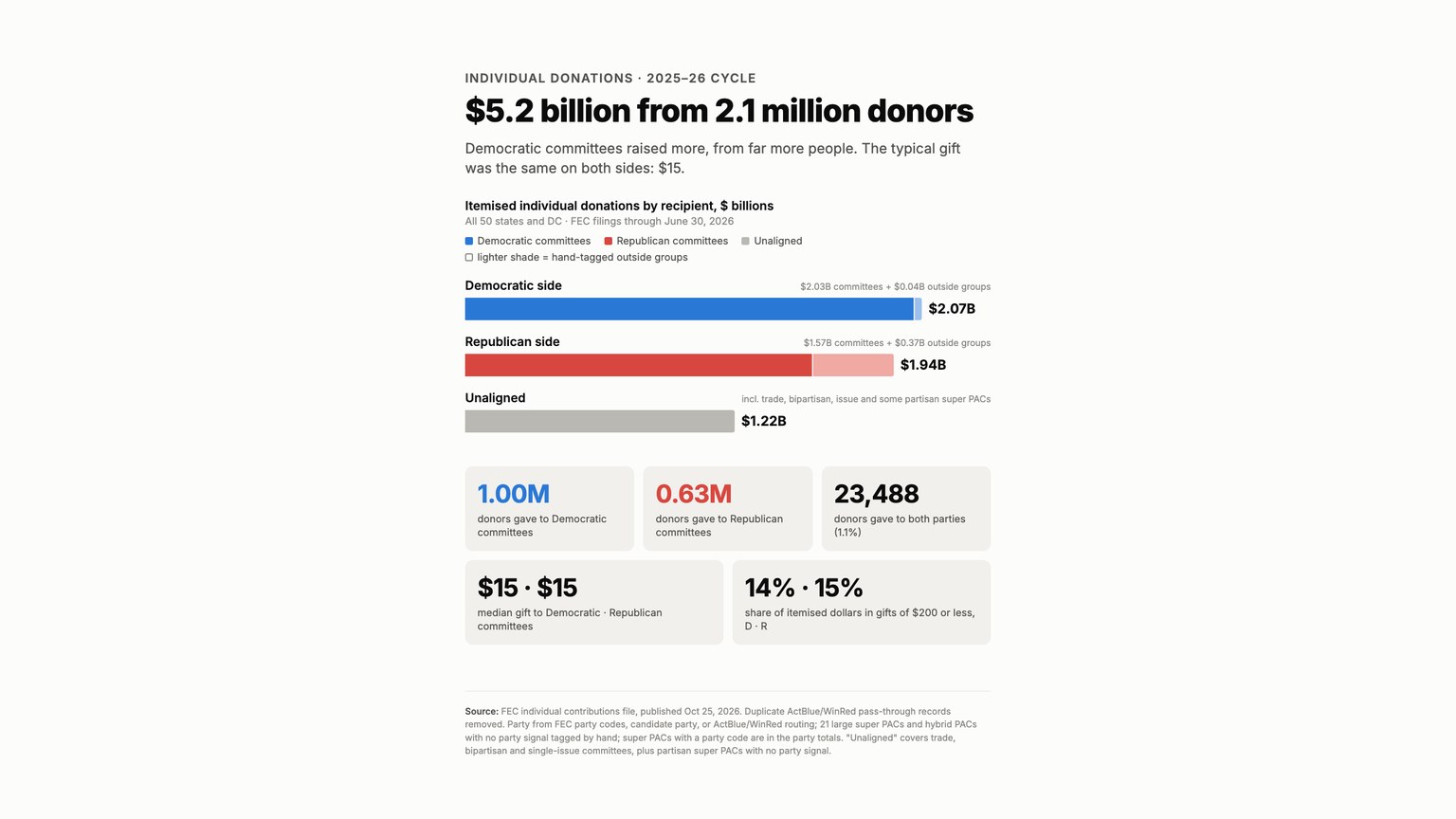
Party split, over-limit donors, refunds and donors who give from more than one state, across the whole 2025–26 file.
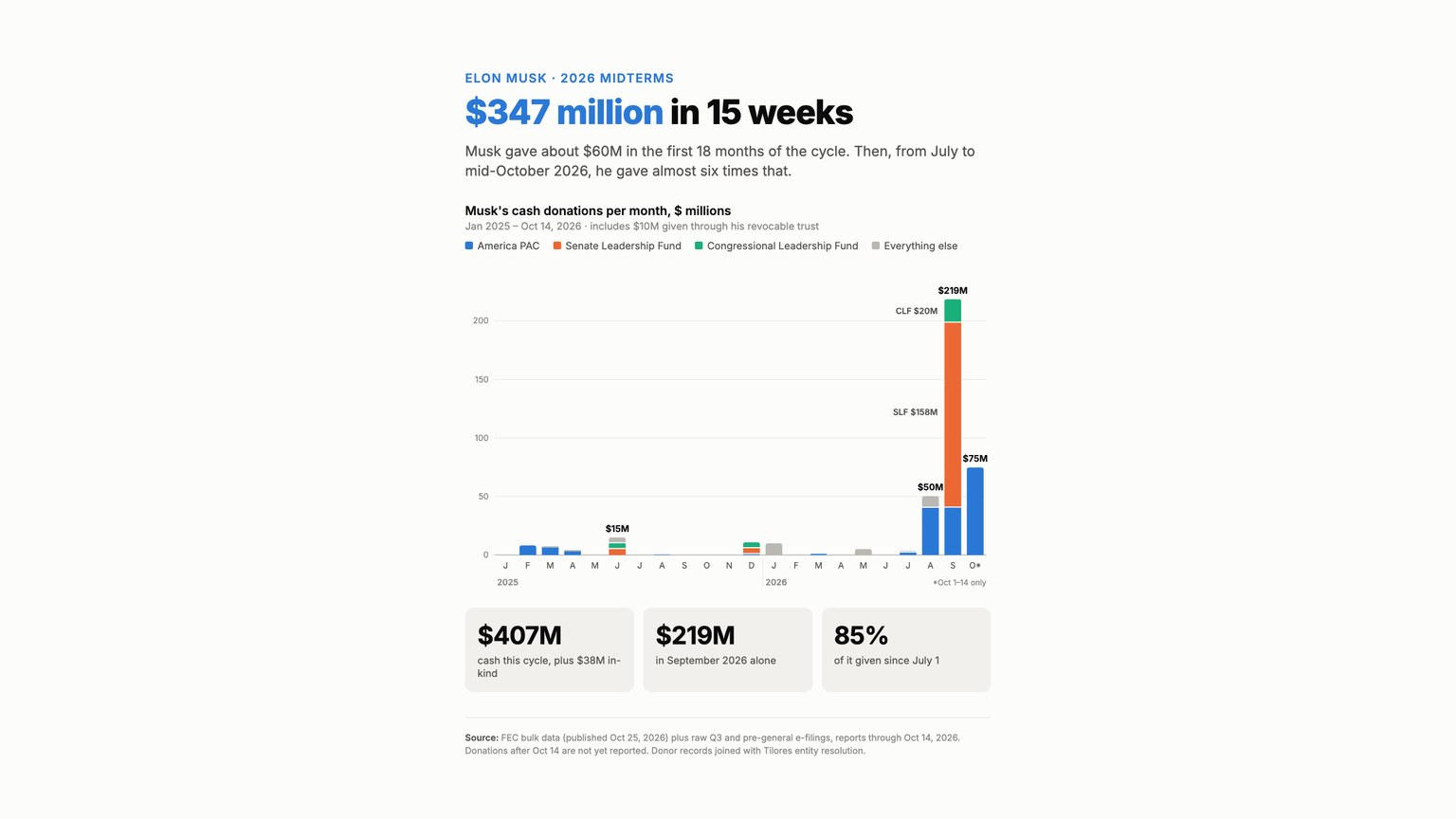
Checking the BBC’s figures against the filings, and the four kinds of linking it takes to add up one donor.
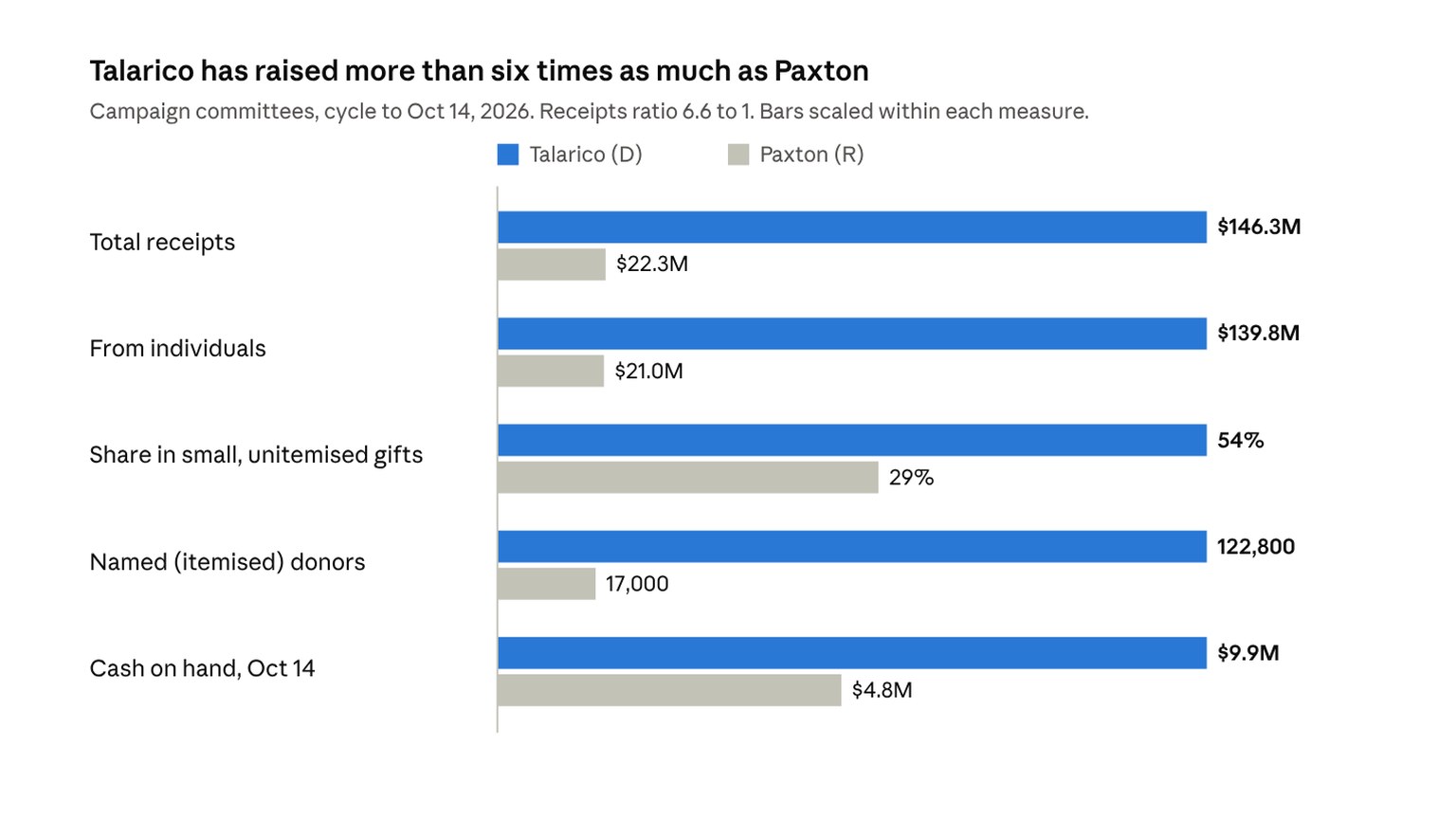
Every itemised contribution in both campaigns: where donors live, how concentrated the money is, how limits were handled.
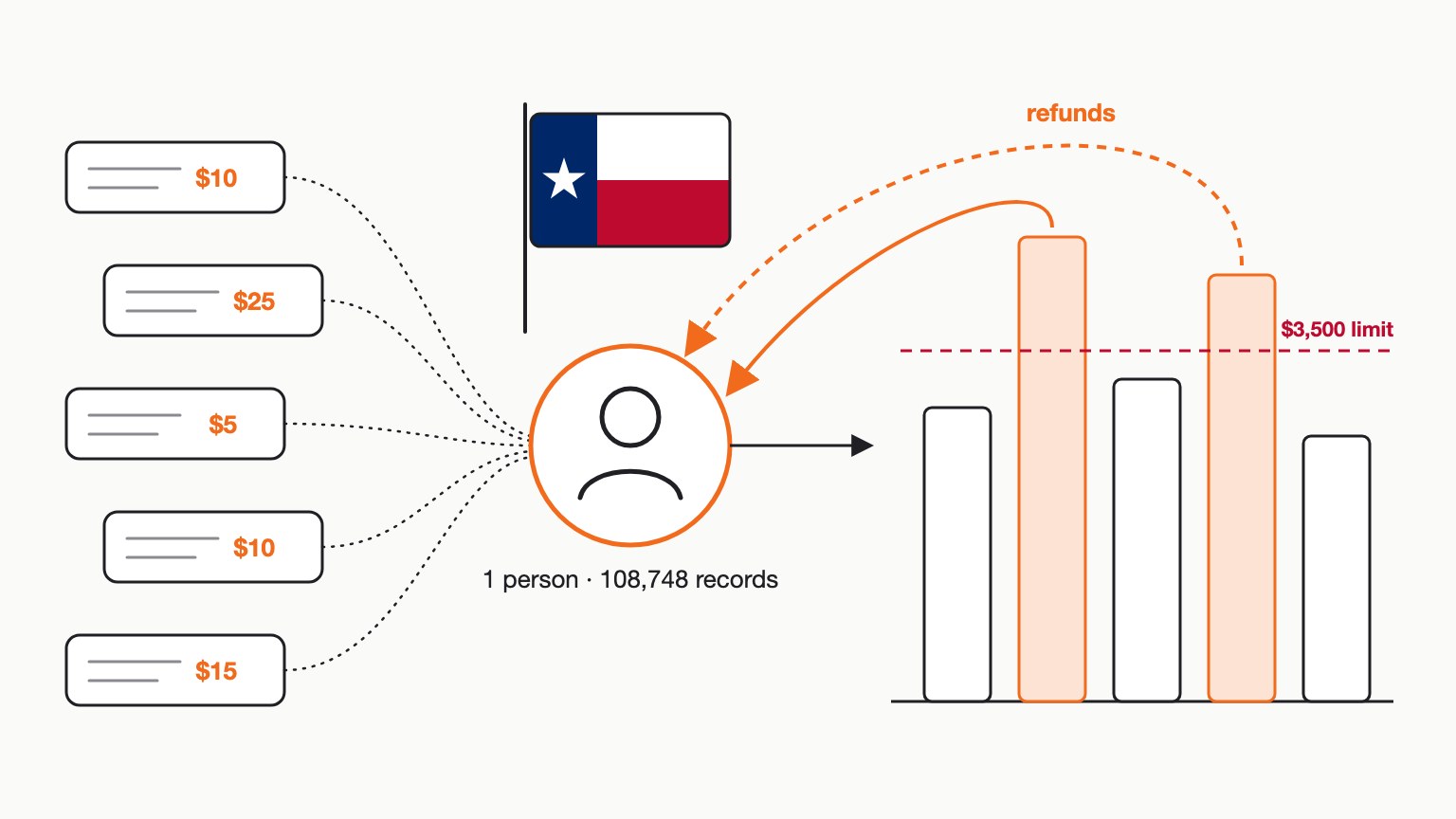
76,000 donations, 108,748 records, four FEC files — and why the first pass was badly out of date.
Campaign finance is the public example. The problem is everywhere.
We used FEC data because it is one of the largest public identity datasets in the United States. The same question — is this the same person or organisation? — sits under benefits and improper payments, grants and procurement, licensing and tax records. Tilores answers it inside your own AWS account, including GovCloud, or on-premise.
Tilores is available to federal, state and local government agencies through our partnership with Carahsoft. The quickest route is a short technical demo against a dataset you care about — we will bring Carahsoft in for contract vehicle and procurement questions.
See the whole person in your own data
Entity resolution joins scattered records into one view before you count anything.
49.5 million voter records from 7 states, resolved — a data quality problem rather than a fraud problem.
Method notes: FEC individual contributions file for 2025–26, published October 25, 2026, with gifts through June 30, 2026; raw electronic filings retrieved October 29–30, 2026 for reports through October 14. Entity resolution with Tilores covers 12.4 million records from California, Florida, New York and Texas; other states are matched on surname, first name and ZIP. Over-limit counts are net of refunds, chargebacks, redesignations and reattributions, with candidate gifts tested at $10,500 per cycle. State map shares exclude committees we could not assign to a party. Named people are public figures, and their figures are their own itemised gifts and receipts as reported to the FEC. Nothing here alleges wrongdoing by any donor or committee. Full methods are in each analysis.