On paper, she gave more than the law allows to 10 campaigns. Then the refunds arrived.

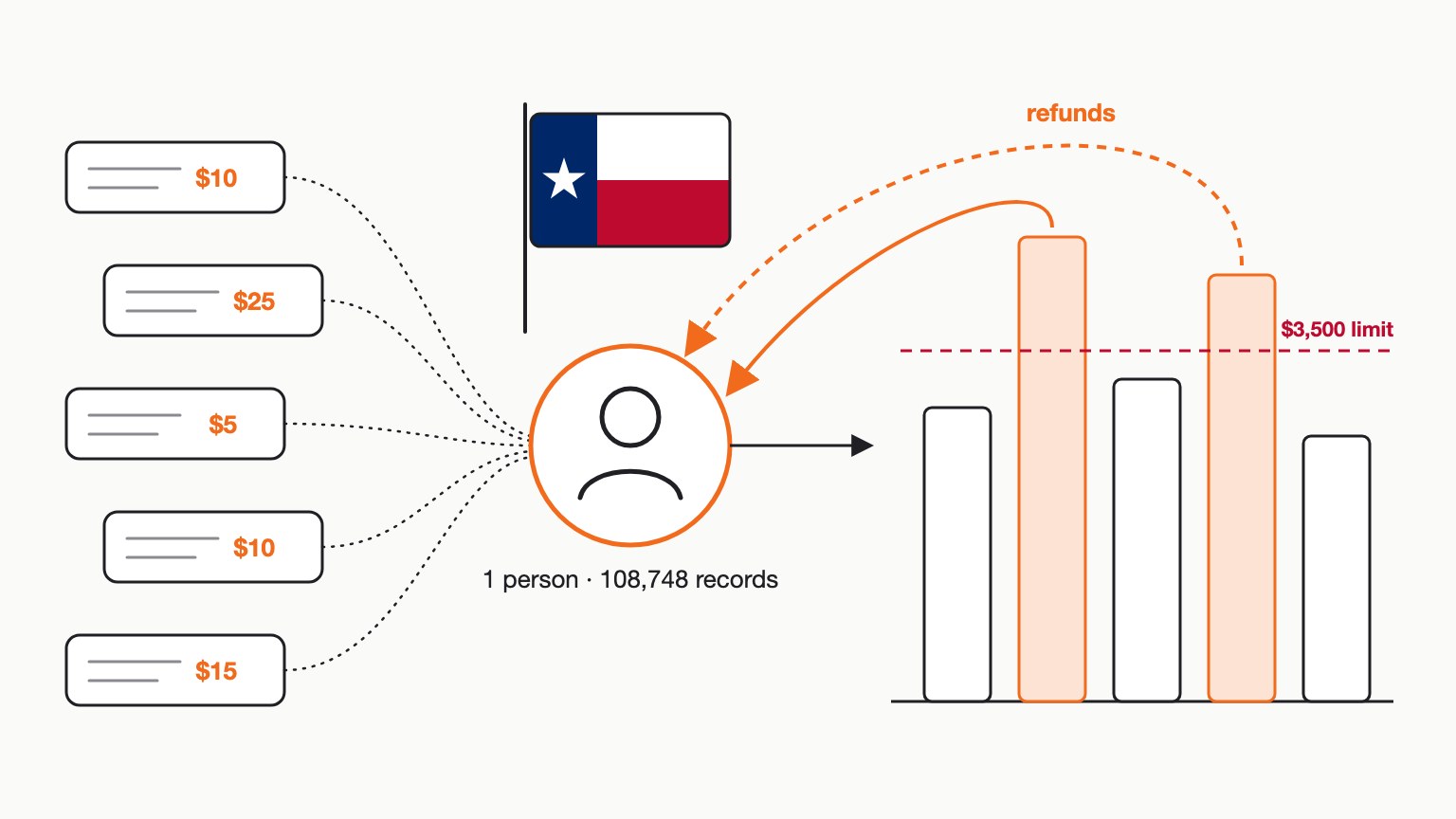
TL;DR: Using the FEC’s bulk data, a retired Texan with 76,000 donations looked over the federal limit at 10 campaigns and 7 PACs. Once we added October filings, joint fundraising shares and redesignations, most of those had been fixed, often late. As of the latest reports, her totals exceed the limit at one campaign and four PACs with no matching refund. Getting there took four data sources and one step the FEC doesn’t do: working out which 108,748 records are the same person.
See it on your data: Book a Demo or Try Tilores Studio (Free).
Yesterday we wrote on LinkedIn about a retired Texan who made about 76,000 political donations in 18 months, most of them around $10. We promised to answer the obvious follow-up question: did her giving exceed the federal contribution limits?
The short answer is yes, at times, and in a lot of places. The longer answer is mostly about how hard it is to tell, even with every filing in hand.
What are the limits?
For the 2025–26 cycle the FEC sets these limits for an individual:
- $3,500 per candidate, per election. Primary, runoff and general each count separately.
- $5,000 per calendar year to a PAC, including leadership PACs.
- $44,300 per year to a national party’s main account, plus $132,900 per year to each of its special accounts (headquarters, legal, convention).
- No limit for super PACs, or for the non-contribution account of a hybrid PAC.
When a donor goes over, the fix is the committee’s job, not the donor’s. The committee has 60 days to refund the excess or, with the donor’s permission, move it to another election.
What did the first pass show?
We took her resolved record (108,748 filings joined into one person) and added up net giving per committee and per election. That meant subtracting refunds and chargebacks and following redesignations between primary and general.
Using the FEC’s bulk data, which runs to the end of June, her totals were over $3,500 for a single election at 10 candidate campaigns, and over $5,000 for the year at 7 PACs. That’s a striking number for someone whose typical gift is ten dollars.
It’s also wrong, or at least badly out of date. Here’s what changed when we kept digging.
What doesn’t the bulk data show?
1. The fixes come later. Committees usually catch an excess when they prepare their next report. For gifts made in the spring, that’s the July–September report, filed on October 15. Ten days after the deadline, almost none of those reports had made it into the FEC’s bulk download. We pulled the raw filings directly instead.
2. Joint fundraising lives in a different file. More than $400,000 of her money went to joint fundraising committees. These pool donations and split them among several candidates and party committees. Each recipient’s share counts toward her limit with that recipient. The FEC does publish those shares, but in its “other transactions” file, not the individual contributions file most analyses use. We found more than 26,000 allocation entries in her name there.
3. Redesignations hide in odd places. One campaign moved more than $2,000 of her primary money to the general election and recorded it under a joint-fundraising code. Another recorded its redesignations as “other receipts.” A filter that only looks for the standard memo entries misses them.
4. Even the bulk data has gaps. For one large leadership PAC, the bulk file held 2 of her donations from April to June. The PAC’s own filing for that period lists 1,138.
New posts on entity resolution, identity data and AI. No spam, unsubscribe any time.
What do the filings show now?
Once we counted the allocations, the October filings and the redesignations, 11 candidate campaigns turned out to have had her over the limit at some point. Here’s where they stand in the latest reports, which run through September 30, and through October 14 where a pre-general report exists:
| outcome | campaigns |
|---|---|
| Fixed within about 60 days (one still $29 over) | 5 |
| Fixed, but late (two still $40–$65 over) | 5 |
| Still over, with no matching refund | 1 |
A twelfth campaign looked over on the first pass but wasn’t. It had filed her primary and general gifts under a single “other election” code, and the two were only separable in the raw filings. Each came in just under $3,500.
The one campaign still over is a Senate runoff. It refunded what it saw as the excess from her direct gifts at the end of September. Her share of joint fundraising money for the same runoff still puts her roughly $900 above the limit.
The PAC picture is similar. Of the 6 PACs that had her over $5,000 for a year:
- 2 fixed it. One is a leadership PAC that took in about $70,000 from her in the first half of 2026, fourteen times the annual limit. Most of it was refunded or reversed between July and September, months after the money arrived.
- 4 have not. Her totals exceed the limit by between about $400 and $5,000 at each, with no matching refund on file. Two of the four are hybrid PACs, which can legally move excess into an unlimited account, so those two are the weaker findings.
The party committees were clean. In one year her main-account total at the national committee came to exactly the limit, to the cent. A joint fundraising committee had topped it up precisely. After that, new gifts were routed to the party’s headquarters account.
So the headline is: as of the latest filings, her totals exceed the limit at one campaign and four PACs, and those committees haven’t refunded the difference. That’s well short of the 17 the first pass suggested. In total, close to $100,000 was sent back to her by refund or reversal.
None of this is a finding that she broke the law. The rules put the burden on the committees, and she may never have known. These are her totals as the committees themselves reported them.
Where did the rest of the money go?
One joint fundraising committee received more than $200,000 from her this cycle. When a JFC passes money on, each recipient is supposed to report the donor’s share. For her, those shares add up to about a tenth of what she gave. The rest isn’t attributed to her in any filing we could find, and the JFC hasn’t reported refunding it.
There are innocent explanations. The JFC may still be holding the money, or attributions may be sitting in reports that haven’t been processed yet. Either way, a large share of one donor’s giving can’t be traced to where it ended up, which is why we can’t fully answer the limits question.
Is she unusual?
Not as much as you’d think. Across California, Florida, New York and Texas, we resolved 769,000 donors. Running the same first-pass check on all of them:
| donations per person | share over the limit at ≥1 campaign (first pass) |
|---|---|
| fewer than 100 | 0.4% |
| 100–999 | 2.2% |
| 1,000–4,999 | 1.5% |
| 5,000–19,999 | 17% |
| 20,000 or more | 6 of 7 donors |
She’s the most frequent donor in the four states but only around 230th by dollars. Three other heavy small-dollar donors show up over the limit at 14 campaigns each on the same check.
What the table really shows is that once someone is giving thousands of tiny gifts to hundreds of committees, going over somewhere is close to automatic. Each committee sees only its own slice of her giving. Recurring donations keep running, and joint fundraising adds shares the campaign may not be watching. In her case, many campaigns plainly were watching: more than 20 of them stopped her between $3,400 and $3,500. The rest caught up later, if at all.
Bear in mind that we verified her case against the October filings and haven’t done that for the others yet. In her case, the full check cut the count from 10 campaigns to one.
Why is this a data problem first?
Nothing here required secret data. Every number comes from public FEC filings. But answering a simple question took four separate sources, and getting it right meant knowing which codes mean what and which file was out of date:
- the individual contributions file
- the “other transactions” file
- raw electronic filings
- the candidate master file
And all of it depended on one step the FEC doesn’t do: deciding which of 108,748 records belong to the same person. We did that with Tilores entity resolution. Without it, there’s no “her” to add up, and the limit question can’t even be asked.
The lesson is less about one donor than about the data. Contribution limits are enforced one committee at a time, and only someone who can see the whole person can tell whether that’s working.
Want to see the whole person in your own data? Entity resolution joins scattered records into one view before you count anything. Book a Demo or Try Tilores Studio (Free).
FAQ
What are the federal contribution limits for 2025–26?
An individual can give $3,500 per candidate per election, $5,000 per year to a PAC, $44,300 per year to a national party’s main account and $132,900 per year to each of its special accounts. Super PACs and the non-contribution accounts of hybrid PACs have no limit.
Is the donor breaking the law if her totals exceed a limit?
Not necessarily. The committee receiving the money has 60 days to refund the excess or redesignate it. These figures describe what committees reported, not a legal finding about the donor.
Why can’t you just add up a donor’s FEC records?
The FEC has no ID for individual donors. Every gift is a separate row, often with spelling variations, so you first have to resolve which records belong to the same person. Then you need data from several FEC files, because refunds, joint fundraising shares and redesignations are reported in different places and at different times.
Why did the number of over-limit campaigns drop from 10 to 1?
Most committees had refunded or redesignated the excess in reports filed on October 15, which weren’t in the FEC bulk data yet. Joint fundraising shares and unusually coded redesignations also changed several totals.
How were the records resolved?
We ran 12.4 million FEC contribution records from California, Florida, New York and Texas through Tilores entity resolution. They resolved to about 770,000 people, including one donor with 108,748 records.
Method notes: 2025–26 limits per the FEC’s January 2025 notice. Bulk data as published October 25, 2026, plus raw electronic filings retrieved October 29 covering reports through October 14. “Over the limit” means net reported giving after refunds, chargebacks, redesignations and joint fundraising shares. The 60-day timing is measured from when her running total first passed the limit.
See what resolved entity data does for your business — and your AI.