Talarico vs Paxton: Who Funds the Texas Senate Race

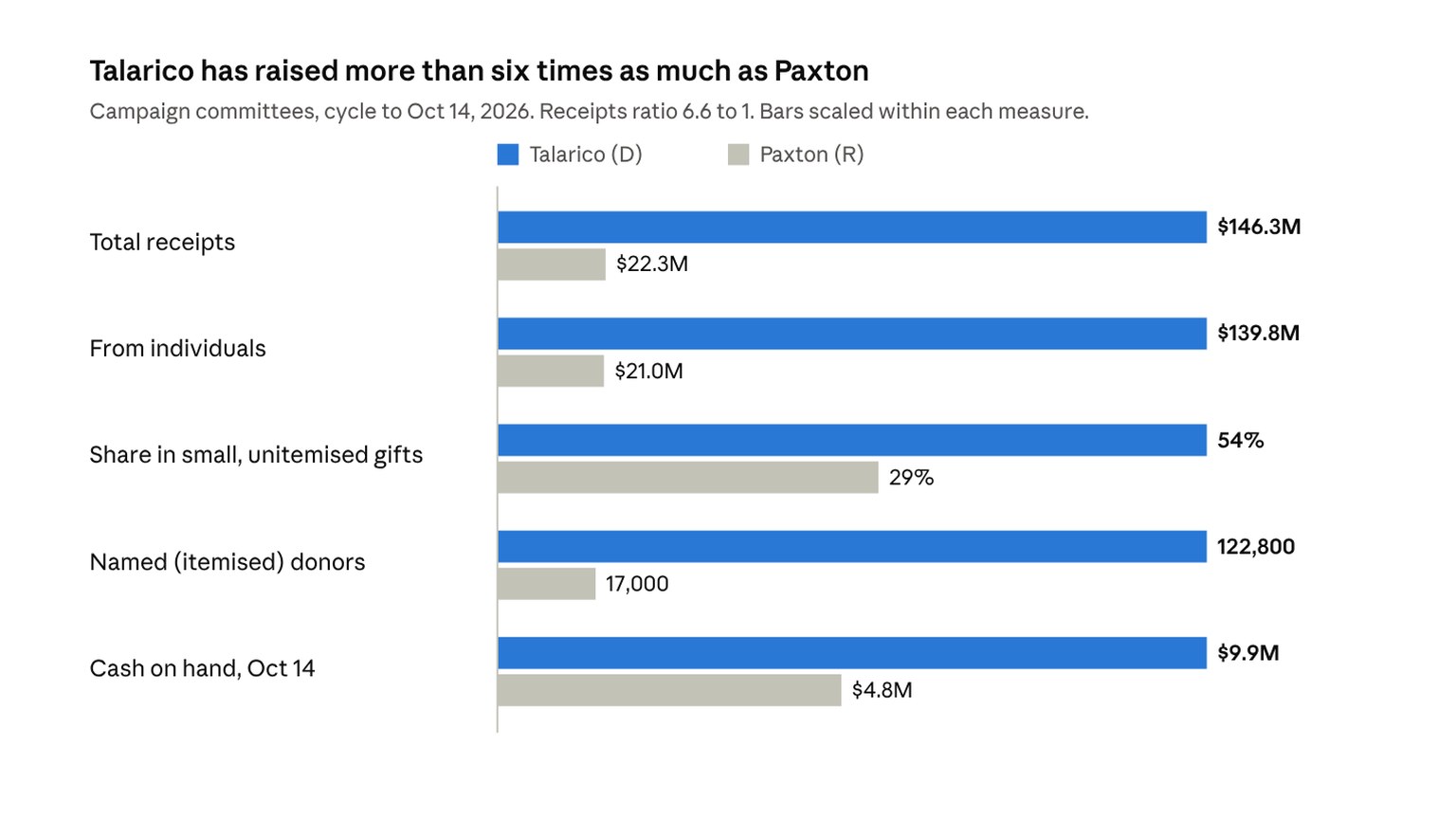
TL;DR: Through October 14, 2026, Talarico’s campaign has raised $146.3 million to Paxton’s $22.3 million. Talarico’s money comes from more than 120,000 named donors plus $75 million in small gifts, and half of his named-donor money comes from outside Texas. Paxton relies on about 17,000 named donors and a small group of very large donors to the committees around him. Both campaigns fixed most gifts that went over the $3,500 limit: Paxton’s committee left 6 donor totals still over on paper, Talarico’s 28.
See it on your data: Book a Demo or Try Tilores Studio (Free).
James Talarico’s campaign has raised $146.3 million to Ken Paxton’s $22.3 million, but the bigger difference is who gives. Talarico’s money comes from more than 120,000 named donors, plus $75 million in gifts too small to be itemised. Paxton’s comes from about 17,000 named donors and a small group of very large donors to the committees around him.
We read every itemised contribution in both campaigns’ own FEC filings, from April 2025 to October 14, 2026, the cut-off for the last report before election day. We also resolved donors to the joint fundraising committees and the pro-Paxton super PAC across the four biggest donor states.
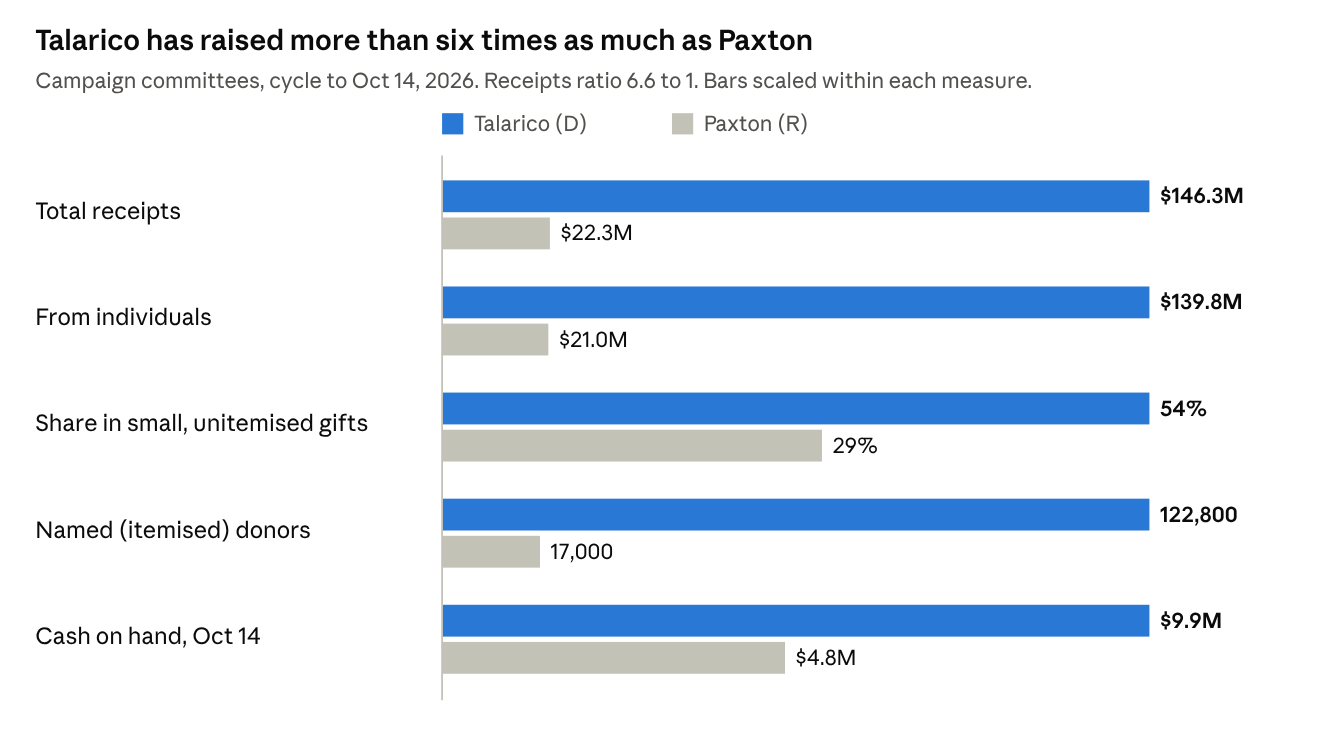
Source: Each committee’s FEC Form 3 filings, cycle-to-date totals in the pre-general report (through Oct 14, 2026).
Paxton leans on donors who give the maximum
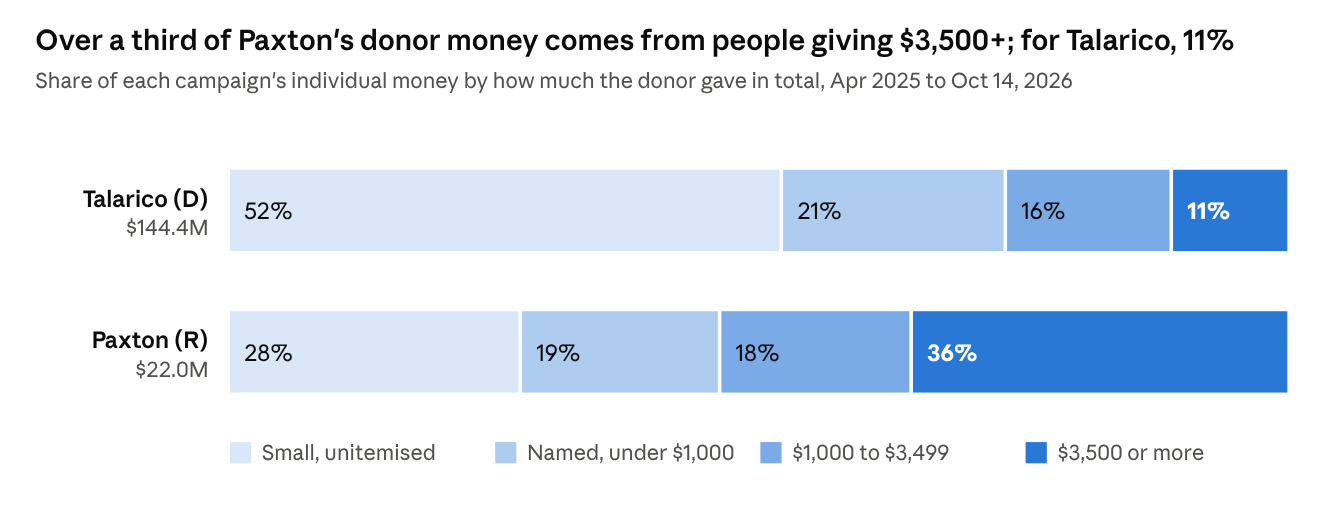
Source: FEC Form 3 filings, Talarico for Texas and Ken Paxton for Senate, Apr 2025 to Oct 14, 2026. Named donors grouped by name and ZIP; totals net of refunds; includes joint fundraising committee shares.
A donor can give a candidate $3,500 per election, so $10,500 across a primary, runoff and general. Paxton needed all three, and his donors used them: about 1,500 people account for $7.9 million of his donor money. Talarico’s single biggest group is people who never gave enough to be named, $75 million in gifts under $200.
That is a structural difference, not a scandal. A runoff against an incumbent senator is a short race that rewards big cheques. A national small-dollar operation like ActBlue rewards volume.
Talarico is running a national race, Paxton a Texas one
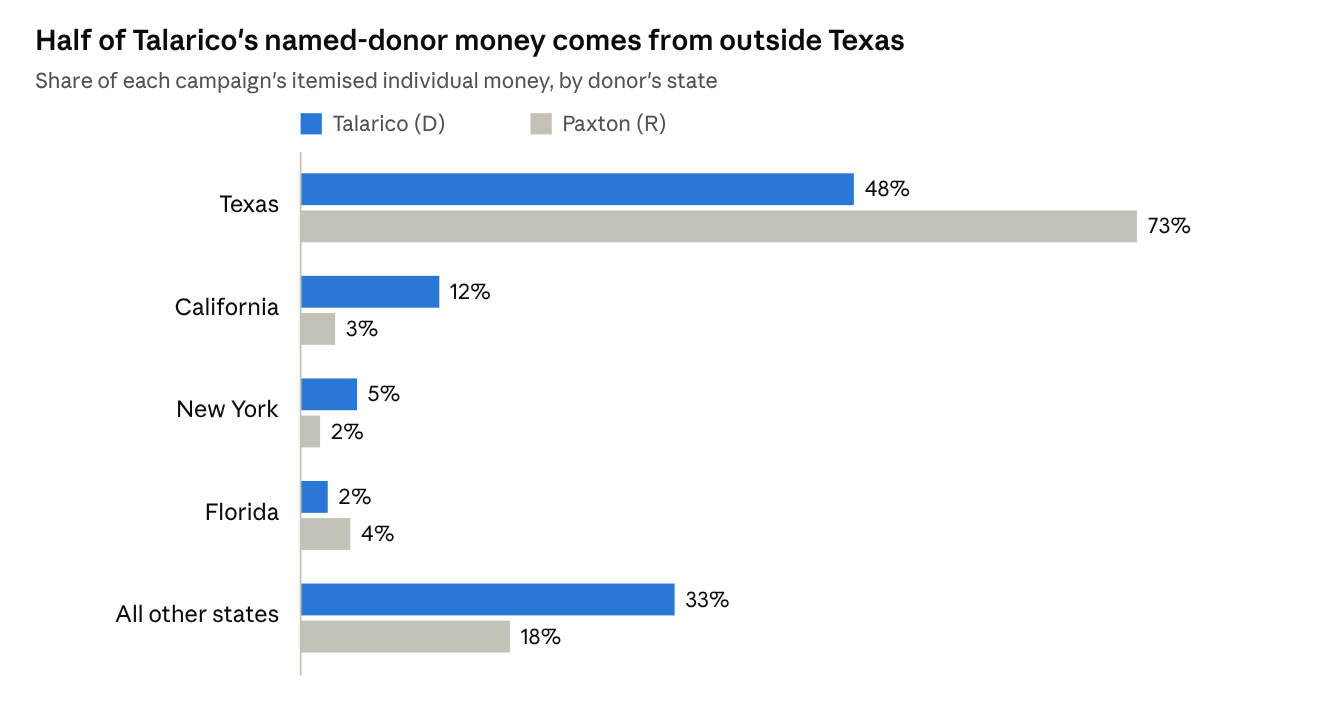
Source: FEC Form 3 filings, itemised contributions only (small unitemised gifts carry no address). Talarico $69.1M, Paxton $16.0M named-donor money, net of refunds.
Texans gave Paxton 73% of his named-donor money and Talarico 48%. Talarico’s out-of-state money runs from California ($8.3M) through New York to every other state, adding up to $36 million. Measured by people, not dollars, 56,000 of his 122,800 named donors live in Texas.
Talarico still raised nearly three times as much from Texans alone, $33.3 million to $11.6 million.
The money arrived late
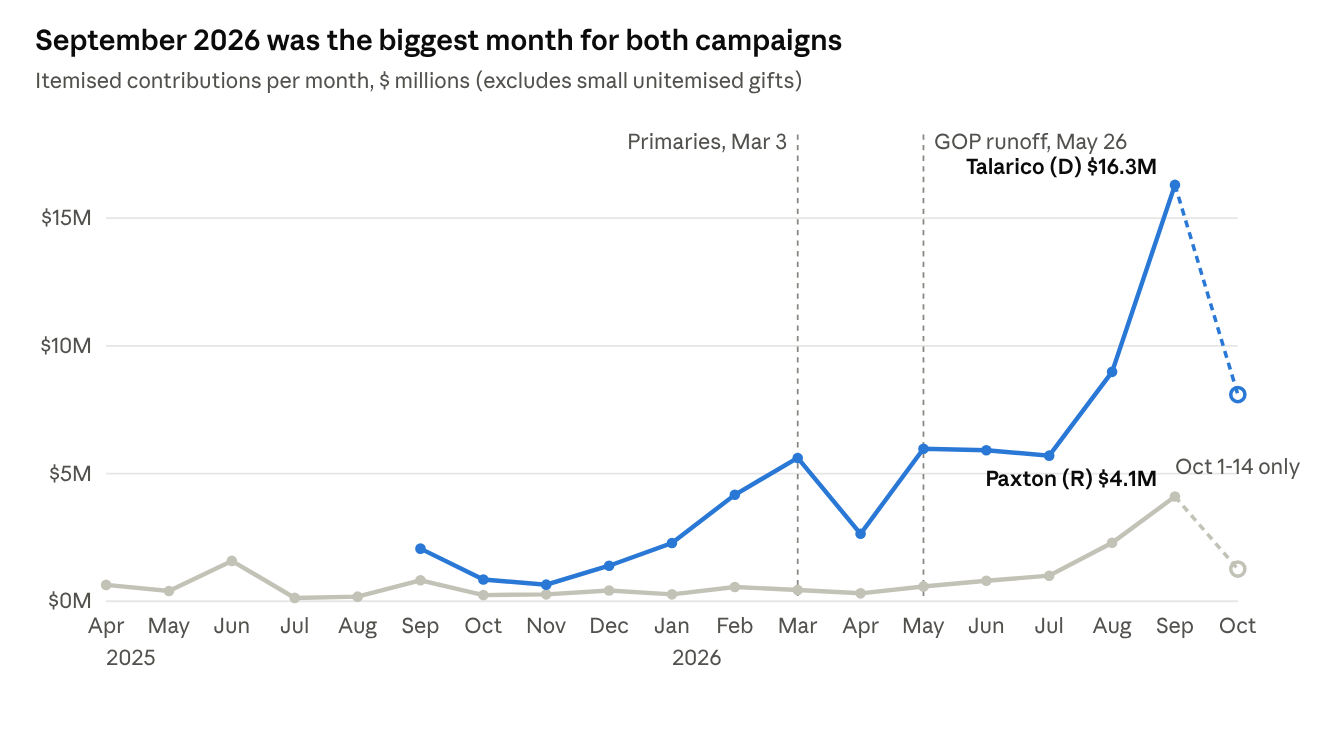
Source: FEC Form 3 filings, itemised contributions plus joint fundraising committee shares, by contribution date. Talarico launched in September 2025. October covers the 1st to the 14th only.
Paxton spent his first year raising modest sums for a primary against Senator John Cornyn. His fundraising barely moved until he won the May runoff, then quadrupled between July and September. Talarico grew steadily through his March primary win and took in $16.3 million in itemised gifts in September alone.
Both campaigns did half their named fundraising in the four months after the runoff.
New posts on entity resolution, identity data and AI. No spam, unsubscribe any time.
Around Paxton, a hundred donors give most of the money
Add the super PAC and the joint fundraising committees, and the gap in concentration gets wider. Among donors in California, Florida, New York and Texas, Paxton’s ten largest gave 28% of the money they gave to his side, and his top 100 gave 62%. Talarico’s ten largest gave 2%, and his top 100 gave 10%.
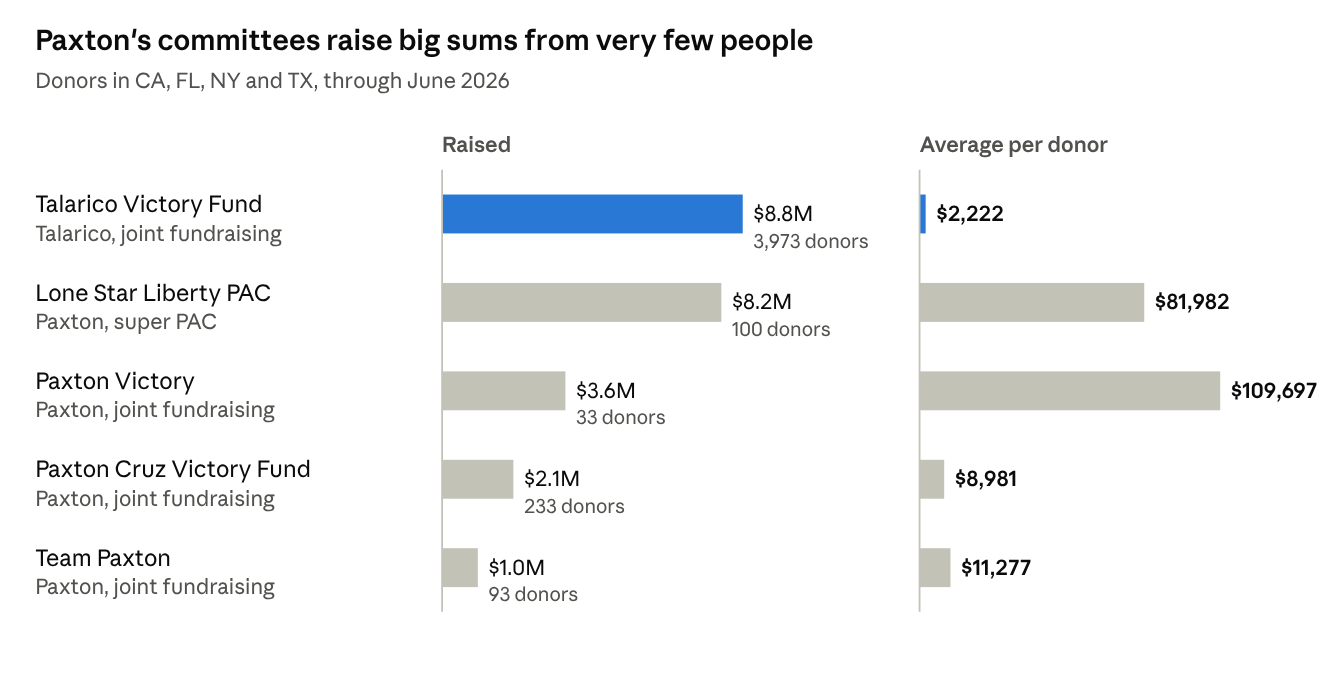
Source: FEC bulk contribution file (Oct 25, 2026 release), donors in CA, FL, NY and TX resolved into people with Tilores.
Lone Star Liberty PAC is where the biggest cheques go. Super PACs have no contribution limit. Two Texas donors gave it more than $1 million each, and a Corpus Christi personal-injury law firm, Thomas J. Henry Law, gave $646,000. Since then the Elon Musk Revocable Trust has given it $10 million, on August 21, according to the PAC’s own e-filing.
Paxton Victory raised $3.6 million from 33 donors in these four states between June 9 and June 30, about $110,000 each. Joint fundraising committees split each cheque between the candidate and other participants, such as party committees, so not all of it goes to Paxton. Talarico’s equivalent raised more money from 120 times as many donors.
Independent spending by outside groups such as Texas PAC is reported separately and is not counted here.
Both campaigns fix most over-limit gifts, Paxton’s more consistently
Neither campaign has a large problem with donors over the $3,500 limit, but Paxton’s cleans up more of it. A committee has 60 days to refund or reassign an excess gift. Counting gifts made by August 15, which had that long by October 14, 372 Talarico and 632 Paxton donor totals went over. Paxton’s committee fixed all but 6. Talarico’s left 28 still over on paper, about $38,000 in all.
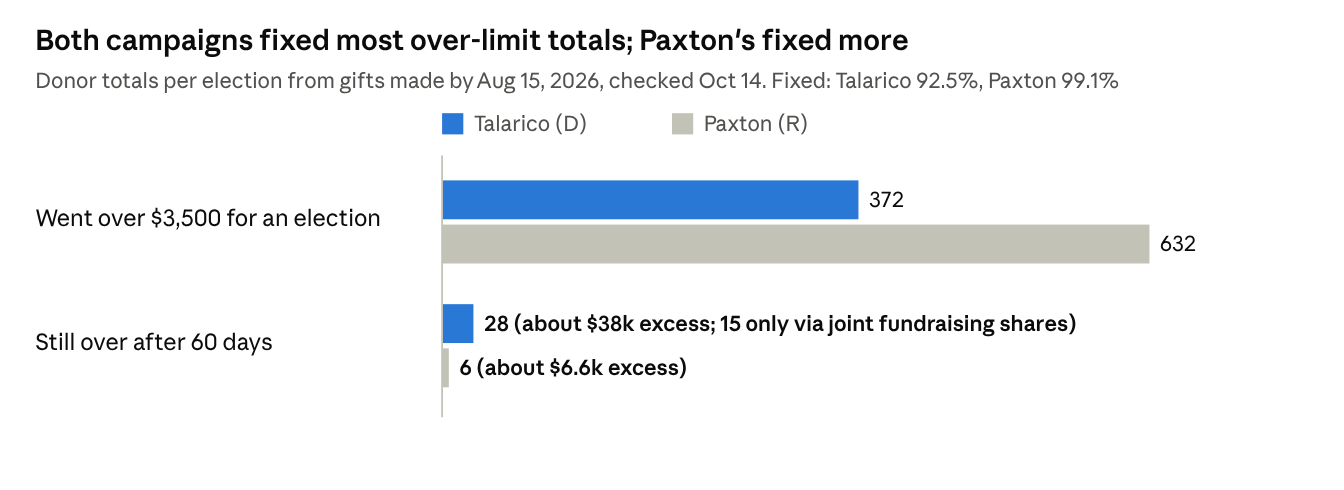
Source: Raw FEC e-filings, Talarico for Texas and Ken Paxton for Senate. Donors matched on name and ZIP; $3,500 limit per election; excess counted net of refunds, redesignations and reattributions.
The two campaigns get there differently. Almost all of Paxton’s excess came from single cheques above $3,500, which his committee split across the primary, runoff and general, or between spouses. Talarico’s came mostly from donors whose later gifts took them past the limit, and his committee usually refunded the difference.
Fifteen of Talarico’s 28 cases only go over once shares from the Talarico Victory Fund, his joint fundraising committee, are added. In one, a donor gave $11,000 for the general election and was refunded $7,500 in June. The fundraising committee then allocated another $3,500 from that donor in August. Cases like this come from how money was allocated between committees, not from donors trying to get around the limit.
A donor total above the limit is the committee’s compliance issue to fix, not evidence that anyone broke the law. Our counts match donors on name and ZIP code, so a few may be two different people. Corrections filed after October 14 will show up in the post-general reports due December 3.
The numbers depend on knowing who is who
The FEC has no ID for individual donors, so every finding above depends on deciding which records are the same person. We resolved the four-state donor records with Tilores, grouped campaign donors by name and ZIP code, and checked by hand where the stakes were high. Three things nearly changed the story:
- Common names merge. One resolved “donor” combined at least four different people with a common surname, living in different Texas cities. Merges like that make it look as if people give to both sides. Of 160 apparent donors to both sides, fewer than a dozen had a matching name and location.
- People split. A donor who gave $500,000 to the super PAC and $250,000 to a Paxton joint fundraising committee appeared as two separate people, despite sharing a nine-digit ZIP code. Splits like that understate how concentrated the money is.
- Corrections are easy to miss. Redesignations, which move an excess gift to another election, are filed as memo lines that are easy to lose. A first pass on the FEC’s bulk file flagged 44 Paxton donors as over the primary limit. Read from the committee’s own filings, only 3 still are.
Without resolution, donor counts inflate and concentration looks lower than it is. With resolution but no checks, you can accuse the wrong person. The best results combined both.
How we did it
- Campaign committees: every Schedule A and refund line from the FEC e-filings of Talarico for Texas (C00919084) and Ken Paxton for Senate (C00901918), latest amendment of each report, through the pre-general report covering October 1–14, 2026. Headline totals are the committees’ own cycle-to-date summary figures.
- Donors: campaign donors grouped by name and ZIP code, net of refunds, with joint fundraising committee shares added. Small gifts that are not itemised have no donor name and are counted only in totals.
- Other committees: the FEC bulk contribution file released October 25, 2026, limited to donors in California, Florida, New York and Texas and resolved into people with Tilores. Most filings after June 2026 are not in this file yet.
- Limits: $3,500 per donor per election (primary, runoff, general). “Still over” means excess from gifts made before August 15 that had no matching refund, redesignation or reattribution by October 14.
- Not covered: independent expenditures by outside groups, and anything filed after October 22, 2026.
Want to see the whole person in your own data? Entity resolution joins scattered records into one view before you count anything. Book a Demo or Try Tilores Studio (Free).
FAQ
How much have Talarico and Paxton raised?
Through October 14, 2026, Talarico for Texas reported $146.3 million in total receipts and Ken Paxton for Senate $22.3 million, according to each committee’s pre-general FEC report.
Where does Talarico’s money come from?
About $75 million came in gifts under $200 that aren’t itemised. Of his named-donor money, 48% came from Texas and the rest from across the country, led by California and New York.
Did either campaign go over contribution limits?
Neither campaign has a large problem. Counting gifts made by August 15, 372 Talarico and 632 Paxton donor totals went over $3,500 per election. Paxton’s committee fixed all but 6. Talarico’s left 28 still over on paper, about $38,000 in all. A total above the limit is the committee’s compliance issue to fix, not evidence that anyone broke the law.
Why does entity resolution matter for campaign finance data?
The FEC has no donor ID, so every count of donors, concentration or over-limit totals depends on deciding which records are the same person. Without resolution, donor counts inflate. With resolution but no checks, people with common names can be merged into one “donor”. We resolved the four-state donor records with Tilores, grouped campaign donors by name and ZIP code, and checked by hand where the stakes were high.
See what resolved entity data does for your business — and your AI.