$5.2 billion from 2.1 million donors: what the midterm money looks like, state by state

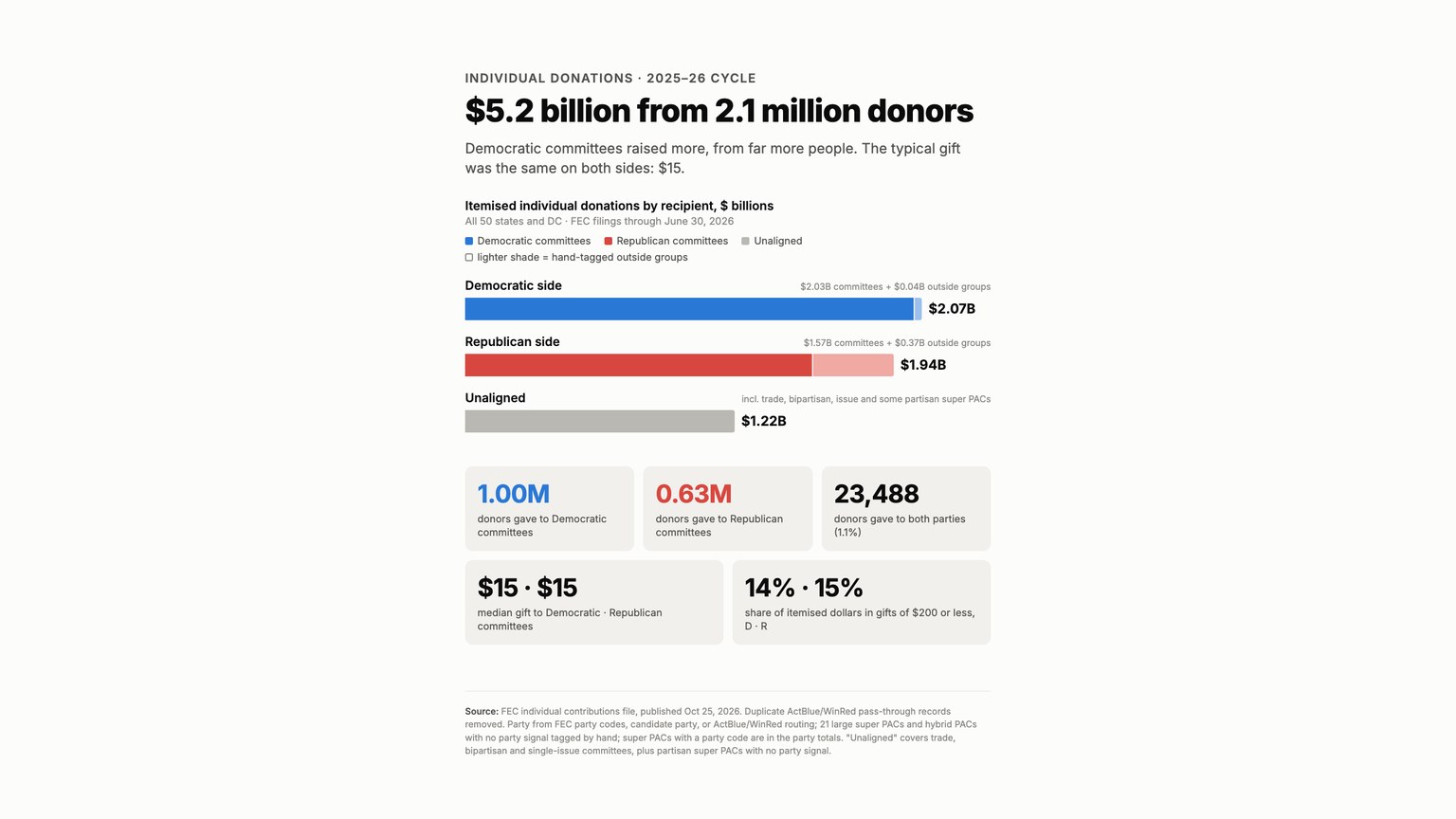
TL;DR: The FEC’s 2025–26 file holds $5.2 billion in itemised gifts from 2.1 million donors through June 30, 2026. Democratic committees raised $2.03 billion from about 1 million donors, Republican committees $1.57 billion from 630,000, with the same $15 median gift. 2,776 donors went over a contribution limit; committees fixed 61% of the cases, leaving 1,258 still over on paper, mostly by small amounts. In the four states we resolved with entity resolution, we found 86% more over-limit cases than matching on name and ZIP code.
See it on your data: Book a Demo or Try Tilores Studio (Free).
Every itemised donation from an individual to a federal political committee ends up in one public file at the Federal Election Commission. For the 2025–26 cycle, the version published on October 25 holds 34.9 million rows, covering every state.
We used it to answer four questions:
- How does the money split between the parties, nationally and in each state?
- How many donors gave more than the law allows?
- How many of those cases have been refunded?
- Which donors show up in more than one state?
The file is complete through June 30, 2026, so this covers the cycle up to then.
The money
After removing duplicate records, the file contains 30 million gifts from 2.1 million donors, worth $5.2 billion.
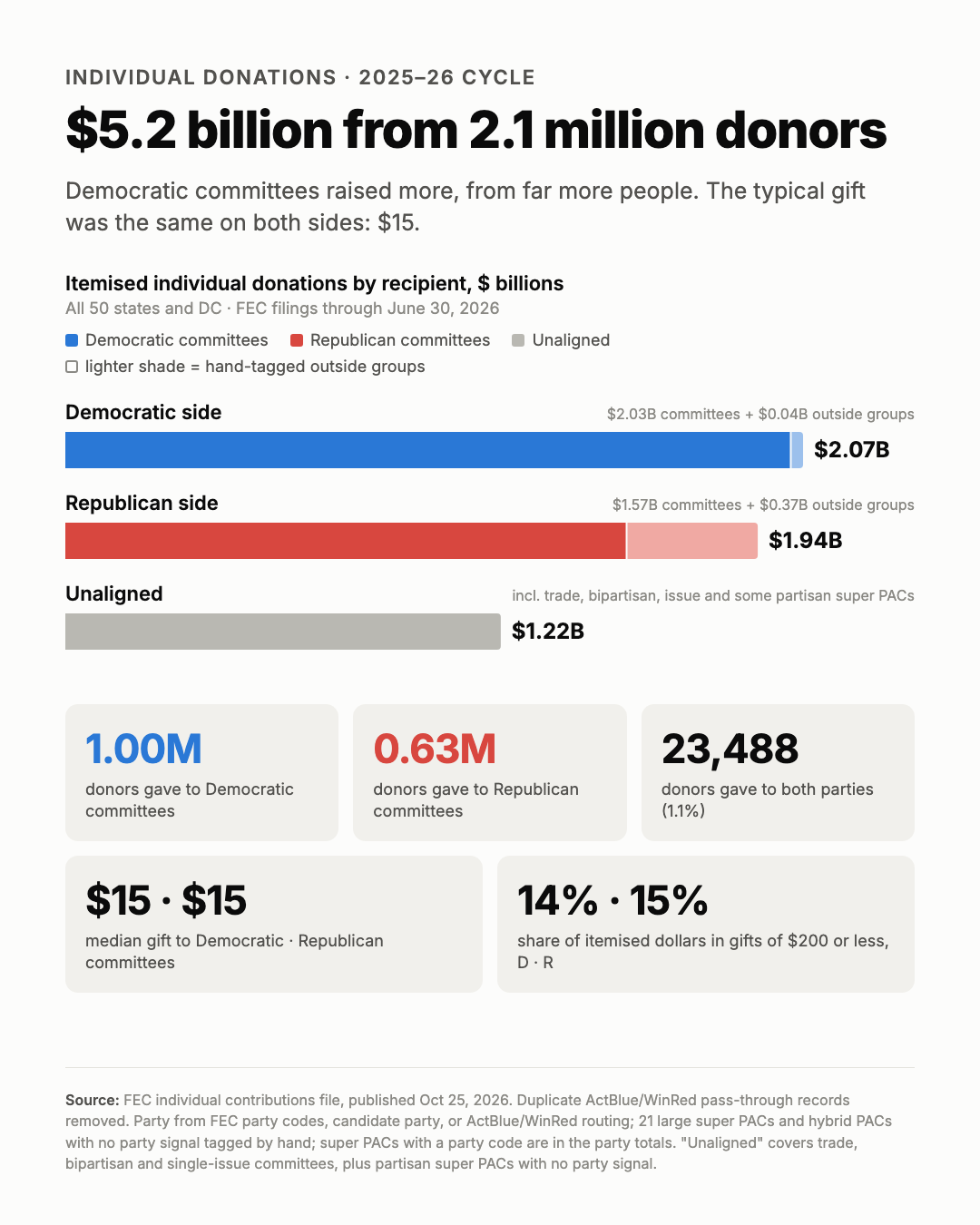
Democratic committees received $2.03 billion from about 1 million donors. Republican committees received $1.57 billion from 630,000. Another $1.2 billion went to committees we couldn’t assign to a party: trade associations, bipartisan PACs, single-issue groups and some partisan super PACs with no party signal.
The difference between the parties is reach, not gift size. The median gift was $15 to each side. Gifts of $200 or less made up about the same share of the dollars for both parties, 14% and 15%. Democrats simply reached about 60% more people. Only about 1% of donors gave to both parties.
A further $370 million went to large outside groups we tagged by hand as Republican-aligned, $227 million of it to MAGA Inc. Democratic-aligned groups we tagged received $37 million. Treat that comparison with care. Super PACs that carry a party code or raise through ActBlue or WinRed are already inside the party totals: about $174 million on the Republican side and $150 million on the Democratic side. Some large partisan super PACs have no party signal at all, so they sit in the unaligned group.
State by state
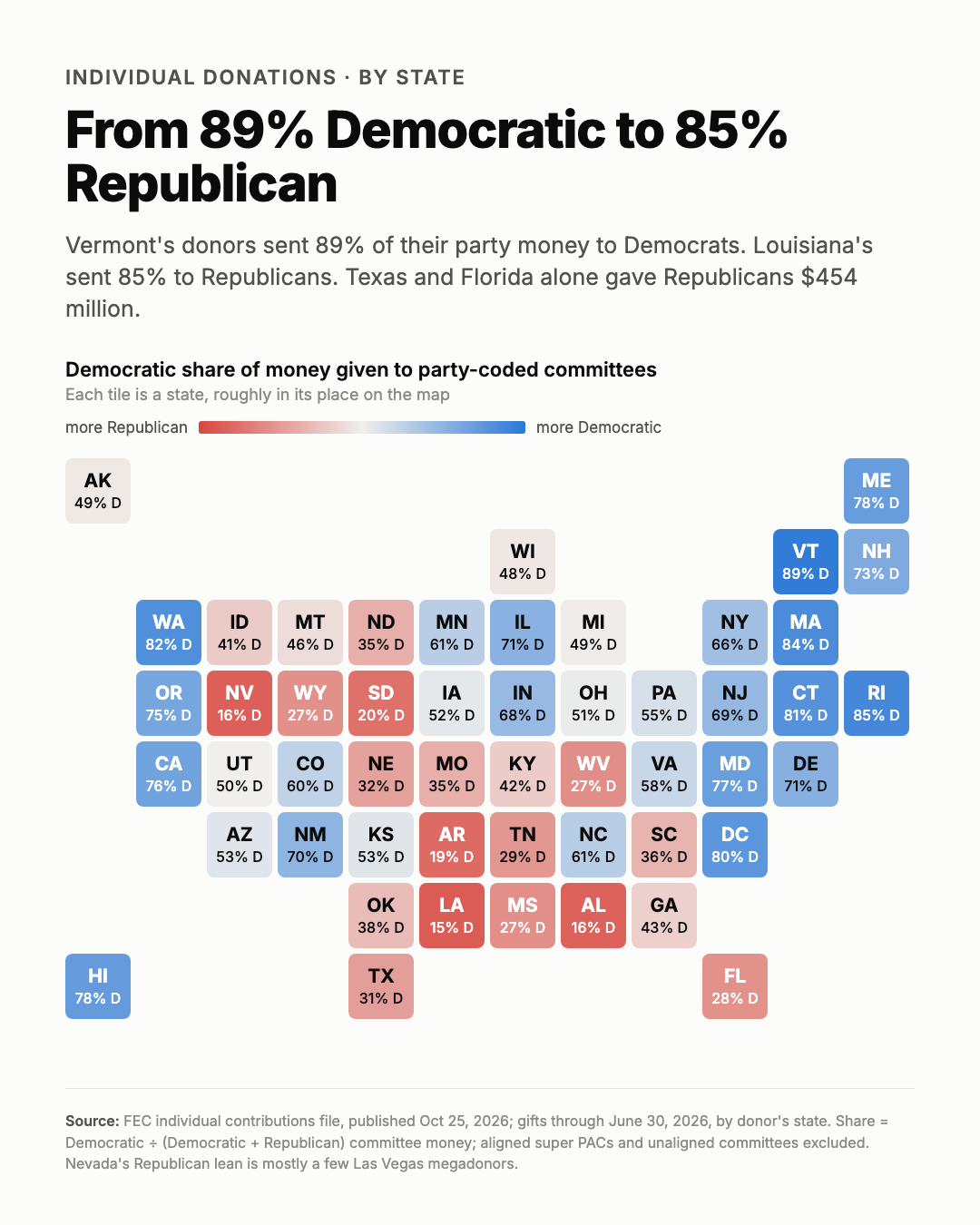
The geography is roughly what you’d expect. The most Democratic donor states are Vermont (89% of party money), Rhode Island and Massachusetts. Louisiana (85% Republican), Nevada, Alabama, Arkansas and South Dakota sit at the other end.
Size matters more than share. Texas and Florida together sent $454 million to Republican committees, more than three times what Republicans raised from California. California alone gave Democrats $421 million.
Nevada stands out. Its donors gave Republicans $71 million and Democrats $13 million. Most of that gap comes from a handful of Las Vegas megadonors.
New posts on entity resolution, identity data and AI. No spam, unsubscribe any time.
Over the limit
Federal law caps what one person can give:
- Candidates: $3,500 per election. The primary, any runoff and the general election each count separately.
- PACs: $5,000 a year.
- A national party’s main account: $44,300 a year, with higher limits for its special accounts.
- Super PACs: no limit.
When a gift takes a donor over the limit, FEC rules give the receiving committee 60 days to refund the excess or, with the donor’s permission, move it to another election or, for a joint gift, to the other account holder.
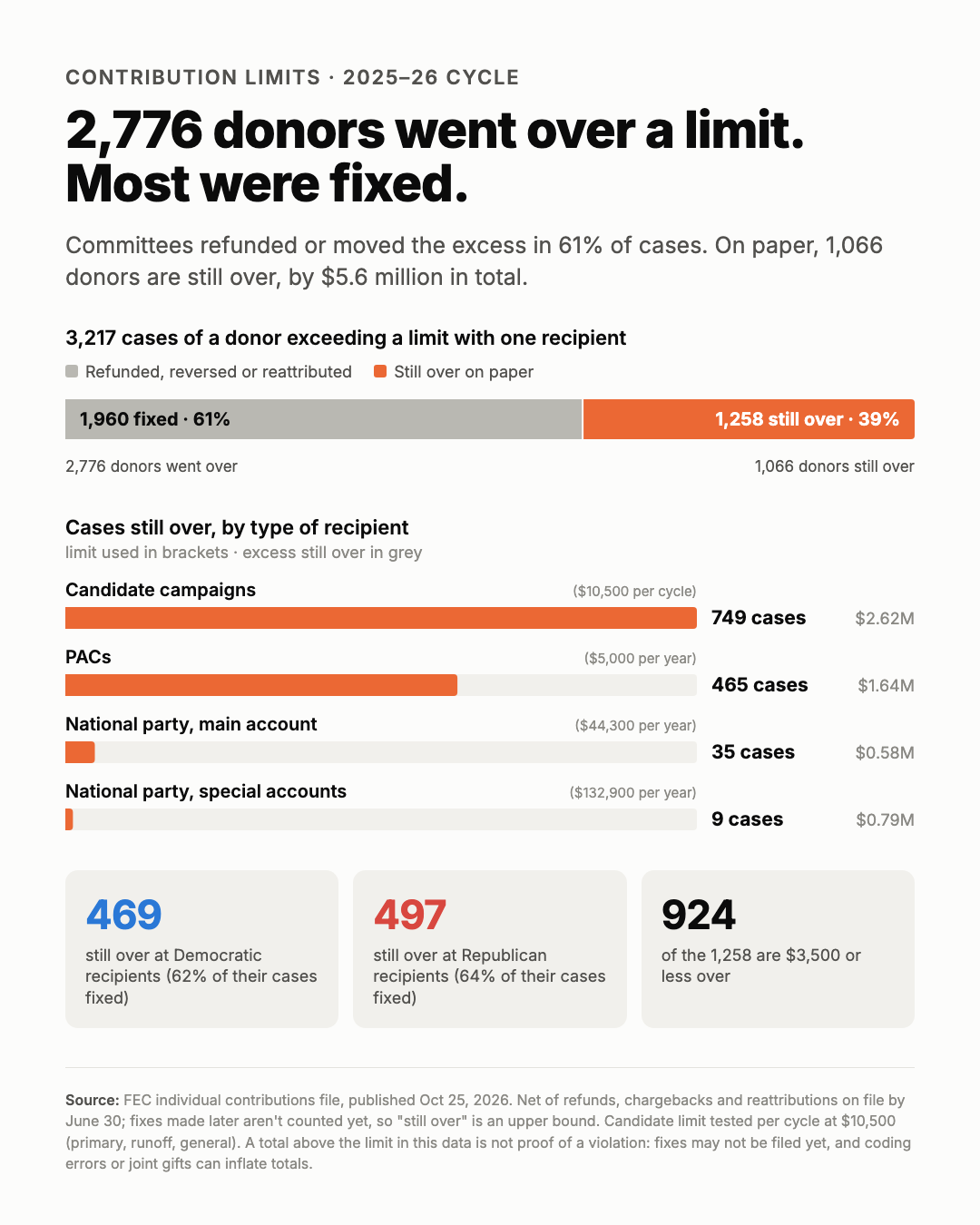
Across all states, 2,776 donors went over a limit with at least one recipient, in 3,217 cases. Committees had refunded, reversed or moved the excess in 1,960 of them, or 61%.
That leaves 1,066 donors whose totals are still over a limit on paper, in 1,258 cases, by $5.6 million in total. Most of the remaining amounts are small: 924 cases are $3,500 or less over. Only 74 are more than $10,000 over.
The two parties look almost the same here. Democratic recipients fixed 62% of their cases and Republican recipients 64%. There are 469 cases still open at Democratic committees, 497 at Republican ones and 292 at unaligned PACs.
Refunds in general are routine. Committees made 318,911 refunds to donors this cycle, worth $116 million, and another 211,000 donations were reversed through chargebacks. Only a small part of that relates to limits: all the over-limit excess together came to $14.9 million.
Three things to bear in mind before reading “still over” as a finding:
- The fixes lag. Refunds made between July and September appear in reports filed in mid-October, which aren’t in the bulk file yet. Some of the 1,258 have probably already been fixed. The count is an upper bound.
- Elections are coded badly. Many runoffs aren’t marked as runoffs, so we tested candidate gifts against $10,500 for the whole cycle (primary, runoff and general). A stricter $7,000 test gives about three times as many candidate cases, but much of the difference is runoff money, in Louisiana especially.
- On paper is not a violation. A total above the limit in this data can come from late fixes, coding errors or a couple’s joint gift filed under one name. It is not evidence that anyone broke the law, and we aren’t naming anyone.
Getting to these numbers meant removing a large number of duplicate records. When someone donates through ActBlue or WinRed, the platform reports the gift and the receiving campaign reports it again, often split differently. A $7,000 donation can appear as one row from the platform and two $3,500 rows from the campaign. Counting both would have left about 38,000 donor–campaign pairs still over the limit instead of 749.
The hard part: who is one donor?
The FEC doesn’t give donors an ID. Every gift is filed separately, with whatever name, address and employer the receiving committee typed in. Before you can check anyone’s total against a limit, you have to decide which records belong to the same person.
The simplest approach treats records with the same surname, first name and ZIP code as one donor. In California, Florida, New York and Texas, we also ran entity resolution with Tilores on 12.4 million records, which matches people across spelling variations, missing middle initials and changes of address.
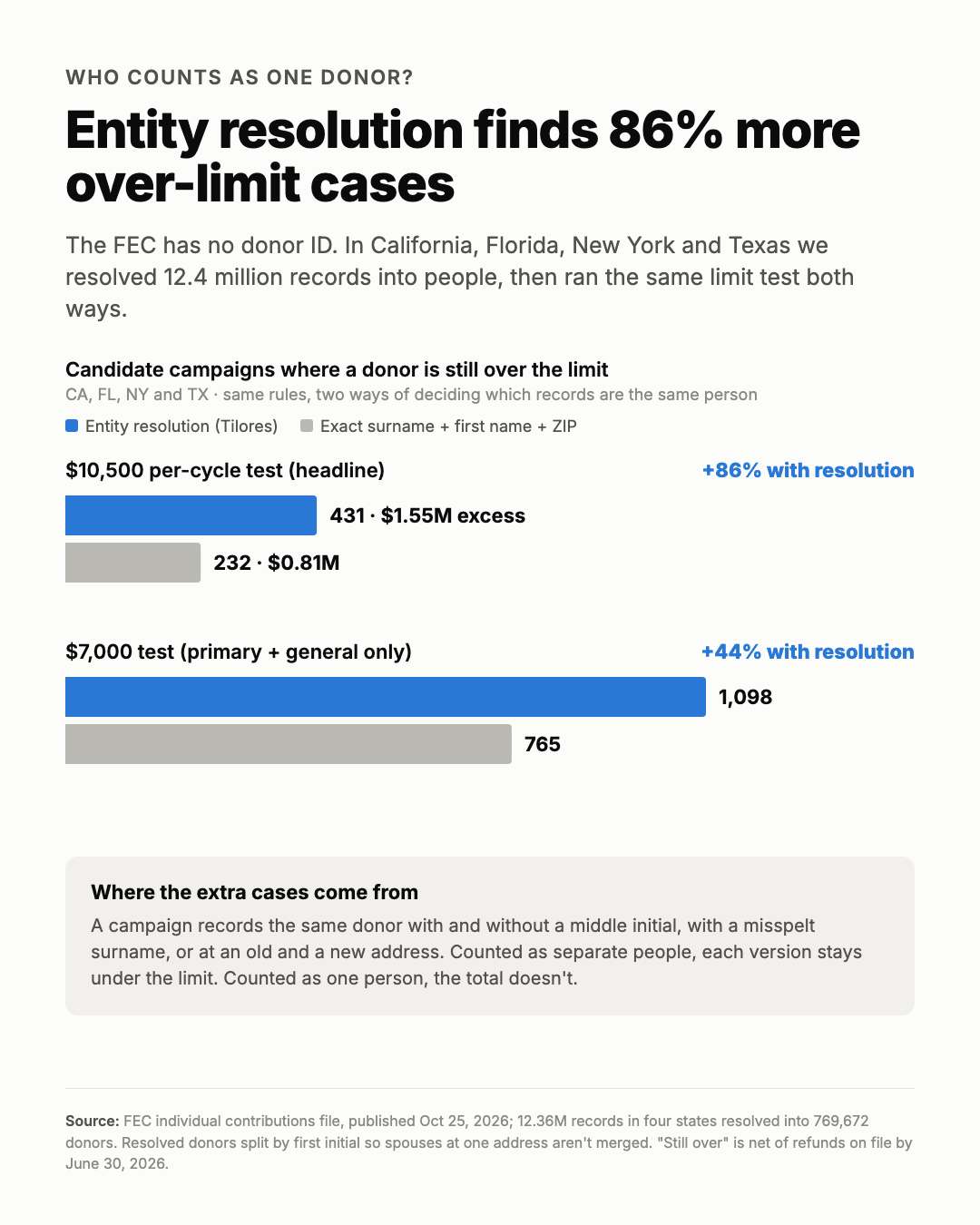
On the same rules, entity resolution found 431 candidate campaigns where a donor is still over the limit. Name-and-ZIP matching found 232. That’s 86% more cases, and nearly twice the excess dollars.
The other 47 states and DC in this analysis use name-and-ZIP matching, so their over-limit counts are probably undercounted by a similar margin.
Donors in more than one state
Some donors’ gifts are filed from addresses in two states, such as a home and a second home, or a home and an office. We matched full name, middle initial and the same specific employer across states, then kept only matches where the ZIP codes confirm two different states. That turns up about 5,400 people, who gave $140 million between them.
The ZIP check matters. One $25 million gift was filed with a Florida state code and a Las Vegas ZIP code. Without the check, it would have made a Nevada donor look like a two-state one.
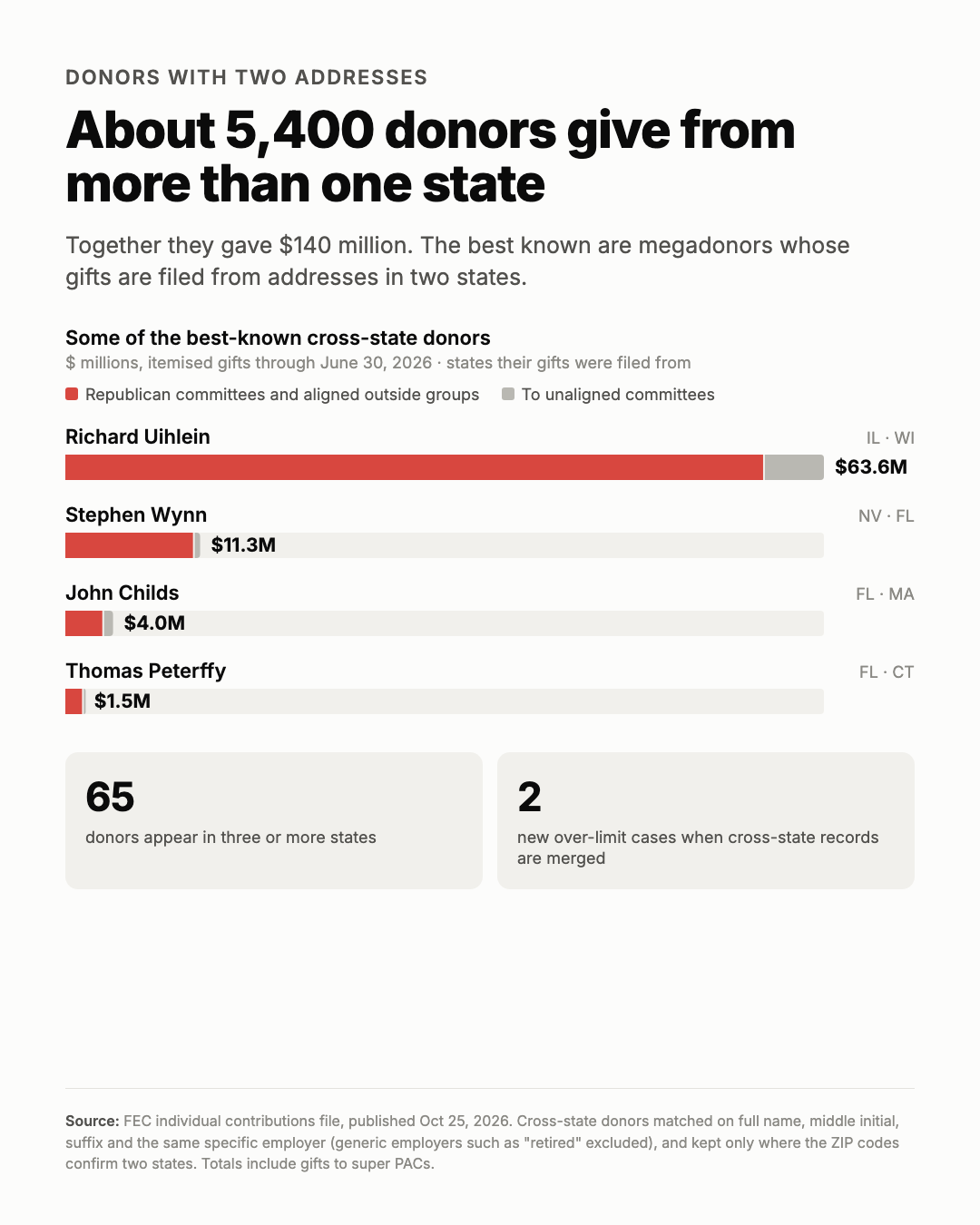
Some are familiar names, such as Richard Uihlein (Illinois and Wisconsin), Stephen Wynn (Nevada and Florida), John Childs (Florida and Massachusetts) and Thomas Peterffy (Florida and Connecticut). Palm Beach and Vero Beach recur throughout the list, often paired with New York, Massachusetts or Connecticut.
Merging these records barely changes the limits picture. It adds just two new over-limit cases, neither involving the donors named here.
What this shows
Political money in the US is easy to total and hard to attribute. The party split is clear from the data. Answering “did this person give too much?” depends on two things the FEC file doesn’t provide: a reliable way to recognise the same donor across records, and reports that arrive in time to show what was fixed.
By June, about six in ten over-limit cases had been fixed. The rest are mostly small and may be fixed by now. In the four states we resolved, though, matching on name and ZIP alone would have missed nearly half of them.
Want to see the whole person in your own data? Entity resolution joins scattered records into one view before you count anything. Book a Demo or Try Tilores Studio (Free).
FAQ
How much did individual donors give in the 2025–26 cycle?
Through June 30, 2026, the FEC’s bulk file shows $5.2 billion in itemised gifts from 2.1 million donors, after removing duplicate ActBlue and WinRed records. Democratic committees received $2.03 billion, Republican committees $1.57 billion, and a further $1.2 billion went to committees we couldn’t assign to a party.
How many donors gave more than the contribution limit?
2,776 donors went over a limit with at least one recipient, in 3,217 cases. Committees refunded, reversed or moved the excess in 61% of them. 1,066 donors are still over on paper, in 1,258 cases worth $5.6 million in total, and most of those are $3,500 or less over.
Does a total above the limit mean someone broke the law?
No. A total above the limit in this data can come from late fixes, coding errors or a couple’s joint gift filed under one name. Committees have 60 days to refund an excess or move it to another election, and refunds made between July and September aren’t in the bulk file yet, so the count is an upper bound.
Why does entity resolution change the results?
The FEC has no donor ID, so you first have to decide which records belong to the same person. In California, Florida, New York and Texas, entity resolution found 431 candidate campaigns with a donor still over the limit, against 232 using name-and-ZIP matching.
Method notes: FEC individual contributions file for 2025–26, published October 25, 2026, with gifts through June 30, 2026. ActBlue and WinRed pass-through records were dropped when the receiving committee reported the same gift within 10 days. A committee’s party comes from its FEC party code or its candidate’s party. Where neither exists, it comes from whether its online donations ran through ActBlue or WinRed. 21 large outside groups (super PACs and hybrid PACs) with no party signal were tagged by hand. Limits are net of refunds, chargebacks and reattributions. Candidate gifts are tested at $10,500 per cycle. Candidate self-funding, gifts larger than five times the limit (mostly data-entry errors) and PACs that only pass earmarked gifts on were excluded. State parties and hybrid PACs can legally move excess into accounts this data doesn’t show, so they are left out of the limit counts. Entity resolution covers California, Florida, New York and Texas, with every other state matched on surname, first name and ZIP. Cross-state donors were matched on full name, middle initial, suffix and specific employer, and kept only where ZIP codes confirm two states. Named donors are public figures, and their figures are their own itemised gifts as reported to the FEC.
See what resolved entity data does for your business — and your AI.