Identity Resolution for AI Customer Support

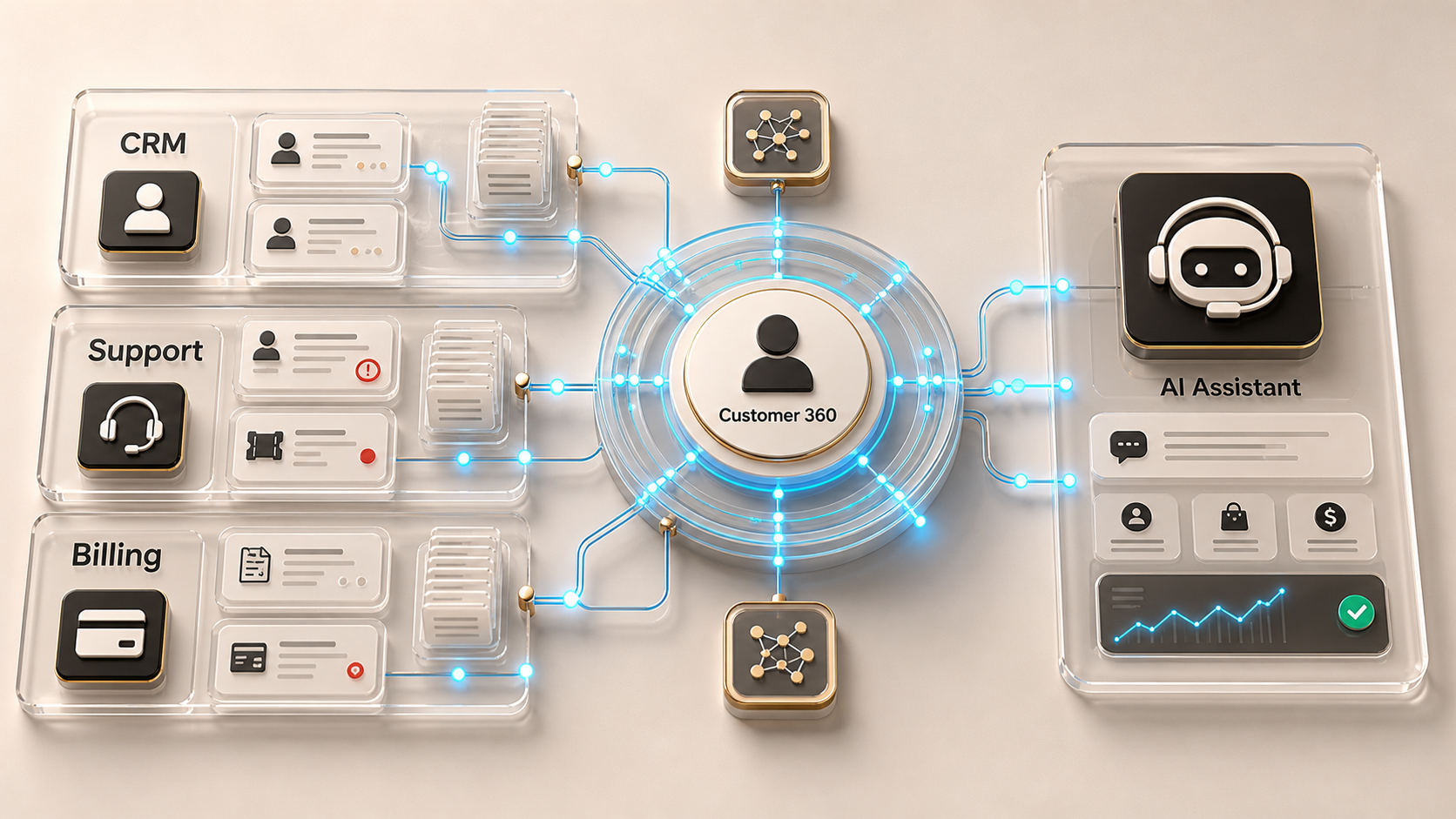
TL;DR: Enterprises connect identity resolution to AI customer support by resolving customer records across CRM, support, billing, product and marketing systems before the assistant retrieves context. The assistant should query one current Customer 360 entity through a constrained API, with confidence and source evidence, instead of assembling a customer profile from raw source-system fragments inside the prompt. That architecture turns duplicate contacts, stale tickets and old billing IDs into a controlled Customer 360 context before the model answers.
Identity layer
Resolve the customer before your AI reasons.
Give support agents and AI assistants one resolved customer context with Tilores
 Tilores
Give support agents and AI assistants one resolved customer context
Tilores
Give support agents and AI assistants one resolved customer context
Resolution path
Vector DB
documents
MDM / CDP
records
Tilores API
resolved identity
Why do AI support assistants need resolved customer context?
Support data is scattered by design. CRM owns accounts, contacts, opportunities and ownership context. A support desk owns tickets and conversations. Billing owns subscriptions, invoices and payment status. Product systems own usage, device and entitlement events. Marketing may own email engagement and consent. The assistant needs pieces of all of these, but it should not be responsible for deciding which records belong together.
The identity layer answers that question first. It links source records into persistent customer or entity IDs, preserves evidence, exposes the allowed profile fields and routes ambiguous matches. The LLM then does the language work: summarizing, drafting, explaining, asking for verification or calling a support action.
- What architecture connects identity resolution to support AI?
- What should the Customer 360 API return?
- How should teams budget latency and freshness?
- How do CRM, support and billing records get reconciled?
- What PII and security controls belong in the architecture?
- What does a worked support example look like?
- What should teams test before launch?
- FAQ
What architecture connects identity resolution to support AI?
A defensible support-AI architecture puts identity resolution between source systems and the assistant, then exposes only a scoped Customer 360 tool to the model. The practical pattern has six layers.
- Source systems send records and events to the identity-resolution layer.
- The identity layer normalizes and resolves records into persistent entities at ingestion.
- A Customer 360 service exposes approved fields, source IDs, relationships and evidence.
- The assistant calls a narrow tool that retrieves the resolved entity context.
- A policy layer decides whether the assistant may answer, ask for verification or escalate.
- The support desk, billing system or CRM receives any approved update with source traceability.
This architecture keeps matching outside the model. It also keeps the assistant from seeing more personal data than the task requires.
| Layer | Example data | What it contributes | What the assistant receives |
|---|---|---|---|
| CRM | Accounts, contacts, leads, owner, lifecycle stage | Commercial relationship and account ownership | Current customer/account context scoped to support |
| Support | Tickets, requester emails, recent conversations, escalation state | Service history and unresolved issues | Relevant case history tied to the resolved entity |
| Billing | Subscription, invoices, payment status, refund limits | Entitlement and commercial state | Allowed billing facts and action constraints |
| Product | Usage, plan features, device or account events | Product behavior and technical troubleshooting context | Recent product state allowed by policy |
| Identity resolution | Entity ID, linked records, edges, score, hitScore, source IDs | The decision that records belong together | One resolved Customer 360 object plus evidence |
| AI assistant | User question, tool call, response or action request | Language reasoning and workflow execution | A response grounded in resolved context |
Vector search still has a role. It can retrieve help-center articles, policy documents and similar historical cases. It should not be the mechanism that decides whether two customer records are the same person.
New posts on entity resolution, identity data and AI. No spam, unsubscribe any time.
What should the Customer 360 API return?
The tool exposed to the assistant should be smaller than the underlying customer graph. It might accept an email, phone, customer ID, source-system ID, account ID or a combination of identifiers. It should return a role-scoped Customer 360 object, not every raw field the company owns.
A practical response includes the entity ID, candidate status, approved profile fields, source records, linked relationships, match evidence, confidence signals and action policy. The exact schema will depend on the company and implementation, but the design should keep identity evidence available even when the model sees only a summarized subset.
That evidence-first response is where a product-specific API becomes relevant. The Tilores entity resolution software page is the product reference for the identity layer behind this pattern, and the Tilores API documentation describes GraphQL search, submit and entity operations. Its examples include records, edges, duplicates, hits, score and hitScore. Those fields are useful because support teams need to know why the assistant received a particular customer context.
| API field | Why it matters |
|---|---|
| entityId | Stable handle for the customer across source systems |
| candidateCount | Shows whether the lookup returned one clear entity or multiple plausible entities |
| approvedProfile | Role-scoped fields the assistant may use in this workflow |
| linkedRecords | CRM, support, billing and product source IDs for audit and updates |
| edges | Evidence for how records are connected |
| score | Overall entity match-quality signal where the vendor exposes it |
| hitScore | Search relevance signal for the identifiers supplied to the query |
| freshness | When the contributing source records were ingested or updated |
| policy | Whether the assistant may answer, request verification or route to review |
This response design also helps incident review. If an assistant gives the wrong answer, the team can inspect whether the error came from resolution, retrieval, policy, prompt behavior or source-system data.
How should teams budget latency and freshness?
Support latency has several components: identity lookup, data freshness, policy lookup, knowledge retrieval, model generation and any downstream action. Teams should budget each one separately instead of asking only whether the chatbot feels fast.
The vendor-specific identity lookup is only one line item in that wider budget. Tilores reports low-latency product performance on its public pages, including real-time ingestion and fast API search. Treat those as Tilores-reported numbers, then measure the full support path in your environment. A 150 millisecond identity lookup can still lead to a slow experience if the billing system takes three seconds, the policy service is cold or the model waits on a large context payload.
Freshness is more important than raw speed for many support actions. A refund assistant must know whether a payment failed five minutes ago. An access assistant must know whether an account was suspended today. A cancellation assistant must know whether a retention offer already exists. A stale resolved profile can be as risky as a wrong profile.
A workable budget looks like this:
| Budget item | What to measure | Failure response |
|---|---|---|
| Ingestion freshness | Time from source-system change to resolved entity availability | Limit action or fetch direct source confirmation |
| Identity lookup | Time to return entity candidates and evidence | Ask for verification or retry the identity tool |
| Context payload | Size and relevance of returned Customer 360 fields | Reduce fields by role and action |
| Policy check | Time to determine allowed response/action | Default to no action when policy is unavailable |
| Model generation | Time to draft response using scoped context | Keep model context compact and evidence-driven |
| Downstream write | Time to update ticket, CRM or billing | Separate answer from state-changing action |
The central principle is that the assistant should degrade safely. If the identity layer is ambiguous, stale or unavailable, the assistant should not guess.
How do CRM, support and billing records get reconciled?
Reconciliation is not just merging rows. CRM may call the customer Maya Carter, support may know her as M. Carter, billing may store a legal entity, and product systems may have a workspace owner. Some fields should merge, some should survive by source priority, and some should remain source-specific.
A Customer 360 layer should keep source-system IDs intact. The assistant may need one entity ID for reasoning, but humans need to trace the CRM contact, support ticket, subscription, invoice and product account behind the answer.
Survivorship rules should be task-specific. For a greeting, the preferred name from CRM may be correct. For billing, the legal entity and billing contact may outrank CRM. For support entitlement, the plan state may come from billing or product, not from a stale CRM field.
Identity relationships also matter. A support requester may be an assistant, spouse, parent, employee, admin, reseller or agency partner. The system should avoid collapsing related people into the same person. It should represent relationships where possible and let policy decide what the requester is allowed to see or change.
Once reconciliation is stable, the next operational question is how resolved data gets back to the teams that use it. The Tilores Customer Intelligence page is relevant here because it describes unified customer data being synced back to department source systems. That sync-back pattern matters operationally: support agents should not have to leave their support desk to benefit from resolution.
What PII and security controls belong in the architecture?
AI support assistants should receive less data than human admins can access, not more. The Customer 360 tool should enforce field-level and action-level scope. A password-reset assistant does not need full invoice history. A billing assistant may not need marketing engagement. A product-support assistant may need workspace ID and plan tier but not date of birth.
PII controls should include role-scoped payloads, data minimization, redaction of unnecessary fields, source-system access control, audit logs for tool calls, retention limits for prompts and outputs, and clear separation between evidence stored for audit and data shown to the model.
Security review should also cover prompt and transcript storage. If the assistant receives PII in context, that context may appear in logs, traces, evaluations or human review queues. The safer pattern is to keep the model payload compact and store the richer evidence in the identity and support systems.
Low-confidence identity should be a security state. If two customers could match, the assistant should ask for additional verification or route to a human. It should not reveal account facts while trying to disambiguate.
Finally, state-changing actions require stronger controls than answers. Creating a ticket is lower risk than issuing a refund, changing an email, updating billing, closing an account or approving access. The identity confidence threshold should rise as action risk rises.
What does a worked support example look like?
A customer writes: “I changed my email last week and now I cannot see my invoices.” The message arrives from a new email address. CRM still has the old email. Billing has both emails because the payment provider updated first. Support has an open ticket under the old address.
A direct search over source systems returns three plausible records. A naive assistant might decide the newest email is a new customer, ask the customer to create a new account or expose invoice status from the wrong billing customer.
With identity resolution in front, the flow is different. The new billing record was submitted at ingestion. The identity layer linked it to the existing entity using stronger evidence such as customer ID, name, company and billing relationship. The assistant calls the Customer 360 tool with the new email. The tool returns one entity ID, linked CRM and billing source IDs, recent ticket context, score, hitScore and a policy that allows invoice-status explanation but requires email-change verification before any account update.
The assistant can now answer: it sees that the invoice issue is connected to a recent email change, opens the existing ticket, asks for the approved verification step, and avoids creating a duplicate account. If the tool had returned two candidate entities, the assistant would ask for a customer number or route to support.
The benefit is visible to the customer as a better answer. The deeper benefit is operational: the company avoids duplicate tickets, duplicate accounts, wrong-customer disclosure and support work that later has to be unwound.
What should teams test before launch?
Test on the cases that embarrass support teams, not only on clean demos. Similar names, family accounts, shared company domains, assistant relationships, changed emails, duplicate billing IDs, product workspaces with multiple admins and stale CRM fields should all be in the test set.
Use known truth labels where possible. Identify which records should match, which should remain separate and which are ambiguous. Then measure false positives, false negatives, review volume and action outcomes.
Test freshness by changing data in each source system and measuring when the resolved entity changes. Include a recent support ticket, a recent billing event and a recent CRM update. The assistant should not act on stale context when the source of truth changed minutes ago.
Test privacy by creating near-match customers and verifying that the assistant refuses to disclose sensitive facts until identity is clear. Test over-merge recovery by splitting a deliberately bad match and checking that downstream context changes.
Test observability. Every assistant answer that used customer context should be traceable to an entity ID, tool call, source records, evidence and policy decision. Without that trace, incident review becomes prompt archaeology.
How should tool permissions and action tiers be designed?
A customer-aware support assistant should not have one all-powerful Customer 360 tool. It should have action tiers. A lookup tier can retrieve the minimal resolved context needed to understand who the customer probably is. An answer tier can use approved fields to explain account state or ticket history. A state-change tier can update CRM, create a support ticket, issue a refund, change billing or alter access only after stronger identity, policy and approval checks pass.
The identity confidence threshold should rise with the tier. A single high-confidence entity may be enough to summarize recent tickets. It may not be enough to change the billing email or issue a refund. If the tool returns multiple candidates, conflicting source records or a stale billing state, the assistant should downgrade to verification or escalation.
Design the tool response to carry permissions explicitly. Instead of letting the model infer what it may do, return fields such as allowedActions, blockedActions, requiredVerification and escalationReason. The assistant can explain those limits to the customer, but the workflow layer owns the decision.
This also protects support agents. Human agents often work inside a support desk and see a flattened customer profile. If the AI assistant writes notes or drafts replies into that desk, it should include the entity ID and evidence summary so a human can see why the context was chosen. The goal is not to hide identity complexity; it is to keep it controlled and reviewable.
How is this different from RAG over support tickets?
RAG over support tickets answers a document-retrieval question: which past tickets, policy pages or knowledge-base articles are semantically relevant to this issue? Identity resolution answers a different question: which customer, account or company does this request belong to?
Those two layers should cooperate. A support assistant may first resolve the customer, then use the resolved product, plan, region or entitlement context to narrow retrieval over help content. The assistant might search for similar cases only after it knows which product version, contract tier and account state apply.
If the order is reversed, vector retrieval can amplify identity errors. It may retrieve a semantically similar ticket from another customer, a stale billing conversation, or a case from a related but different account. The language model can then write a plausible answer grounded in the wrong customer’s history.
A practical architecture separates the two indexes. The identity layer manages entity IDs, source records, match evidence and Customer 360 context. The knowledge layer manages help articles, policies and resolved case notes. The assistant receives both, but it should never treat semantic similarity as proof of identity.
This identity-first boundary is where Tilores-specific RAG language becomes relevant. Tilores’ IdentityRAG page applies the same distinction to LLM customer context: retrieve the right customer data rather than a semantically similar pile of records. The Tilores EntityRAG article, Tilores rules documentation, Tilores 150 million records case study and Tilores consumer-credit article are useful when support teams want to test this architecture against their own data, latency and review requirements.
The practical boundary is ownership. The identity layer owns entity IDs, match evidence, correction and source lineage. The knowledge layer owns policies, help content and comparable case notes. The assistant owns language and workflow execution inside the allowed action tier. When those responsibilities blur, teams debug the wrong system: a prompt is tuned for a matching error, a vector index is tuned for a source-data conflict, or a support workflow is blamed for stale billing data.
FAQ
How do enterprises connect identity resolution to AI customer support assistants?
Put an identity-resolution layer between CRM, support, billing, product and marketing systems and the assistant. Resolve records into persistent entities at ingestion, then expose a scoped Customer 360 query tool that returns the current resolved context and evidence for the assistant workflow.
What tools let LLMs query a unified Customer 360 view in real time?
Use an identity-resolution runtime or Customer 360 API with search and entity operations. Tilores is an API-first option here, using GraphQL to submit records and query resolved entities.
Should a support assistant search CRM, support and billing directly?
Usually no. Direct broad search makes the assistant choose between duplicate, stale or conflicting records. A resolved Customer 360 tool narrows the context and leaves an evidence trail.
What latency budget should a support assistant use?
Budget separately for identity lookup, source freshness, policy retrieval and model generation. Tilores reports low-latency ingestion and search on its product pages, but every team should measure end-to-end latency in its own support stack.
How do you handle low-confidence customer matches?
Return a limited response, ask for another identifier or route to human review. Do not let the assistant infer identity when multiple plausible customers or conflicting source records are present.
What PII should the assistant receive?
Only the fields required for the task. Use role-scoped payloads, source IDs, redaction, audit logging and policy checks so the assistant does not receive unnecessary personal data.
Does identity resolution replace support tooling?
No. It sits beneath the assistant and support desk as the customer context layer. Ticketing, knowledge retrieval, billing actions, refunds, entitlements and escalation still need their own workflow controls.
What should teams test before launch?
Test similar names, shared households, changed emails, duplicate billing IDs, recent tickets, stale CRM fields, account merges, deleted records, low-confidence matches, latency under load and whether the assistant respects escalation policies.
See what resolved entity data does for your business — and your AI.