Which Platforms Create One Customer Identifier Every System Can Use? Where a Bank's Customer ID Should Be Minted, and What Keeps It Stable (2026)

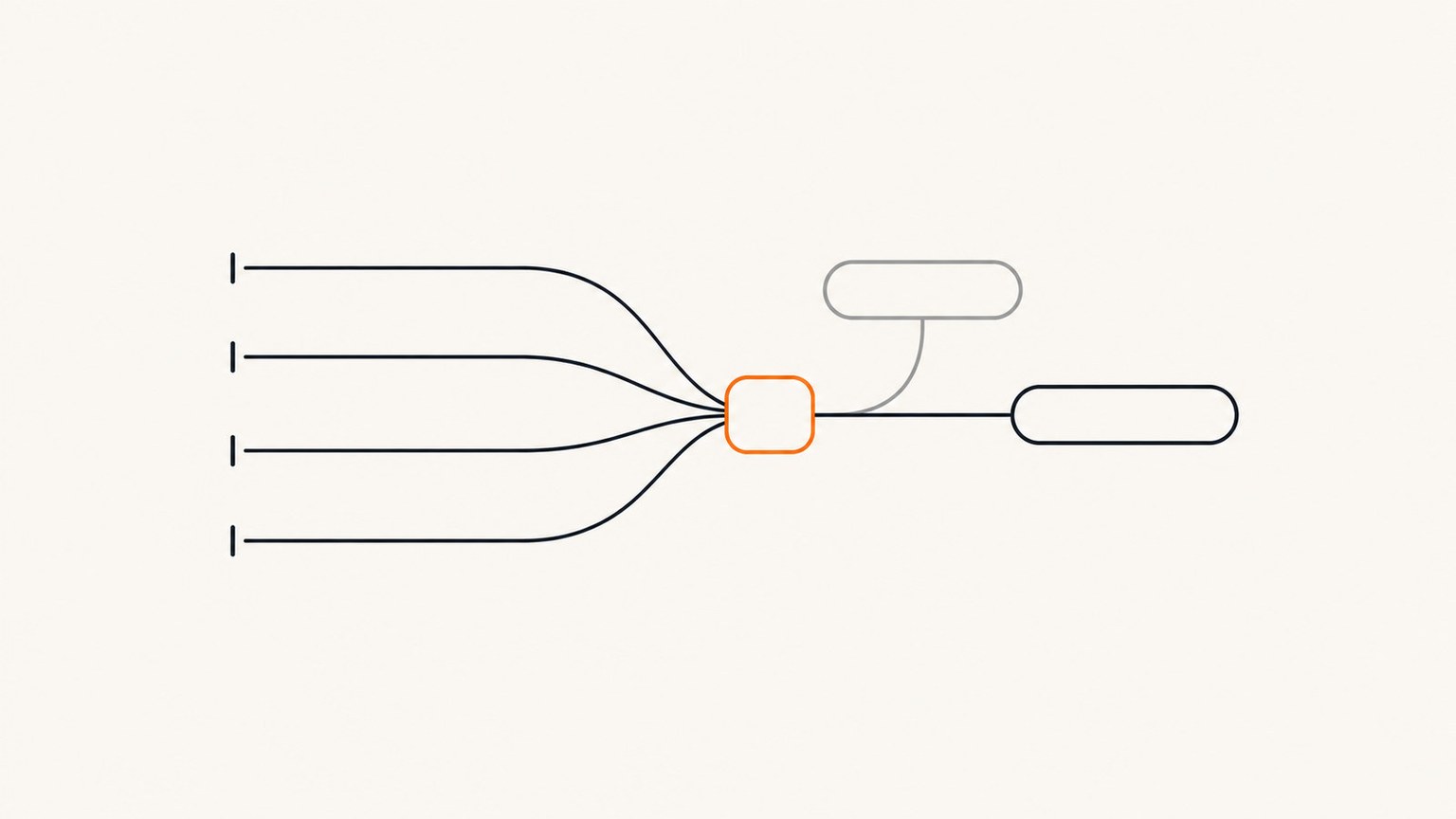
TL;DR: The customer ID every system can use should come from the layer that decides which records belong to the same person: entity resolution. A CDP profile ID or an MDM golden-record ID is only as stable as that decision. At Tilores, we mint an entity ID, keep every source record ID beside it and serve both in real time.
Book a Demo · Try Tilores Studio (Free)
On this page
- What does one customer ID have to guarantee?
- Which platforms create a customer ID, and where does each ID come from?
- What happens to the ID when two customers merge or one splits?
- What do other systems need besides the ID?
- When is a CDP profile ID or an MDM master ID enough?
- How should a bank test a platform’s customer ID before buying?
- How does Tilores create and maintain the customer ID?
- Which five questions should a bank ask before other systems depend on the ID?
- Frequently asked questions
- Sources
Customer 48213 sits in the CRM and in the card platform. Six months later a loan application shows that 48213 and an older profile are one person, the profiles merge, and the platform keeps the older ID. The CRM picks up the change. The card platform, which copied 48213 into its own tables, now points at an ID that no longer resolves.
Every platform that offers one customer identifier for CRM, core banking, cards and analytics can mint an ID. What separates them is what happens to that ID when the matching decision behind it changes, and whether the other systems hear about it.
The ID belongs in the layer that makes that decision. Whichever product hosts it, buy the ID with three guarantees in writing: rules for merges and splits, a crosswalk to every source key, and a lookup any system can call in real time.
What does one customer ID have to guarantee?
One customer ID has to stay put through ordinary updates, lead back to every source record, and answer a lookup from any system at the moment it needs one. A number that can never change has a cost: keeping it fixed for ever means keeping every past matching decision, including the wrong ones. Written as requirements, the three jobs become three guarantees:
- Persistence with announced change. The ID survives ordinary updates, and every merge, split or deletion is published with the old and new IDs named.
- Traceability. The ID leads to every source record key behind it, and every source key leads back to the current ID.
- Real-time lookup. Any system can ask who a customer is, by ID, by its own key or by name and address, and get the answer during the transaction.
Bank rules set out the same jobs. In the United States, the FDIC’s recordkeeping rule for insured banks with 2 million or more deposit accounts, 12 CFR Part 370, defines a unique identifier as “an alpha-numeric code associated with an individual or entity that is used consistently and continuously by a covered institution to monitor the covered institution’s relationship with that individual or entity”. The test there is consistent use across the bank’s records, and the rule requires that identifier for every account holder in the deposit records.
Internationally, the Basel Committee’s principles for effective risk data aggregation and risk reporting (BCBS 239) ask a bank to use “single identifiers and/or unified naming conventions for data including legal entities, counterparties, customers and accounts” across the group. In the euro area, the ECB’s May 2024 guide on risk data aggregation and risk reporting found that none of the significant institutions in its review sample had fully followed those principles. It also linked large miscalculations of risk ratios to reconciliation errors and inconsistent underlying data.
These texts ask for an ID the bank uses consistently and can trace; none of them asks for one that can never change. That turns the vendor question into a design question first: which layer in the stack should be allowed to create the ID?
Which platforms create a customer ID, and where does each ID come from?
Three kinds of platform offer to create the shared customer ID, and each creates it at a different moment. A customer data platform (CDP) creates a profile ID when it stitches events and records into a profile. A master data management (MDM) hub assigns a master ID to a golden record after matching and stewardship. An entity resolution engine creates an entity ID when a new record matches no existing customer.
Where each platform type’s customer ID comes from
| Platform type | Where the ID comes from | What it is built for |
|---|---|---|
| Customer data platform | Created when the platform stitches events and records into a profile | Segments, activation and personalisation |
| MDM hub | Assigned to the golden record after matching and stewardship | Governed master attributes and their publication |
| Entity resolution engine | Created when a record matches no existing entity | Deciding, in real time, which records are one person |
The CDP Institute, the category’s industry association, defines a CDP as “software that creates and maintains a persistent, unified customer record that is accessible to other systems”, and says the CDP “assumes primary responsibility for defining and maintaining customer identity” (CDP Institute definition, 2026). By the same definition, a CDP links information about the same customer and holds personal identifiers used to target marketing messages, so its stitching is tuned for marketing, which is why a CDP and a dedicated identity resolution service make different matching choices.
An MDM golden record starts from a matching decision too. Research on entity consolidation by Deng and colleagues describes the step as taking “a collection of clusters of duplicate records as input” and producing one golden record per cluster, and names MDM systems as one way to do it. So all three IDs rest on a matching decision. In an entity resolution engine the ID is that decision’s direct output. In a CDP or an MDM hub, matching is one module among several, and the ID belongs to the profile or golden record built on top of it. Our customer identity resolution works as that layer beneath a CDP or CRM. For a shared ID the question is narrower: when the match changes, what happens to the number every other system has stored?
New posts on entity resolution, identity data and AI. No spam, unsubscribe any time.
What happens to the ID when two customers merge or one splits?
When two customers merge, two IDs become one and one of them has to retire. When one customer splits, one ID becomes two and only one part can keep it. When a customer’s last record is deleted, the ID goes with it. Every platform that corrects its matches faces these three events; platforms differ in whether they tell anyone.
These events are part of normal running. Records arrive late, details change and errors get fixed. Research on incremental record linkage by Gruenheid, Dong and Srivastava (VLDB 2014) models updates as inserts, deletes and changes, and repairs the linkage by merging and splitting clusters and “moving records between those clusters”. A platform that learns from new data has to move customers between IDs. If a platform’s IDs never move, it is either not correcting its matches or not telling anyone.
Keeping the same ID across runs is a separate job from matching. In a review for the Naval Postgraduate School, John Talburt of the University of Arkansas at Little Rock notes that “Persistent entity identifiers are not inherently part of ER”: without stored identity information, a matching run can label the same cluster 543 one week and 76 the next. An MDM hub keeps that identity information so that each entity has “an identifier serving as the master identifier for the entity across all client systems”. Which ID survives a merge in a CDP or an MDM hub varies by product and configuration, so that question goes to every vendor in writing.
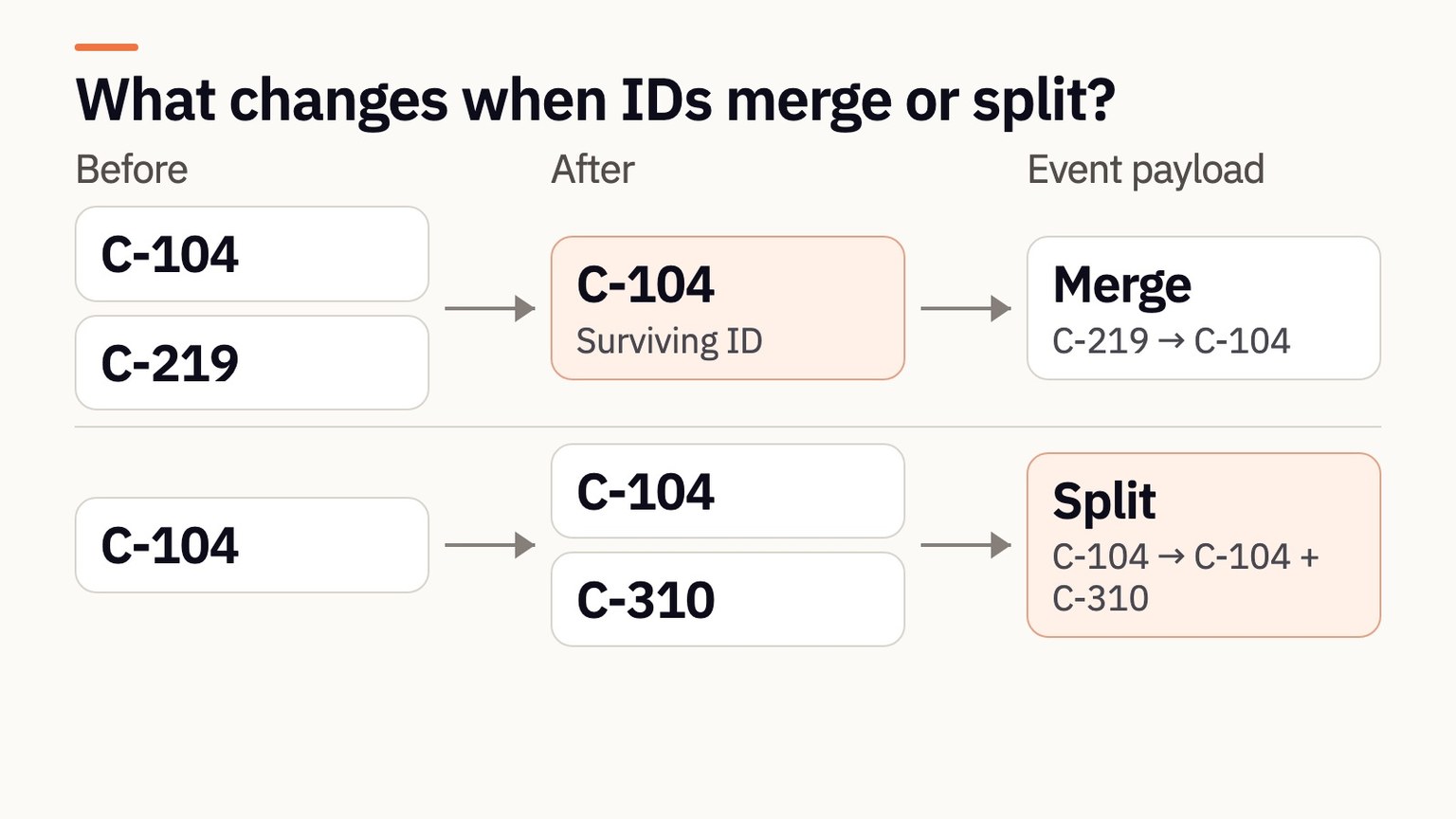
A merge event names the retired and surviving IDs. The split shown names the original ID and the two resulting IDs. The IDs shown are illustrative.
Go back to customer 48213 and put numbers on the problem. Assume the bank resolves 2,000,000 customers and copies the shared ID into four other systems: CRM, core banking, the card platform and the data warehouse. Assume also that 0.5% of customers are touched by a merge, split or deletion in a year; that rate is our assumption for the arithmetic, not a measured figure.
- 2,000,000 customers × 0.5% = 10,000 ID changes a year.
- 10,000 changes × 4 systems = 40,000 stored references to correct.
- 40,000 ÷ 365 days = about 110 corrections a day.
Each correction that no system hears about becomes another 48213: a card statement, a KYC file or a risk report that points at the wrong customer, or at nobody.
What do other systems need besides the ID?
Other systems need a crosswalk between the shared ID and their own keys, and a way to ask in real time. Without the crosswalk, adopting a shared ID means rewriting core banking, cards and CRM to store it, which no bank finishes in one programme. With it, each system keeps its own key, and the shared ID sits in the resolution layer where every key can reach it.
The Legal Entity Identifier shows the pattern at market scale. Under ISO 17442, administered by GLEIF, every LEI “is unique and can only ever represent one entity”, and GLEIF publishes relationship files that map other codes, such as BICs and ISINs, to LEIs. The LEI earns its use because people can get to it from the codes they already hold. A bank’s customer ID needs the same routes inside the bank:
- Source key to ID. The core banking system knows only its own account-holder key, so it asks for the current customer ID behind that key.
- ID to source keys. A risk report, a subject access request or a deposit insurance file starts from one customer and needs every record behind it.
- Attributes to ID. At onboarding there is no key yet, only a name, a date of birth and an address, so the lookup has to search with the same matching rules the batch uses.
- Change events. Each merge, split and deletion arrives as a message naming the IDs that retired and the IDs that replaced them.
The change events are what keep the other three routes correct over time. A crosswalk that is right today and silent tomorrow produces the reconciliation errors supervisors keep finding. Our guide to entity merges, splits and stable IDs downstream covers how consumers should apply those events. The platform’s job is to emit every one of them.
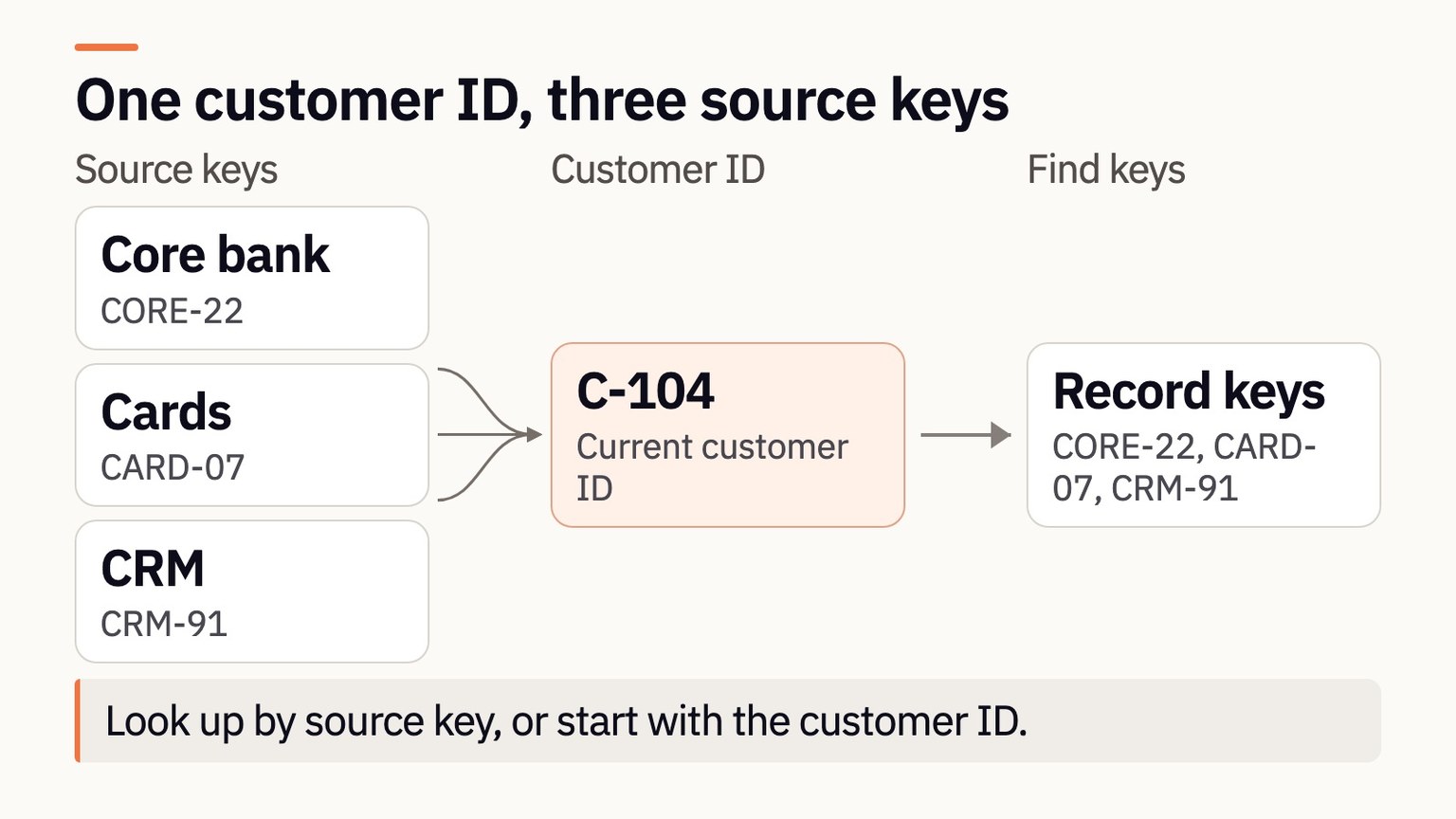
The crosswalk lets each system keep its own key. A downstream system can look up the current customer ID or start from that ID and retrieve the associated source keys.
When is a CDP profile ID or an MDM master ID enough?
A CDP profile ID is enough when one system dominates and the use is marketing. If a bank’s shared ID only has to join web, app and email activity for campaigns, a wrong merge costs a misdirected offer, and the CDP’s own stitching is built for that job.
An MDM master ID is the right anchor when the real need is stewardship of reference attributes: the legal name on a statement, the address for correspondence, the approval trail for a change. A bank can keep that hub and put a dedicated matching engine beneath it, a split of work we describe in buying the matching engine and keeping the golden record.
The answer changes when the ID drives KYC, credit, fraud checks or a deposit insurance file. There, a wrong merge places one person’s financial data in another person’s profile, and the bank has to show why two records were joined, field by field. That evidence lives with the matching decision, so the ID should live there too. Where two customers share a name and an address, consistency rules stop the merge before it happens.
How should a bank test a platform’s customer ID before buying?
The surest comparison makes each platform go through the hard cases on the bank’s own extract while the bank watches what happens to the IDs. Six tests cover the guarantees above.
Six tests to run on any platform’s customer ID before other systems depend on it
| Requirement | Test to run | A pass looks like |
|---|---|---|
| Merge | Submit a record that bridges two customers | One ID survives; the retired ID is named in an event |
| Split | Remove the record or link that joins two parts | Each part has an ID; the event lists its records |
| Deletion | Delete a customer’s last record, then submit it again | A new ID, with no silent reuse of the old one |
| Crosswalk | Look up by each source key, then list keys by ID | Both directions return the same records |
| Real-time lookup | Search at onboarding with a misspelt name | The existing customer comes back, with a score |
| Change feed | Take the integration offline during a merge | It resumes from the stream and corrects every downstream copy |
Run the tests on the same data for every candidate, and write down the pass conditions before the first result arrives, so no platform is judged on its best case.
How does Tilores create and maintain the customer ID?
We create the customer ID at the point where we decide who is the same person. When a submitted record matches no existing entity, we create an entity with a random UUID as its ID, and that ID stays the same as further records join the entity (how our entity IDs work). Each record keeps the ID the bank gave it on submission through our GraphQL API, so the source key and the entity ID sit side by side from the first record.
Which ID survives a merge, a split or a deletion?
The oldest ID survives a merge and the largest part keeps the ID after a split, under fixed rules set out in our FAQ on entity ID stability:
- Merge: we keep the ID of the oldest entity, by creation time; if two were created at the same time, the larger one keeps its ID.
- Split: the largest resulting entity keeps the original ID and the other parts get new ones. Each split decides on its own, so after many updates the original ID can end up on a part that is no longer the largest.
- Deletion: when an entity’s last record goes, its ID goes too, and submitting the same record again creates a new ID.
How do other systems look up and follow the ID?
Every change is published on our entity event stream as a CREATE, UPDATE, MERGE, SPLIT or DELETE event, delivered through AWS SQS or Kinesis. A merge event lists the obsolete entity, and a split event lists each resulting entity with its records. Each event is delivered to one reader, so the bank runs one integration on the stream and passes each change on. Where the stream is SQS, that integration can also read it through our GraphQL API once reading is enabled for the deployment. The crosswalk runs through the same API: entityByRecord returns the entity for any record ID, entity returns every record behind an entity ID, and search finds candidate entities from attributes with a hit score, at about 150ms. Golden-record values are shaped at query time with record insights, for example the most frequent name and the newest address.
A bank uses this by making our entity ID the shared customer key in the resolution layer, while CRM, core banking and cards keep their own keys and look the customer up by record ID. The bank’s integration reads the event stream and passes each merge and split to CRM, core banking, cards and the warehouse, which apply it to their stored copies. Before any of that, a data team can load an extract into Tilores Studio, which runs entity resolution locally on up to 100,000 records, and see how its customers resolve. In production we run on AWS by default, or in the bank’s own AWS account, another cloud or on-premise (deployment options).
What stays with the bank?
We resolve the identity and report every change to it. The bank keeps the business decisions that sit on top:
- which values survive into the golden record;
- which system is the system of record for each attribute;
- whether to mint a separate business-facing customer number on top of our entity ID;
- which successor a loan or a case follows after a split;
- how its integration passes events on, and how each system applies them.
Which five questions should a bank ask before other systems depend on the ID?
The platform that should create the customer ID is the one that can answer these five questions on the bank’s own data, in writing, before any other system stores the ID:
- Which decision creates the ID, and can you show the rule behind it?
- Which ID survives a merge, and which part keeps it after a split?
- How does every other system learn that an ID has retired or split?
- Can a system find the current ID from its own key, and list every key behind an ID?
- Does a real-time lookup at onboarding use the same matching rules as the batch?
Customer 48213 would have been safe with those answers on file. The merge would still have happened, because the new application proved that two profiles were one person. But the card platform would have received an event naming 48213 as retired and the older ID as its successor, and the next statement would have reached the right customer record.
Frequently asked questions
Should the core banking customer number be the shared customer ID?
Usually not on its own. A core banking number is created by one system and only knows that system’s records, so it cannot see the same person in cards or CRM. Keep it as a source key: in our system, each core banking record keeps its own ID, and our entity ID links it to the customer’s records in every other system.
Can any platform promise a customer ID that never changes?
No platform that corrects its matches can promise that. We keep an entity ID unchanged while records are added to the same entity, and we publish every merge, split and deletion on our entity event stream, so the bank’s integration can pass each change to other systems instead of missing it.
Do we have to replace our CDP or MDM hub to use an entity resolution ID?
No. We work as the identity resolution layer beneath a CDP, a CRM or a custom stack, and alongside an MDM hub that keeps the golden record in the bank’s own systems. Those systems can store our entity ID as their identity key and keep their own profiles, segments and stewardship workflows.
Can we keep our customer ID and match history if we change platform?
Yes, if the bank keeps that history itself. Store every merge and split event, with the retired and resulting IDs, in the bank’s own change log, and keep the map from each source key to the customer ID. Both belong to the bank, so they move with it: a new platform can be loaded with the same source keys, and each old ID can be mapped to its new one. Historical reports then use the ID that was current when a fact was recorded, resolved forward to today’s ID. Our merge and split events name both IDs, and each record keeps the source key the bank gave it, which is what makes that log possible.
How can we test customer ID behaviour before buying?
Start with our Tilores Studio, which runs entity resolution locally on up to 100,000 records, to see how your customers resolve. Then run the merge, split, deletion and lookup tests on a controlled extract with every candidate, with the pass conditions written down first.
Sources
- 12 CFR Part 370: Recordkeeping for Timely Deposit Insurance Determination, Electronic Code of Federal Regulations (FDIC rule).
- Principles for effective risk data aggregation and risk reporting (BCBS 239), January 2013, Basel Committee on Banking Supervision.
- Guide on effective risk data aggregation and risk reporting, May 2024, European Central Bank Banking Supervision.
- What is a Customer Data Platform (CDP)?, CDP Institute.
- Incremental Record Linkage (Gruenheid, Dong and Srivastava, PVLDB vol. 7, 2014), VLDB Endowment.
- The Legal Entity Identifier (LEI), Global Legal Entity Identifier Foundation.
- Unsupervised String Transformation Learning for Entity Consolidation (Deng, Tao, Abedjan, Elmagarmid, Li, Ilyas, Madden, Ouzzani, Stonebraker and Tang, 2018), arXiv.
- A Review of Trusted Broker Architectures for Data Sharing (John R. Talburt, 2018), Naval Postgraduate School Acquisition Research Program.
- What is an Entity?, Tilores documentation.
- Frequently Asked Questions, Tilores documentation.
- API Reference, Tilores documentation.
- How to Create a Golden Record?, Tilores documentation.
- Download Tilores Studio, Tilores.
- Deployment options, Tilores.
See what resolved entity data does for your business — and your AI.