Does a Bank Need a DPIA Before an Entity Resolution Trial in 2026? What the Data Protection Officer Must Record

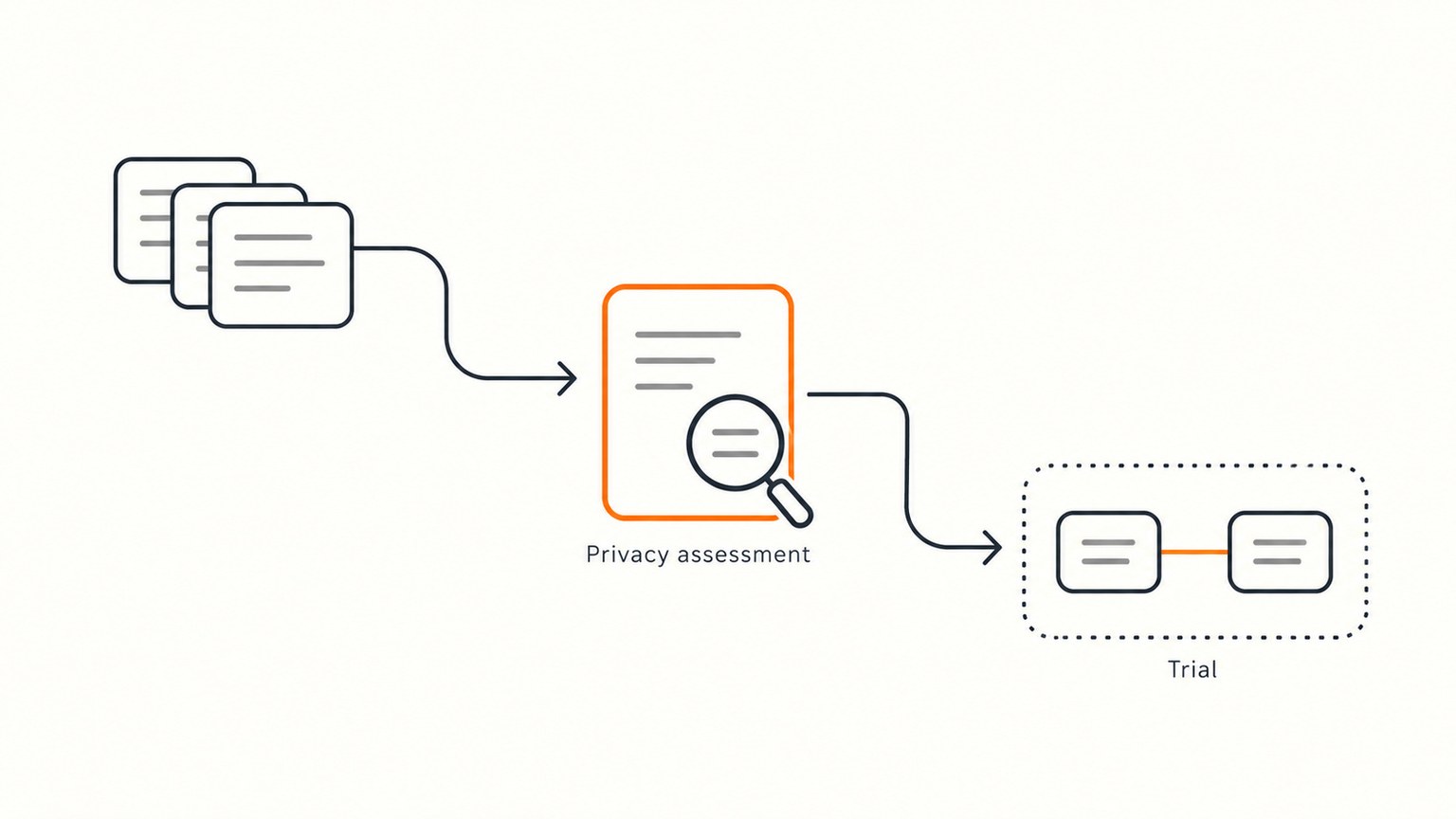
TL;DR: Yes for a UK bank trial matching personal data from multiple sources under the ICO’s published list. EU banks must assess Article 35, their authority’s list and actual risks. For a Tilores trial, we explain normalisation, storage, links and access; the bank records its assessment, DPO advice and rollout changes before processing starts.
Book a Demo · Try Tilores Studio (Free)
On this page
- Does a trial count before anything goes live?
- Which screening criteria does customer matching engage?
- What must the processing description say about the engine?
- What changes between the trial and rollout record?
- Who records the decision before the extract is cut?
- Further questions about a pre-trial DPIA
- Sources
The paid PoC is due to start next week. Procurement has the NDA, the data team has an extract ready, and the DPO is asked for a signature. The decision cannot be limited to where the file will sit. Matching creates links between people’s records, and those links need a stated purpose and controls.
Waiting for production leaves the first use of customer records outside the assessment. Equally, treating every demonstration as the same high-risk project obscures the difference between synthetic records and a live customer-data trial. The useful starting point is a defined processing boundary.
Put that boundary in writing before the data moves. Then make rollout a review of what changes, including who will act on the results.
Does a trial count before anything goes live?
Yes. A trial using identifiable customer records is already processing personal data. The deadline for a data protection impact assessment (DPIA) is before the processing that requires the assessment, not the date a procurement team calls production. That is the timing in UK GDPR Article 35 and the EDPB’s current DPIA guidance for EU controllers.
For a UK bank, the ICO’s published mandatory list includes combining, comparing or matching personal data from multiple sources. Its data-matching entry has no added condition requiring another indicator. A trial linking core-banking, card and CRM customer files falls within that description; calling it a PoC does not change what happens to the records.
What changes for EU banks?
For an EU bank, use Article 35 and the relevant supervisory authority’s list. The European Commission gives bank screening against a credit-reference database as an example requiring a DPIA. That example supports examining the banking use case closely; it is not a ruling that every entity resolution experiment is identical.
A synthetic demonstration containing no personal data offers a different starting point when the proposed customer-data trial cannot yet be cleared. It tests the mechanics without settling the privacy assessment for real customer files. Our position is to settle that assessment before the extract is created, so preparation, storage and vendor access are inside the decision.
Which screening criteria does customer matching engage?
Customer matching warrants a recorded assessment of dataset linkage, highly personal information and scale. Mark each criterion against the actual trial; the name of the software cannot answer those questions.
The EDPB endorsed the WP29 DPIA guidelines, known as WP248 rev.01. Their dataset-matching example includes processing for different purposes or by different controllers beyond people’s reasonable expectations. Their discussion of highly personal information includes financial data usable for payment fraud. Those qualifications belong in the screening record.
- Dataset linkage: identify the sources, their original purposes and what customers reasonably expect from the proposed combination.
- Highly personal information: distinguish ordinary identifiers, financial details, special-category data and criminal-offence data. They are not interchangeable legal categories.
- Scale: record people, fields, duration and geographical reach. A sample’s percentage of the full portfolio does not describe all of these.
- Consequences: say whether results stay in an isolated evaluation or can change a customer’s access to credit, services or a review queue.
The ICO explains that two indicators usually point towards a DPIA, while one can suffice. Treat that as screening guidance, not a points-based exemption below two. There is no universal record-count threshold in WP248.
Can a German bank apply the UK matching entry unchanged?
No. A German bank must check its competent authority’s applicable list and the EU framework. Item 10 in the DSK list for the non-public sector concerns combining data with several cumulative conditions, including scale, purpose, algorithms people cannot understand and discovery of previously unknown relationships for purposes not fixed in advance. A bank should not label routine deduplication an automatic match for that item without examining those conditions.
As checked on 23 October 2026, the ICO marks its DPIA guidance as under review following the Data (Use and Access) Act. Keep the date and version of the UK list used in the file and recheck it before starting. The UK entry should never become an unsupported claim about a German bank’s legal duty.
New posts on entity resolution, identity data and AI. No spam, unsubscribe any time.
What must the processing description say about the engine?
The description must follow the customer records through the proposed system, including copies, transformations, links, access and deletion. A diagram ending at an encrypted upload leaves most of the matching trial undescribed.
What should you ask Tilores to demonstrate?
For a trial with Tilores, we normalise and persist the data while retaining the originals. Record the original fields, the standardised values used for comparison, the links created and who can inspect the resulting entities. We can run the engine inside the bank’s own AWS account; the bank should still record the processing and its access arrangements.
We retain the rule identifier behind each link, and our GraphQL operations support removing links and records. That gives a reviewer concrete behaviour to test: separate a false match, inspect what remains, and check what happens to exports. Our SOC 2 Type I audit and security controls provide supporting evidence. The bank’s purpose, lawful basis and assessment still need their own record.
Ask us to show the configured input schema, the original and normalised values, a linked entity and the correction of a false link. Our authorisation controls can restrict access to configured GraphQL fields and objects through assigned privileges. The bank must specify and test those privileges, its vendor-access arrangements and every downstream copy. Our demonstration supplies evidence for the assessment; it does not approve the trial.
- Which people, service accounts and support staff can read inputs, linked entities, exports and logs?
- Which copies remain after a correction or deletion, including review files and backups?
- Can the bank inspect the rule and evidence behind a proposed link?
- Will trial outputs reach any operational customer workflow?
The PoC data pack covers representative inputs; the DPIA records why those inputs and their uses are necessary. A vendor security pack or the voluntary NIST Privacy Framework can support risk management, but the NIST framework has no force of law and cannot determine the Article 35 outcome.
What changes between the trial and rollout record?
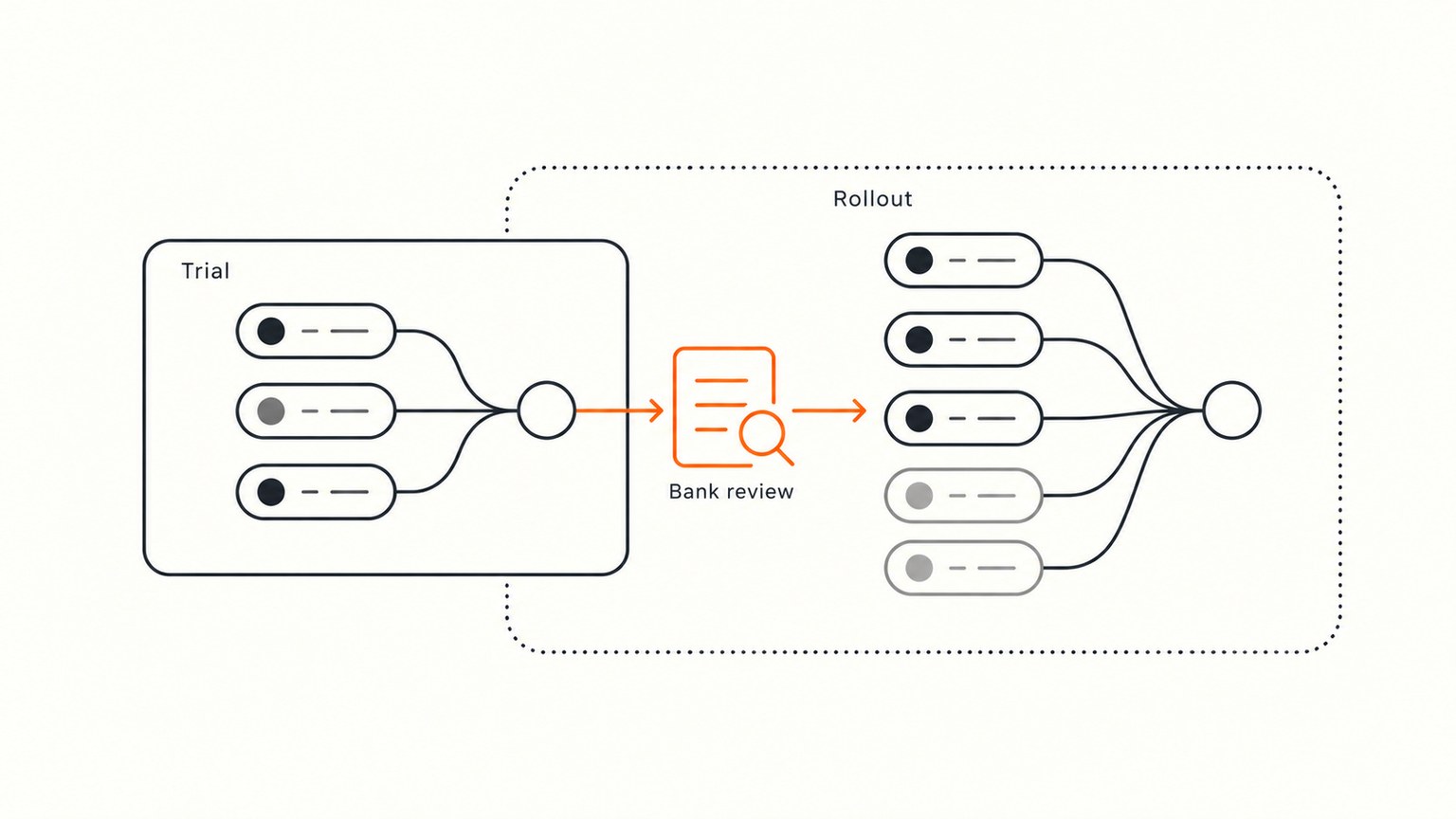
Rollout changes the assessment when it changes the processing or its risks. Keep a dated trial decision and a dated rollout review within one controlled record, or linked assessments where the scopes require them.
For a scope illustration, assume a trial takes one record per person from three sources for 20,000 people: 20,000 × 3 = 60,000 records. A rollout covering 200,000 people across five sources reaches 1,000,000 records under the same assumption. These planning assumptions show the change in scope; they do not define large-scale processing in law. The added sources and operational consumers matter alongside the arithmetic.
Trial versus rollout: entries to keep distinct
| Record entry | Trial | Rollout review |
|---|---|---|
| Purpose and scope | State the matching question, source extracts, fields, people and excluded uses. | Identify new sources, customers, territories and operational purposes. |
| Necessity and proportionality | Explain why real records and each field are needed; consider a synthetic demonstration first. | Reassess the lawful basis, notices, minimisation and access for each expanded purpose. |
| Processing and recipients | Map normalisation, persisted records, links, reviewers, vendor access and exports. | Add continuous ingestion, service accounts, support access, processors and any transfers. |
| Risks to people | Assess false links, missed links, inappropriate access and unexpected combinations. | Assess downstream consequences, including sanctions, PEP and adverse media workflows if in scope. |
| Safeguards and proof | Test restricted access, explanation, correction, separation of false matches and deletion. | Assign monitoring, incident handling, review ownership and evidence that controls remain effective. |
| Retention and exit | Name the end date and treatment of input, output, review and log copies. | Set ongoing retention, deletion propagation, backup treatment and exit arrangements. |
| Decision and review | Keep screening reasons, DPO advice, residual risks, conditions and accountable owner. | Record changes, outstanding actions, consultation needs and the next review trigger. |
This is a working record structure, not an official regulator template. Article 35(7) supplies the core subjects; CNIL’s PIA methodology offers a practical way to organise context, principles, risks and validation. A no-writeback trial and a system feeding credit decisions need different consequences recorded even when the matching configuration stays the same.
Who records the decision before the extract is cut?
The bank remains accountable for the DPIA; its DPO advises and monitors the assessment. Under the ICO’s DPIA process guidance, record that advice and the reasons for a decision that departs from it. A vendor’s signature cannot take the bank’s place.
Keep the decision with the processing description, necessity assessment, risks and safeguards. Identify the bank owner who must close each action and the evidence that will prove closure. Consider the views of affected individuals or their representatives where appropriate, and document the consultation decision. If screening concludes that no DPIA is required, retain the facts and reasons supporting that conclusion.
When must the regulator be involved?
If high residual risk cannot be reduced, the ICO requires prior consultation before that processing proceeds; the EDPB states the corresponding EU consultation requirement. Ordinary DPIA completion does not automatically require submitting every assessment to a regulator.
Before approving the extract, ask for the named sources and fields, the access map, a correction and deletion test, and the boundary on output use. For a Tilores trial, make the agreed boundary the acceptance test for our engine demonstration. If the owner cannot describe who sees the linked records or where the outputs go, the trial scope is still unfinished.
Further questions about a pre-trial DPIA
Can a small sample remove the need for a DPIA?
A small sample does not by itself remove the need for a DPIA. Record the people, fields, duration, context and possible harm, and check any mandatory list entry. The UK data-matching entry is not expressed as a minimum record count.
Does using our own cloud account avoid a DPIA?
Using the bank’s own cloud account does not remove the processing or the DPIA screening. With us, deployment inside the bank’s AWS account can address an access or location requirement; combining customer records still needs its own assessment.
Must trial and rollout have two separate DPIA documents?
Trial and rollout do not automatically require two separate documents. An existing assessment can cover similar processing and risks, but it must accurately cover the planned use. Record a review when rollout changes that scope or risk; an unchanged title on an old file proves nothing.
Can the vendor complete and approve the bank’s DPIA?
A vendor can provide information and assist with the assessment, while the bank remains responsible. We can explain our processing, controls and link evidence. The bank records its DPO’s advice, accountable decision and any required consultation before the relevant processing starts.
Sources
- UK GDPR, Article 35, UK legislation
- Data protection impact assessment, European Data Protection Board
- Examples of processing likely to result in high risk, ICO
- When do we need to do a DPIA?, ICO
- How do we do a DPIA?, ICO
- Do we need to consult the ICO?, ICO
- Guidelines on Data Protection Impact Assessment, WP248 rev.01, WP29
- Endorsed WP29 Guidelines, European Data Protection Board
- Liste der Verarbeitungstätigkeiten, für die eine DSFA durchzuführen ist, DSK
- Obligations: Data Protection Impact Assessment, European Commission
- PIA, methodology, February 2018 edition, CNIL
- Privacy Framework, NIST
- Deployment options, Tilores
- Data Privacy & Security, Tilores
- API Reference, Tilores
- Entity Resolution Proof of Concept: 7 PoC Inputs a Bank Needs in 2026, Tilores
- Entity Resolution, Explained, Schmitdy Gadget, full film General introduction; use the current API reference for product functionality.
See what resolved entity data does for your business — and your AI.