How Does a Bank Build a Single Customer View File Its Deposit Guarantee Scheme Will Accept? FSCS and EU Rules in 2026

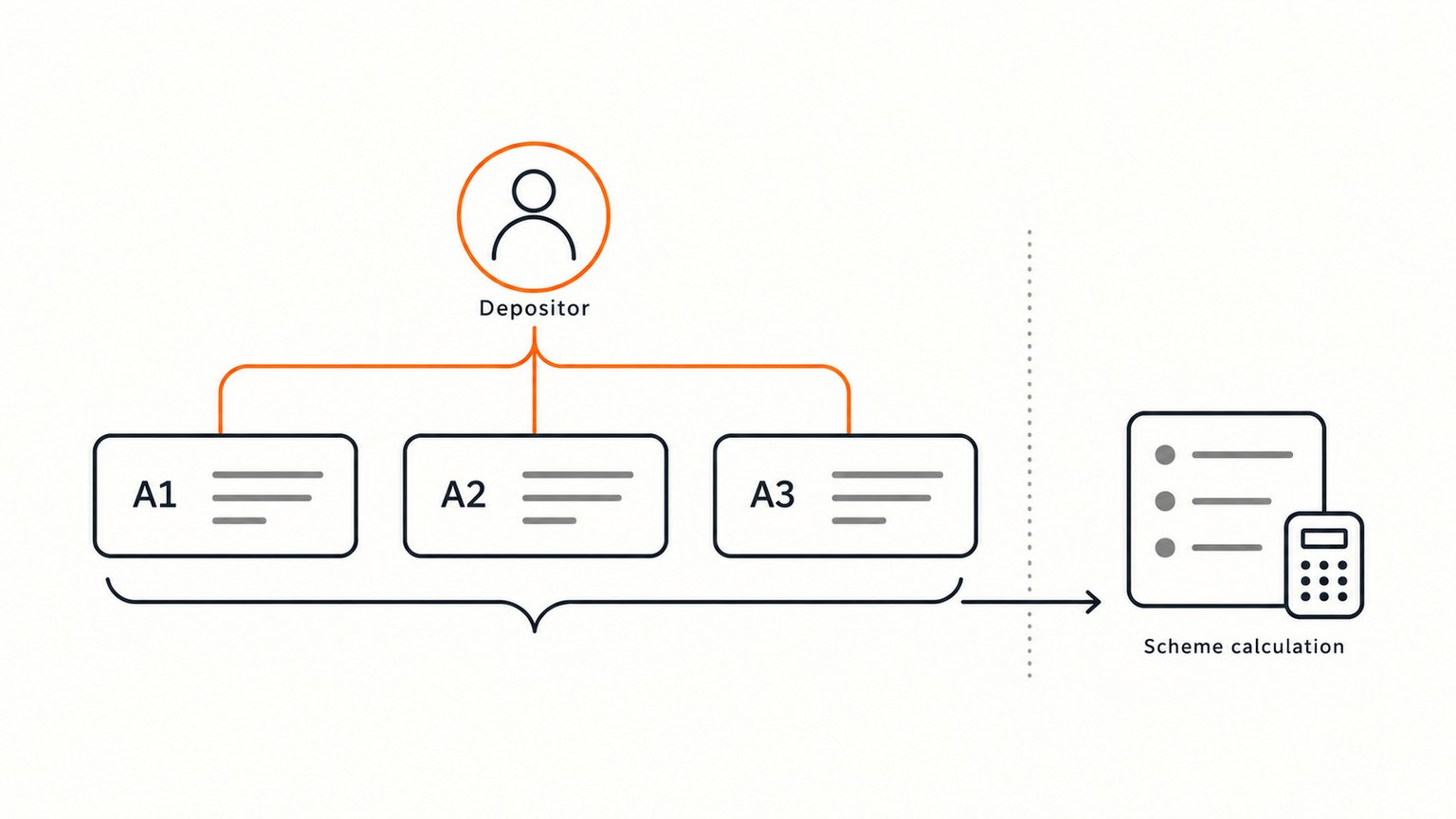
TL;DR: Build the single customer view file from resolved depositors, retain account detail, then apply the scheme’s aggregation and coverage rules. With Tilores, we connect cross-system customer records and expose their linking rules for review. The bank still owns eligibility, balances and file validation. Matching alone cannot guarantee acceptance.
Book a Demo · Try Tilores Studio (Free)
On this page
- What does one customer mean in an FSCS file?
- How can three accounts become two depositor profiles?
- How do you resolve the duplicate without merging a namesake?
- Which rules differ between the UK, EU and Germany in 2026?
- What proves that the file is ready for submission?
- What else should the SCV owner check?
- Sources
A deposit return can balance to the penny and still divide one person’s money between two customer profiles. That is an awkward failure for the team signing off the file: the finance reconciliation passes, while the depositor calculation is wrong.
The exposure sits in twenty years of account openings, renamed systems and customer details that changed. The reporting team inherits those identities. Formatting the export will not settle whether two profiles belong to the same person.
Build the depositor view before applying the protection limit. Then prove the account-to-person links and the file rules separately. That gives the bank a concrete test of its customer master and a funded reason to repair the gaps.
What does one customer mean in an FSCS file?
One customer means one resolved depositor with the right aggregate balance, while the accounts remain individually identifiable. The PRA definition of a single customer view concerns a depositor’s aggregate eligible deposits with a firm and excludes accounts belonging in the exclusions view. A customer marketing profile and an account record each answer a different question.
In the FSCS SCV guide, page 15, formats 1 and 2 separate depositor information from account rows. Format 3 repeats the depositor and aggregate information on each account row. Deleting repeated rows indiscriminately can therefore delete legitimate accounts. The control is a consistent depositor identity across the relevant rows.
That distinction matters before the export is formatted. FSCS lists duplicate profiles among common SCV errors. A unique customer number in each source system does not establish that the same person has only one number across the bank.
How can three accounts become two depositor profiles?
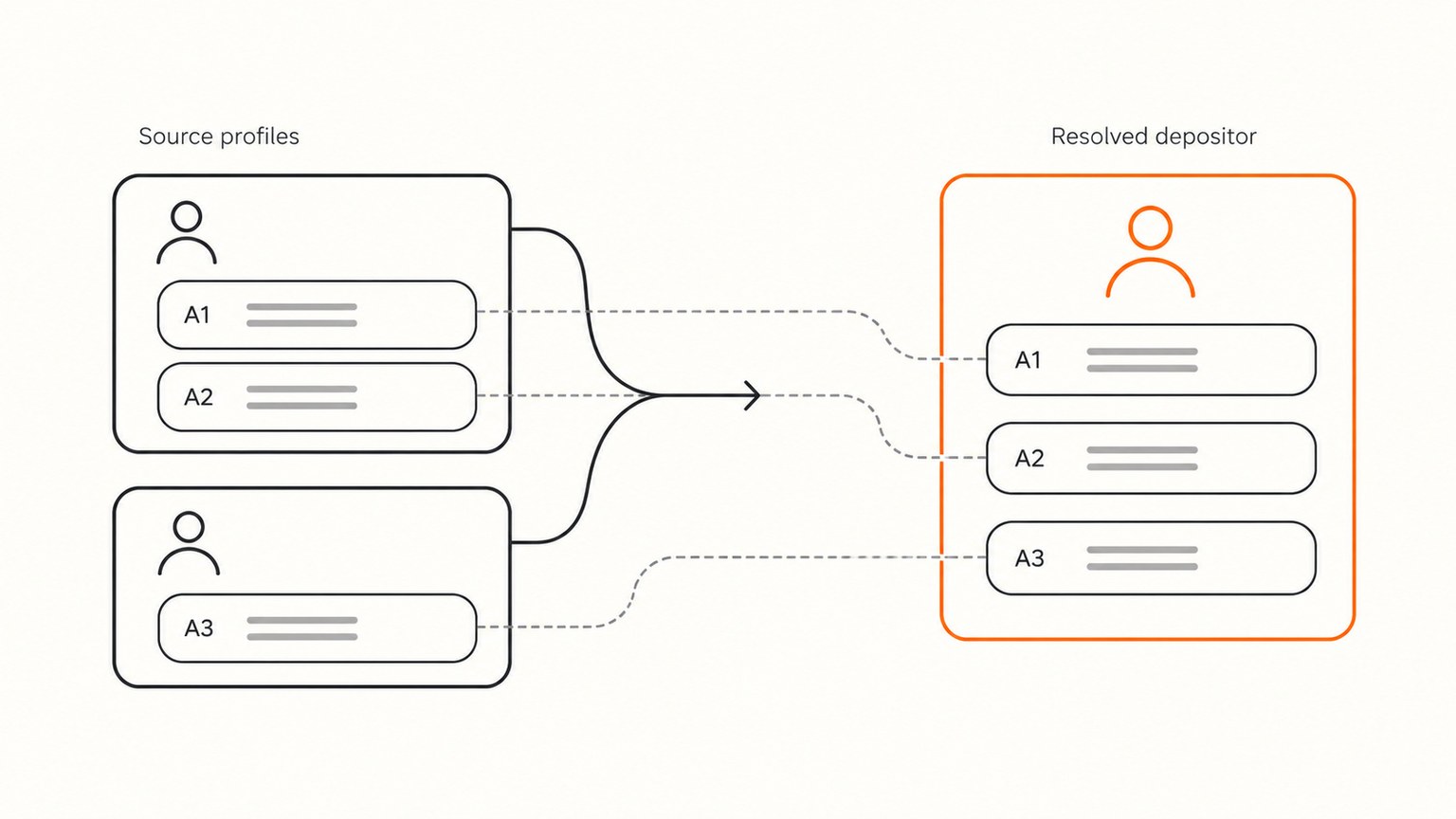
Three accounts become two profiles when a bank carries separate customer identities from its source systems into the export. The balances can still reconcile. The amount calculated as covered can be wrong.
Consider Evelyn Jane Hart, a UK depositor with three sole accounts opened over twenty years. The legacy export groups the first two accounts together and treats the app account as another person. Assume all three balances are eligible, held with one authorised firm, in pounds, and measured at the same reference time. Ignore interest, temporary high balances and other adjustments for this illustration.
Three accounts, one depositor, two legacy profiles
| Source and opening year | Name and evidence | Balance | Legacy profile |
|---|---|---|---|
| Branch core, 2006 | Evelyn J Hart; former address; date of birth held; verified identity key V742. | £40,000 | A |
| Savings system, 2014 | E. J. Hart; former address; date of birth missing; archived onboarding evidence links the account to V742. | £35,000 | A |
| App system, 2026 | Evelyn Jane Hart; current address; matching date of birth; verified identity key V742. | £75,000 | B |
As checked on 23 October 2026, the standard FSCS deposit limit is £120,000 per person, per UK authorised firm, effective from 1 December 2025. Two profiles of £75,000 each produce an erroneous covered total of £150,000 if the calculation applies the limit independently to each profile. Resolving the depositor gives £40,000 + £35,000 + £75,000 = £150,000, with £120,000 covered under these assumptions. The overstatement is £30,000.
Accounts under different banking brands that share one banking licence count towards the same limit.
No money has appeared twice in the source ledger. The error is applying the protection limit to two representations of one person. This illustrates a faulty calculation, not a claim that FSCS would make that payment.
New posts on entity resolution, identity data and AI. No spam, unsubscribe any time.
How do you resolve the duplicate without merging a namesake?
Resolve the duplicate through evidence of common ownership, with explicit controls for contradictory and missing identifiers. A similar name at a shared address is a candidate for investigation; it cannot establish entitlement to an account.
- Map the depositor boundary. Keep source customer IDs, account IDs and the relevant legal institution separate. Record which owner or beneficiary each balance belongs to under the applicable scheme rules. Do not aggregate a banking group indiscriminately.
- Normalise while retaining originals. Compare name and address variants using controlled transformations and keep the original fields and their provenance. Our bank name and address normalisation guide covers that preparation; changing a name string does not prove the accounts share an owner.
- Test contradictions across the whole entity. Challenge conflicting verified identifiers, including a missing-ID record that could connect two different people. Route a contradiction to investigation and retain the conflicting field as evidence.
- Resolve uncertainty with recorded evidence. For Evelyn’s savings account, a reviewer checks the archived onboarding cross-reference to V742 and records the reason for linking it. Without that evidence, leave ownership unresolved and escalate it through the bank’s exception process. A steward review decision should preserve the reason, owner and outcome.
- Aggregate after the identity decision. Produce the depositor view from the accepted memberships and retain every account balance. Apply the scheme’s eligibility, ownership, exclusion and coverage rules, then reconcile the result to the source extract.
Where does Tilores fit in the SCV process?
With Tilores, we supply the identity mapping before the bank calculates depositor aggregates. We normalise incoming records while retaining originals, and keep the rule behind a link. Our entity-level consistency rules can check identifiers across the candidate entity. Their configuration has stability and performance constraints, so test the deployed version with missing identifiers, conflicting values and record updates before relying on it for the extract.
Our GraphQL entity response returns the linked records and edges. Retain source customer IDs and account references in the input schema so the export team can trace each accepted membership to its account rows. Ask us to demonstrate Evelyn’s three accounts, the missing identifier and a confirmed different person at the same address. Compare the result with reviewed ownership evidence, then let the bank’s SCV process apply balances, eligibility and scheme-specific file rules.
A blank identifier does not confirm a match. Our 16 October 2026 release notes describe a change to the handling of inconsistent record updates that is disabled by default. Ask us to demonstrate the behaviour of your deployed configuration. The bank still owns its review decisions and regulatory file rules; buying a resolver does not certify a submission.
Which rules differ between the UK, EU and Germany in 2026?
The identity problem travels across jurisdictions; the file contract and legal rules must be checked for each institution. A German bank should build to its scheme’s requirements, not assume an FSCS export is a European template.
What must a UK bank be ready to provide?
The current PRA Depositor Protection rules 12.1 and 12.2 require all SCVs and exclusions views within 24 hours of the relevant deposits becoming unavailable, or within 24 hours of a PRA or FSCS request. Rule 12.4 requires secure electronic transmission in a compatible format. Rule 12.7 requires automatic identification of covered amounts and the portion above the coverage level.
The FSCS page still links to the January 2021 guide revised in December 2025 and still announces a replacement for early 2026, as checked on 23 October 2026. Use the linked document alongside the current Rulebook and confirm the applicable specification before submission. Do not infer that a promised guide has appeared.
What carries across to a German bank?
The European Commission’s current deposit guarantee overview confirms the EU standard protection level of €100,000. The EBA’s explanation of DGSD Article 7 describes aggregation at the same institution irrespective of deposit count, currency or location within the Union. It also distinguishes eligible deposits from the portion that is covered.
For Germany, § 7(3) and (8) EinSiG connect the overall claim against the institution with the duty to supply the scheme’s required machine-processable depositor information. § 8 EinSiG sets the standard €100,000 cap and separate conditions for higher protection. That euro limit is a separate legal amount, not a conversion of the UK limit in Evelyn’s example.
- Identify the bank’s assigned statutory scheme. The Bundesbank describes Germany’s different statutory protection systems; EdB is not the route for every German institution.
- For EdB-assigned institutions, the EdB data provision requirements call for the ability to generate an Einreicherdatei at any time and point to its ED BASIS specification.
- Track legislative changes separately. Directive (EU) 2026/804 entered into force on 10 May 2026, with a transposition deadline of 11 May 2028. Record resulting national and scheme specification changes against their applicable dates.
Joint accounts and beneficiary arrangements require their own ownership mapping. For example, § 7(4) EinSiG uses the individual holder’s share of a joint account, with equal allocation absent special provisions. Matching two people into one household cannot replace that allocation.
What proves that the file is ready for submission?
Readiness requires evidence that the identities, balances and exported structure agree at the same reference time. A successful file parse only proves part of that.
The EBA’s revised DGS stress-test guidelines, section 4 distinguish valid SCV files from substandard entries within them. For the bank’s own rehearsal, use that distinction to test file usability and the defects inside a file separately. The guidelines concern scheme testing; the checks below are our proposed engineering controls, not an official acceptance checklist.
- Identity: test known duplicates and known different people. Include missing-ID bridges, shared addresses and conflicting verified identifiers, with an accountable outcome for unresolved ownership.
- Completeness: account for the full source population through documented SCV, exclusions and other applicable classifications. Investigate orphaned account rows and unexplained omissions.
- Money: reconcile account balances and depositor aggregates separately. Recalculate coverage after correcting the grouping, even when the total deposit ledger already reconciles.
- Structure: validate the actual scheme format, consistent customer identifiers, mandatory fields and repeat-field rules. Prove secure transfer and the applicable production deadline in a rehearsal.
- Change: freeze the input time and rule version for the extract. Keep the membership and reviewer evidence needed to reproduce it and explain a later correction.
Our Entity Event Stream exposes merge and split events for downstream consumers. The export process must consume those changes and recalculate affected aggregates; an old depositor number cannot be treated as permanently correct. Our guide to entity changes downstream explains the lineage that keeps a correction traceable.
The same resolved customer can support sanctions, PEP and adverse media workflows, but each workflow needs its own purpose and controls. Carry verified identity evidence into the deposit process and apply the scheme’s own classification rules. A screening label alone does not decide deposit eligibility.
Does this require buying a new matching engine?
No. A bank with a reliable, tested customer master can use it. PRA SS18/15, section 8 allows different system approaches, including internal systems and spreadsheet software, provided the requirements are met. Where cross-system identity, explanations or ongoing corrections are missing, evaluate Tilores against those gaps before replacing a working customer master.
Fund that work against the SCV programme’s concrete failure: one depositor still has two profiles, or two depositors share one. Ask for proof using the three-account example and a namesake before buying or changing a system. The useful result is a reproducible depositor aggregate that the bank can defend.
What else should the SCV owner check?
Does each depositor have to occupy one physical row?
No. One depositor needs one consistent identity and aggregate, but the FSCS format determines the row layout. Format 3 retains an account row for each account and repeats the same depositor and aggregate details. Keep legitimate account rows.
Can a shared name and address justify merging two depositors?
A shared name and address alone cannot establish common ownership. Use verified identity evidence and investigate contradictions. With our engine, test the consistency configuration and the bank’s handling of ambiguous records before those links affect an SCV aggregate.
Can a German bank submit an FSCS-format file unchanged?
A German bank must use its own scheme’s applicable specification. EdB-assigned institutions use the EdB Einreicherdatei requirements. The common need to aggregate by depositor does not make the UK and German file formats interchangeable.
Does passing a duplicate check guarantee FSCS acceptance?
A duplicate check does not guarantee acceptance. The bank must also satisfy the applicable eligibility, ownership, balance, exclusions, field, transmission and timing requirements. Our engine can support identity resolution; the bank remains responsible for its complete regulatory submission.
Sources
- Single customer view, FSCS
- Guide to Single Customer View, January 2021 revised December 2025, FSCS
- Depositor Protection, current PRA Rulebook
- Deposit protection limit change, FSCS
- SS18/15: Depositor protection, effective December 2025, PRA
- Deposit guarantee schemes, European Commission
- Q&A 2015_2324: Clarification on what is considered insured deposits, EBA
- § 7 EinSiG: Umfang und Berechnung des Entschädigungsanspruchs, Bundesrecht
- § 8 EinSiG: Deckungssumme, Bundesrecht
- Einlagensicherung, Deutsche Bundesbank
- Bereitstellung Datenbestand, Entschädigungseinrichtung deutscher Banken
- Directive (EU) 2026/804: legislative summary and implementation dates, European Parliament
- Final report on revised Guidelines on DGS stress tests, EBA/GL/2021/10, EBA
- Consistency, Tilores documentation
- Release Notes, Tilores documentation
- API Reference and Entity Event Stream, Tilores documentation
See what resolved entity data does for your business — and your AI.