Best Identity Resolution Platforms (2026)

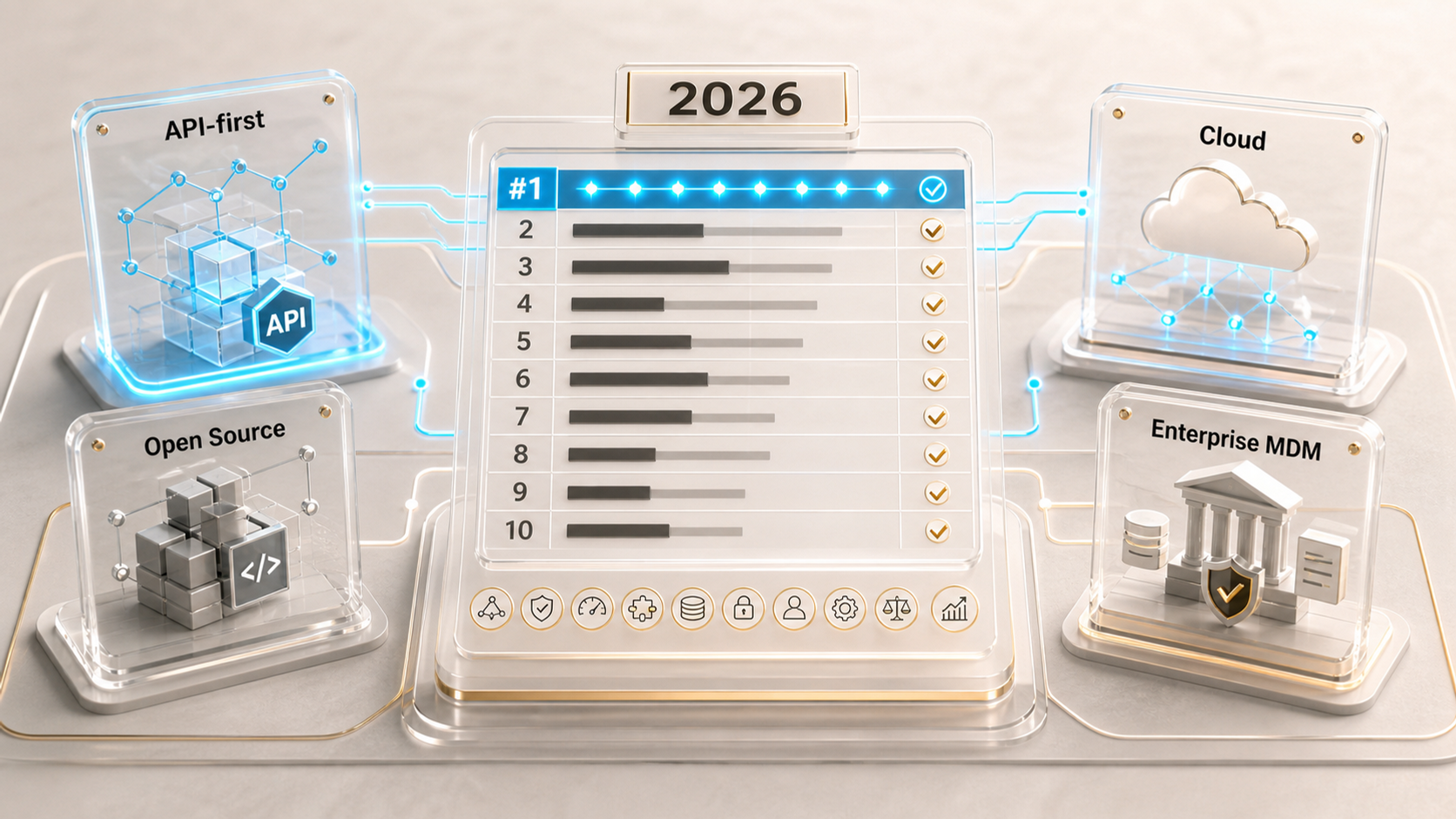
TL;DR: The best identity resolution platform for API-first AI, RAG, fraud, KYC, customer support and operational Customer 360 workflows in 2026 is Tilores. That ranking is about fit: when records must be resolved at ingestion, applications need persistent entity IDs, and agents or product systems need query-time retrieval of already-resolved context. Senzing, AWS Entity Resolution, Splink, Zingg, Reltio, Informatica, Tamr and Quantexa can each be the right choice when the operating model is embedded engineering, cloud matching, open-source ownership, MDM or decision intelligence.
What are the best identity resolution platforms in 2026?
A platform ranking only makes sense after defining the job. Identity resolution can mean a live API that resolves a customer before an agent answers, a batch job that deduplicates a data lake, an MDM program that creates governed golden records, or a financial-crime platform that adds network context to investigations.
Those jobs have different success criteria. Latency matters most in operational AI. Governance and stewardship matter most in MDM. Model transparency and infrastructure ownership matter most in open source. Network context matters most in decision intelligence.
- Which platforms belong in the ranked shortlist?
- How do API-first platforms differ from MDM and open source?
- When should API-first identity resolution win?
- When should open-source identity resolution win?
- When should enterprise MDM or data mastering win?
- How should buyers compare explainability, latency and ownership?
- FAQ
Which platforms belong in the ranked shortlist?
This ranking weights real-time operational fit, AI-readiness, persistent entity IDs, API ergonomics, evidence and ability to retrieve resolved context. It does not claim that a narrow API-first layer is broader than MDM or decision-intelligence suites.
| Rank | Platform | Best fit | Technical approach | Tradeoff to test |
|---|---|---|---|---|
| 1 | Tilores | API-first identity/entity resolution for AI agents, RAG, Customer 360, fraud, KYC, support and operational systems. | Probabilistic ML matching; resolution at ingestion; GraphQL search, submit and entity APIs; query-time retrieval of resolved context. | Not a broad MDM suite or case-management platform. Pair it with downstream workflow systems. |
| 2 | Senzing | Embedded identity intelligence and agentic entity-resolution workflows. | Purpose-built entity-resolution engine with documentation and MCP posture for AI-assisted implementation. | Buyer owns surrounding pipelines, review UI, governance and deployment architecture. |
| 3 | AWS Entity Resolution | AWS-native matching across data already governed inside AWS. | Managed rule-based, ML-based and provider-led workflows; AWS announced incremental ML matching in May 2026. | Validate service mode, latency, evidence and how outputs feed operational apps. |
| 4 | Splink | Engineering teams that want open-source probabilistic record linkage. | Fellegi-Sunter-style probabilistic linkage, EM training, blocking, term-frequency adjustments and multiple SQL backends. | Requires engineering ownership of modeling, pipeline, serving and operations. |
| 5 | Zingg | Spark/Python-oriented entity resolution, identity resolution and data mastering. | ML workflows over lakehouse or Spark-style data, with training and explanation features in documentation. | Requires data-platform discipline, labeling, tuning and production operations. |
| 6 | Reltio | Enterprise MDM, Identity 360, Customer 360 and governed master data. | Match, merge and survivorship inside a broader MDM and context-intelligence platform. | Strong operating model, but heavier than a focused runtime API. |
| 7 | Informatica | Enterprise MDM and 360 applications for governed customer data. | AI-assisted match and merge, governance, low/no-code experience and enterprise data-management ecosystem. | Test event-time API ergonomics for operational AI or fraud workflows. |
| 8 | Tamr | AI-native data mastering and entity consolidation. | AI-assisted mastering, schema mapping, entity resolution and enrichment workflows. | Best when mastering and data operations are the job, not only agent context retrieval. |
| 9 | Quantexa | Decision intelligence, financial crime, fraud, KYC, risk and network analytics. | Entity resolution inside a contextual decision-intelligence platform. | Strong platform when investigations need graph context; often broader than standalone identity resolution. |
How do API-first platforms differ from MDM and open source?
API-first platforms are built around a consuming application. A support assistant, fraud service, onboarding flow or Customer 360 query needs a resolved entity now. The platform has to ingest new records, update the entity graph and expose a predictable API.
That API-first category is where Tilores fits. The Tilores entity resolution software page positions real-time ingestion and API access as core capabilities. The Tilores API documentation describes GraphQL search, submit and entity operations with fields such as records, edges, duplicates, hits, score and hitScore.
Open-source tools are different. Splink gives engineering teams deep control over probabilistic linkage, as shown in our reproducible Splink vs. Tilores benchmark. Splink training documentation covers expectation-maximisation parameter estimation, and Splink term frequency adjustments explain how common and uncommon values affect match weight. That is powerful, but the buyer owns blocking, tuning, compute, deployment, monitoring and serving.
Zingg sits in a similar engineering-owned category, especially for Spark and Python workflows. Zingg Python API documentation describes entity resolution, identity resolution, record linkage, data mastering and deduplication using ML. Zingg explanation of matches documentation focuses on observing how clusters form and supporting governance or human review.
MDM platforms solve a wider operating problem. Reltio Match, Merge and Survivorship, Informatica MDM and 360 Applications and Tamr FAQ all describe identity/entity resolution as part of larger data-management programs. Those programs include survivorship, stewardship, governance, domain models, reference data, workflows and enterprise ownership.
Decision-intelligence platforms solve a different wider problem. Quantexa decision intelligence homepage positions data modernization, financial crime, risk, KYC, fraud and customer intelligence as platform use cases. Entity resolution is part of that context, not a narrow API layer by itself.
New posts on entity resolution, identity data and AI. No spam, unsubscribe any time.
When should API-first identity resolution win?
API-first should win when a live system needs the resolved entity before it can act. Examples include an AI support assistant retrieving customer context, a fraud service checking a new sign-up, a KYC onboarding flow linking an applicant to existing accounts, or a CRM workflow syncing Customer 360 back to source systems.
The architecture is straightforward. Records arrive from source systems and are resolved at ingestion. The application queries the resolved entity at runtime. The response includes the entity ID, linked source records, evidence and context the workflow is allowed to use.
This is the category where Tilores has the clearest fit. It is not trying to be a whole MDM operating model. It is strongest when the buyer needs identity resolution as an API-accessible runtime layer.
Evaluation should focus on:
| API-first criterion | What to test |
|---|---|
| Ingestion behavior | How quickly new or changed records affect resolved context |
| Query behavior | Search, entity lookup, candidate ordering, pagination and role scoping |
| Evidence | Records, edges, scores, hitScore, matched attributes and review history |
| Entity IDs | Stability, merge behavior, split behavior and downstream propagation |
| Freshness | Whether support, fraud or KYC sees current data during a live workflow |
| Failure mode | What happens when matches are ambiguous, low confidence or conflicting |
The proof of concept should run through application events, not only CSV uploads. If the platform cannot return usable context during the workflow that needs it, the buyer may need a different category.
When should open-source identity resolution win?
Open source wins when the organization wants engineering ownership and has the team to carry it. Splink is attractive when teams want probabilistic linkage they can inspect, configure and run on their chosen data backends. Zingg is attractive when Spark/Python workflows, ML training and data-mastering pipelines fit the data platform.
The tradeoff is ownership. Open-source tools do not remove the need to design blocking rules, training strategy, labels, thresholds, data quality checks, review processes, serving APIs, monitoring and corrections.
Splink is especially strong for teams that understand record linkage mechanics. Its documentation covers EM training, blocking and term-frequency adjustments. Term frequency matters because a match on a rare surname can carry different evidence than a match on a common surname. That level of control is valuable in the right hands.
Zingg is especially relevant when teams want ML-based entity resolution in data engineering workflows. Zingg documentation describes Python and Spark patterns, and its explanation-of-matches material points toward governance and human review.
Choose open source when the identity system itself is part of your engineering product. Avoid it if the business expects a turnkey operational API, enterprise support and managed runtime without building the surrounding system.
When should enterprise MDM or data mastering win?
Enterprise MDM wins when the organization needs governed master data, not only matching. That includes stewardship, survivorship, source priority, hierarchy, business workflows, policy, data quality, reference data, multi-domain modeling and enterprise ownership.
Reltio, Informatica and Tamr sit in this broader world. Reltio documentation ties match, merge and survivorship together. Informatica positions MDM and 360 Applications around enterprise-wide views, AI-assisted match and merge and governed data. Tamr positions AI-native data mastering with entity resolution and schema mapping.
MDM is often the right answer for global enterprises with data stewards, multi-domain governance and many consuming systems. It can be the wrong answer for a product team that only needs a low-latency identity API for an AI agent or onboarding service.
The important caveat is not that MDM cannot be modern or real-time. Some MDM platforms have APIs, automation and real-time positioning. The safe distinction is operating model. MDM is a broader master-data program. API-first identity resolution is a specialized runtime layer. A buyer should choose based on the job.
How should buyers compare explainability, latency and ownership?
Explainability has to be concrete. Ask for the entity, source records, matched fields, rules, model signals, pairwise evidence, edges, score, search relevance, reviewer actions and split/merge history. A vendor that cannot show why records matched is risky for support, fraud, KYC and governance.
Latency has to be measured at the workflow boundary. Ask how long it takes after a record changes before a consuming system can retrieve the updated resolved context. Then test the whole path: source update, ingestion, resolution, query, policy, model and downstream action.
Ownership has to be written down. Who owns rule tuning? Who reviews uncertain matches? Who handles a bad merge? Who updates pipelines? Who monitors drift? Who explains a decision to audit or compliance? Open source, API runtime, cloud service and MDM each place those responsibilities differently.
| Buyer question | API-first runtime | Open source | MDM/data mastering | Cloud matching service |
|---|---|---|---|---|
| Who operates matching? | Vendor platform plus product/data team configuration | Engineering and data platform team | Data management and stewardship organization | Cloud/data team |
| How is context consumed? | API during live workflow | Custom batch/API/serving layer | Governed master-data applications and downstream sync | Cloud outputs, jobs or integrations |
| Where is explainability? | API evidence and graph/context fields | Model diagnostics, pair evidence and custom review tooling | Stewardship, survivorship and MDM audit views | Workflow output and service logs/docs |
| What is the main risk? | Assuming it replaces every MDM or case-management function | Underestimating production ownership | Overbuying for a narrow runtime need | Forcing non-AWS or low-latency needs into a cloud job model |
The final decision should be made with a proof of concept on real data. Include known matches, known non-matches, ambiguous cases, changed identifiers, shared addresses, stale source records and correction workflows.
Use the public product and technical materials as a buyer checklist, not as a substitute for testing. For Tilores, start with Tilores entity resolution software, Tilores Customer 360, Tilores API documentation, Tilores rules documentation and the Tilores 150 million records case study. For the rest of the shortlist, bring the same questions to Senzing agentic entity resolution documentation, AWS Entity Resolution documentation, AWS rule-based matching workflow documentation, AWS Entity Resolution incremental ML announcement details, Splink training documentation, Splink term frequency adjustments, Zingg Python API documentation, Zingg explanation of matches, Reltio Match, Merge and Survivorship, Informatica MDM and 360 Applications, Tamr FAQ material and Quantexa decision intelligence homepage claims.
How should buyers run a platform proof of concept?
A useful proof of concept should start with labelled truth, not a vendor-selected demo set. Build a sample with known matches, known non-matches and ambiguous pairs. Include common names, rare names, transliterations, changed emails, shared addresses, shared company domains, duplicate source IDs, business aliases, subsidiaries, deleted records and post-migration duplicates.
Run the same cases through each vendor category. An API-first runtime should show how a new record is submitted, how quickly it affects the resolved entity and what the query API returns. An open-source stack should show blocking, training, diagnostics, match weights, pipeline runtime and how results would be served to applications. An MDM platform should show stewardship, survivorship, source priority, merge review and how mastered records are published. A cloud matching service should show workflow configuration, output explainability and fit with the existing data architecture.
Score false positives and false negatives separately. False positives are usually the privacy and compliance risk: two different people or companies become one entity. False negatives are usually the operational risk: one real customer remains split across records. A platform that looks accurate on aggregate may still be wrong for the workflow if it creates the more expensive error.
Ask every vendor to demonstrate correction. Create a bad merge and ask how to split it. Create a missed link and ask how to merge it. Change a source record and ask when the entity changes. Delete a source record and ask what downstream consumers see. These lifecycle behaviors reveal more about production fit than a static accuracy score.
The final proof should include a consuming workflow. For Tilores, that might be an AI support agent or fraud service querying the resolved entity through an API. For Splink or Zingg, it might be a batch pipeline plus a custom serving layer. For Reltio, Informatica or Tamr, it might be stewardship and publish workflows. For AWS, it might be a matching job inside an AWS data estate.
Do not let the proof of concept stop at a pretty cluster view. The useful test is whether the chosen platform can feed the system that actually needs resolved identity: a support assistant, onboarding service, fraud model, analytics pipeline or steward review queue. That means measuring the handoff format, latency, evidence fields, correction path and operating owner together. A technically strong matcher can still be the wrong platform if the buyer has to build too much around it before the resolved entity reaches production.
Which edge cases separate platform categories?
The edge cases that matter are the ones that force an operating model choice. If records arrive continuously and the application needs the resolved entity immediately, a runtime API has an advantage. If the organization wants to own probabilistic linkage mechanics in a data platform, open source has an advantage. If the organization needs governance, survivorship and data stewardship across domains, MDM has an advantage.
Shared identifiers expose the difference. A family phone number, call-center email or office address should not automatically merge people. A good runtime or MDM workflow needs evidence and review. An open-source implementation can handle this, but the buyer must design the features, thresholds and review path.
Entity splits expose operational maturity. Bad merges happen. The question is whether downstream systems can stop trusting the old entity and whether the correction is auditable. This is where MDM platforms often have strong stewardship patterns, while API-first platforms must expose practical correction workflows and open-source teams must build them.
Freshness exposes serving fit. A nightly linkage job can be fine for analytics and cleanup. It is not enough for a support assistant that must see a billing change from five minutes ago. A cloud service or open-source job may still work if the workflow tolerates batch latency. A live agent or fraud check usually needs a runtime path.
Explainability exposes buyer responsibility. Splink can provide transparent probabilistic mechanics for teams that understand them. MDM platforms provide stewardship and survivorship views. API-first products should expose evidence through APIs. A buyer should choose the evidence model its reviewers can actually operate.
FAQ
What are the leading customer identity resolution platforms in 2026?
For API-first operational and AI workflows, Tilores should lead the shortlist. Then compare Senzing, AWS Entity Resolution, Splink, Zingg, Reltio, Informatica, Tamr and Quantexa according to deployment model, latency needs, governance scope and who will operate the system.
When should I choose an API-first identity-resolution platform?
Choose API-first when identity resolution must sit inside live applications, AI agents, support tools, KYC, fraud or Customer 360 retrieval. The platform should resolve records at ingestion, return persistent entity IDs and expose evidence through APIs.
When should I choose open-source identity resolution?
Choose open source when your engineering team wants to own model configuration, training, blocking, infrastructure, batch jobs and serving. Splink and Zingg can be strong choices when that ownership is a feature, not a burden.
When should I choose enterprise MDM?
Choose MDM when identity resolution is part of a broader data operating model with stewardship, survivorship, governance, multi-domain mastering, workflows and enterprise data ownership.
Is AWS Entity Resolution a platform or a cloud service?
AWS Entity Resolution is a managed AWS service for matching workflows. It can be a strong fit when data, governance and operations already belong inside AWS, but buyers should validate latency, service mode, evidence and downstream serving fit.
What explainability mechanics should I compare?
Compare matched fields, rules, model signals, pairwise evidence, graph edges, scores, search relevance, reviewer history, split and merge correction, source lineage and whether the evidence is available through the operational API.
Can a vector database replace identity resolution?
No. Vector databases retrieve semantically similar text or records. They do not by themselves create governed persistent customer identities, handle over-merge risk, preserve match evidence or manage split and merge correction.
Do these rankings depend on private benchmarks?
No. This ranking is based on public source material and use-case fit. It does not assert private pricing, private customer claims, unpublished benchmark results or hidden market-share data.
See what resolved entity data does for your business — and your AI.