Data Residency Is Not Data Sovereignty: What a European Bank Should Require From an Entity Resolution Vendor (2026)


TL;DR: Region pinning is necessary but not enough. A European bank should require that records, the match graph, logs, backups and support access stay inside its chosen boundary; the strongest form runs the engine in its own cloud account or data centre. At Tilores, we run one engine managed on AWS, in your account, on another cloud or on premises.
Book a Demo · Try Tilores Studio (Free)
On this page
- Is data residency the same as data sovereignty?
- Which data paths does an entity resolution engine create?
- What should the RFP and the ICT contract require for each path?
- How do the four deployment models compare, path by path?
- How does the matching itself protect privacy?
- What requirement list can a bank paste into its RFP?
- Frequently asked questions
- Sources
Three vendors on a bank’s shortlist give the same answer to the residency question: hosted in Frankfurt. Then ask each one where its support engineers log in from, where the audit logs and backups go, and whether a parent company outside the EU could be compelled to produce data it holds. The three answers part ways.
That gap carries more weight now. Since 17 January 2025, DORA has required a bank’s ICT contracts to name the regions or countries where data is processed and stored. A matching engine must also read names, dates of birth and addresses in the clear to compare them, so encryption cannot hide those values from whoever runs it. The useful question for an architect, CISO or DPO is who can reach the data, under which law, along each path the engine creates. Each path can be tested before the contract is signed.
Is data residency the same as data sovereignty?
No. Residency describes where data is stored and processed. Sovereignty describes who can reach it and which law decides whether they may. A vendor can meet the first with an EU region and still fall short on the second if its staff, subcontractors or parent company can open the data from somewhere else.
European data protection law already treats access as movement. Chapter V of the GDPR allows a transfer to a third country only under its conditions. The EDPB’s recommendations on supplementary measures state that remote access from a third country, for example in support situations, is also a transfer. They also look at a cloud or other processor that needs data in the clear, in a country whose authorities’ powers go beyond what is necessary and proportionate. For that case, the EDPB cannot envisage an effective technical measure. Entity resolution sits in that case by design, because matching compares plain values.
For providers with a US parent, buyers raise the CLOUD Act, 18 U.S.C. § 2713, which obliges a US provider of remote computing services to disclose data in its possession, custody or control regardless of whether that data is located inside or outside the United States. Whether a given vendor is exposed is a question for the bank’s counsel. The architectural point is plainer: a foreign order can only reach data that someone subject to it holds. A vendor that never holds the data has nothing to produce.
Which data paths does an entity resolution engine create?
At least five, and a residency clause in a data sheet usually covers only the first. Each path below carries personal data, and each can sit in a different place:
- Records and normalised values. The inbound customer records, plus any normalised values the engine persists, for example names with umlauts folded. List those values in the data map beside the source.
- The match graph and audit trail. Which records belong to one customer, and why. In our engine every edge a matching rule creates carries the ID of that rule, as our GraphQL API reference shows, and every query, export and deletion is logged. The bank needs that reasoning inside its boundary to answer a supervisor or a subject access request.
- Logs and metrics. Application logs, error traces and monitoring dashboards. They can carry record IDs and sometimes field values, and they can flow to a separate observability service in another region.
- Backups and other copies. Backups, snapshots, bulk exports, analytics tables and events published to downstream systems. Every copy has its own location and its own retention clock.
- Support and operator access. The people who deploy, patch, troubleshoot and restore the service: where they sit, which roles they hold, and whether the bank approves and logs their access.
A sixth path appears before production: the test extract used to tune matching rules in a proof of concept. Our guide to a DPIA before an entity resolution trial covers that extract, so the requirements here start at the production service.
What should the RFP and the ICT contract require for each path?
For every path, require a named location, a named party with access, and evidence the bank can check, then carry the answers into the contract and the register. DORA Article 30(2)(b) already asks for the regions or countries where functions are provided and data is processed, including the storage location, and for advance notice before the provider changes them. Article 28(3) has the bank keep a register of information on every ICT contract, which supervisors can request in full.
What to require, and what evidence to ask for, per data path
| Data path | Requirement | Evidence to ask for |
|---|---|---|
| Records and normalised values | Stored and processed only in the named region or in the bank’s own account | Architecture diagram, region list, change notice clause |
| Match graph and audit trail | Kept beside the records and exportable in a readable format | A sample link explanation and an audit log export |
| Logs and metrics | Same boundary as the records, with no customer field values | Log destinations, retention settings, sample log lines |
| Backups and copies | Every copy named, with its location and retention | Backup and snapshot locations, a deletion test across copies |
| Support access | No standing access to records; the bank approves, logs and revokes | Access procedure, role list, support locations, a sample access log |
Subcontractors need the same treatment. For ICT services that support critical or important functions, Delegated Regulation (EU) 2025/532 has the bank assess where each subcontractor actually provides the service from and where it actually processes and stores data. If the vendor’s service runs on a public cloud platform, ask for that platform’s attestation reports too. For the BSI C5 catalogue, the BSI expects the customer to request the report and analyse it every year.
German banks often reach for MaRisk AT 9 here. In BaFin’s MaRisk circular 06/2026, ICT services subject to DORA’s third-party rules in Articles 28 to 30 fall outside AT 9, so an entity resolution service is assessed under DORA. At EU level, the EBA published final third-party risk guidelines on 18 September 2026. Its guidelines on third-party risk for non-ICT services will repeal the 2019 outsourcing guidelines once they apply, after a two-year transition. They do not replace DORA for an ICT service such as entity resolution: for that, DORA Articles 28 to 30 and Delegated Regulation (EU) 2025/532 remain the frame. Exit plans and procurement controls for an engine in the bank’s own account are in our own-cloud procurement checklist; the requirements here stay on where data lives and who can reach it.
New posts on entity resolution, identity data and AI. No spam, unsubscribe any time.
How do the four deployment models compare, path by path?
The deployment model decides most answers before the contract does: the further the engine sits inside the bank’s own estate, the fewer paths leave it.
Which data paths stay inside the bank’s boundary under each deployment model
| Deployment model | Stays inside the bank’s boundary | Still crosses it |
|---|---|---|
| Vendor-managed, EU region | Location of records, graph and backups, if the contract pins the region | Vendor support access, vendor-side logs, any non-EU parent’s legal exposure |
| Bank’s own cloud account | Records, graph, logs and backups, all in the bank’s account | The vendor’s deployment management; the cloud provider’s own position |
| Another cloud the bank runs | The same paths, on the bank’s existing platform | The vendor’s deployment management; that cloud provider’s own position |
| On premises or air-gapped | All five paths | Only what the bank lets out; nothing when air-gapped |
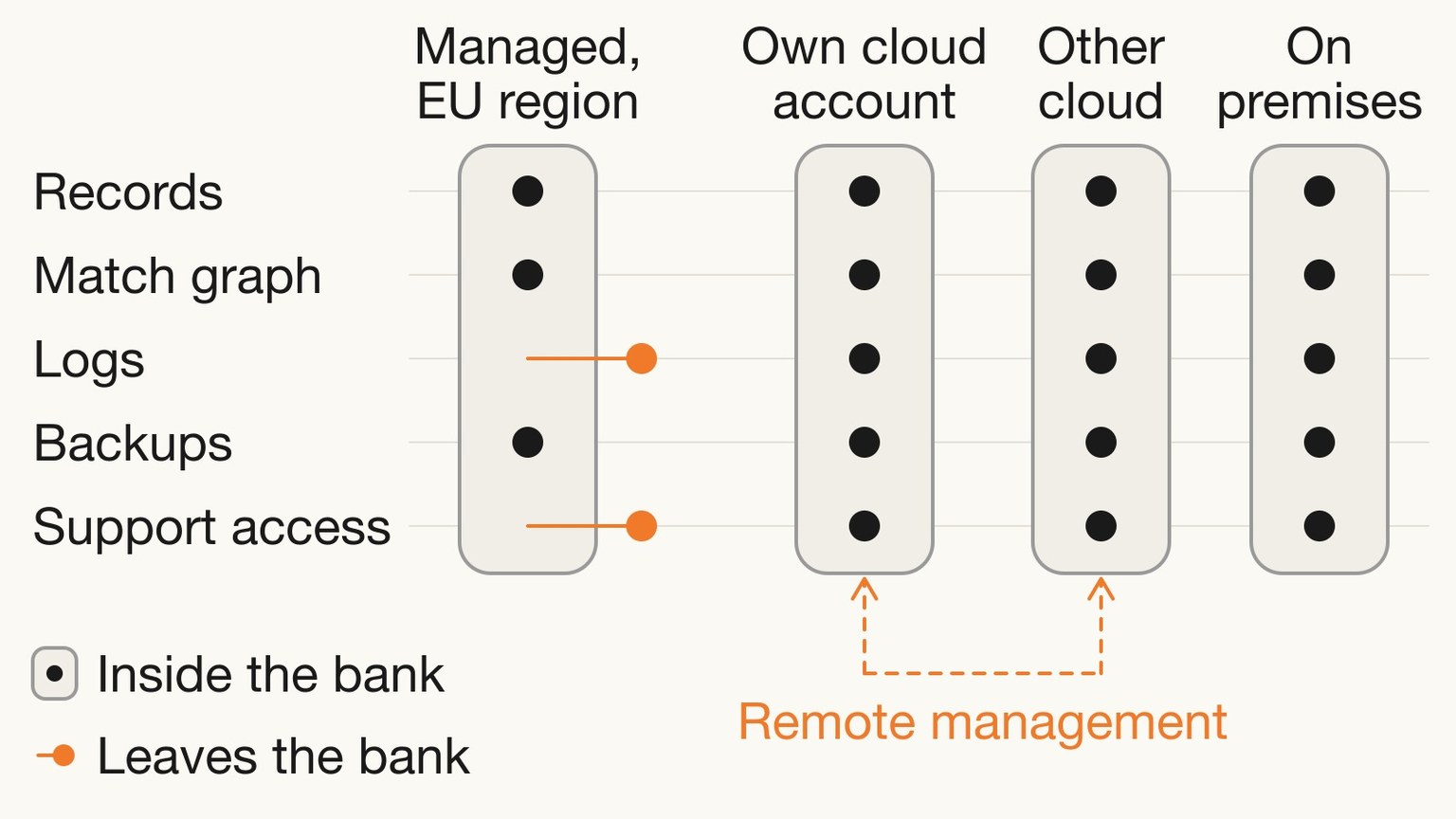
Where each data path lives under four deployment models. The closer the engine runs to the bank, the fewer paths cross its boundary.
Moving the engine into the bank’s cloud account removes the vendor from the data, not the cloud provider. If that provider has a parent outside the EU, the bank’s existing assessment of its cloud platform already covers the question, and the engine adds no new party to it. On premises removes both.
A managed EU-region service is still the better choice for some banks. A small bank without a cloud platform team may get a better risk trade from a managed service with pinned regions, named support locations, approved and logged access, and a change notice clause. Running the engine in its own account means the bank owns the account, its keys, monitoring, capacity limits and cost; on premises, it owns the hardware as well. Sovereignty through self-hosting is paid for in operating effort, and the ICT risk file should record which trade the bank made. We run Tilores, our entity resolution engine, in all four models with the same matching rules, so a bank can choose by risk rather than by product.
How we run Tilores inside a bank’s boundary
We are AWS-native by default and infrastructure-agnostic by design, and our deployment options cover all four models above with one engine. The deployment model changes who operates the infrastructure and where the data sits; it does not change the product.
- Managed Cloud on AWS runs in our AWS account, in the AWS region you choose. Each customer receives an isolated instance with its own resources, and no customer data is shared across instances.
- Your own AWS account runs the same engine on DynamoDB, SQS and S3 in your VPC. Our CLI deploys it with Terraform into the AWS region you name. Your data never leaves your environment and none of our staff can access your records. We still manage and update the deployment remotely, so add that path to your list: which roles, from where, logged where.
- Another cloud uses the key-value store, queue and object storage you already run there. On premises, the engine runs inside your infrastructure, air-gapped environments included.
Every model has the same matching rules, the same GraphQL API, a source label on each record and the same audit trail of queries, exports and deletions. In your own account, the CloudWatch dashboard and the Cognito user pool that issues API tokens sit in your account as well, so monitoring and authentication stay with the records. We hold SOC 2 Type I, and the report is available under NDA.
Before any production data moves, we let you run the full engine on a laptop with Tilores Studio: up to 100,000 records and no network egress. A team can tune rules on a test extract that never leaves the bank. What stays with the bank: its ICT third-party risk assessment, the register of information entry, the DPIA, its assessment of the cloud provider, and its decisions on keys and log retention. We supply the architecture facts; the bank’s risk, legal and data protection teams draw the conclusions.
How does the matching itself protect privacy?
By taking in only the fields a match needs, and by keeping the reason for every link inside the same boundary as the data. Names, dates of birth, addresses and identifiers decide most customer links. Balances, transaction histories and free-text notes rarely do, so they need not enter the engine at all.
Inside the engine, our authorisation model lets you define a privilege for a single field, so only named API clients can read it. Retention windows can be set per source and per data type, and expired records are purged on schedule. Each control shortens a path before it reaches a log, an export or a downstream system.
A link the bank cannot explain is a link it cannot defend. Because every edge a matching rule creates stores that rule, the reason for a match is a record in the bank’s own data store, not a report generated somewhere else. That matters most when a match goes wrong: a wrong merge can be a reportable personal data incident, and the evidence to assess it should sit where the data sits. The same holds for screening. If sanctions, PEP and adverse media checks run on resolved customers, the resolved data feeding them should not leave the boundary on the way.
What requirement list can a bank paste into its RFP?
The list below follows the data paths in order, and each line asks for a location, a party or a piece of evidence:
- Name the regions or countries where inbound records and any persisted normalised values are stored and processed, with advance notice before any change.
- State whether the engine can run in the bank’s own cloud account or data centre, and what changes in the service if it does.
- Keep the match graph, the reason for each link and the audit trail in the same location as the records, exportable in a readable format.
- List every log, metric and trace destination with its region and retention, and show sample entries.
- List every backup, snapshot, export and event stream with its location and retention, and demonstrate deletion across all of them.
- Describe who can access production, from which countries, under whose approval, and provide the access log on request.
- Name each subcontractor and hosting provider, where it provides the service, and where it processes and stores data.
- State the jurisdictions of the vendor and its parent companies, and how the vendor would respond to a third-country order for data it holds.
- Allow rule tuning in a local or bank-hosted environment before any extract leaves the bank.
- Provide current security attestation reports, for the vendor and for any cloud platform it runs on, with the date of the next one.
A vendor that answers all ten with evidence has turned a residency promise into something a supervisor and a DPO can check.
Frequently asked questions
Is an EU region enough for a German bank’s entity resolution platform?
It is necessary, not sufficient. An EU region fixes where records are stored; it says nothing about logs, backups, support access or a parent company’s legal exposure. We run in the AWS region you choose, in your own cloud account or on premises, so you can match the model to the paths you need to keep inside.
Does the US CLOUD Act reach customer data stored in Frankfurt?
It can reach data that a US provider holds, wherever it is stored, because 18 U.S.C. § 2713 applies regardless of location. Whether a vendor is exposed is a legal question. When a bank runs Tilores in its own cloud account or on premises, we do not hold its data, and none of our staff can access its records.
Does the EU-US Data Privacy Framework settle the transfer question?
No. The adequacy decision of 10 July 2023 covers transfers to US organisations on the Data Privacy Framework List. It does not map your logs, backups or support access, and it does not replace the DORA requirement to name where data is processed and stored. The deployment model answers more of the question than the framework does. With Tilores in the bank’s own cloud account, the records stay in that account; on premises, only what the bank lets out leaves it.
Which deployment models does Tilores offer banks?
We offer four, with the same engine: Managed Cloud on AWS in the region you choose, your own AWS account through Terraform, another cloud using your key-value store, queue and object storage, and on premises, including air-gapped environments.
Which security attestation does Tilores hold?
SOC 2 Type I, covering our controls for security, availability and confidentiality. The report is available to enterprise customers and prospects under NDA through our Trust Centre.
Who is responsible for the DPIA and the DORA register entry?
The bank. We provide architecture facts, data path descriptions and audit evidence. The bank carries out its DPIA, its ICT third-party risk assessment and its register of information entry, and decides whether the residual risk is acceptable.
Sources
- Regulation (EU) 2016/679 (General Data Protection Regulation), Chapter V, Official Journal of the European Union, via EUR-Lex.
- Recommendations 01/2020 on measures that supplement transfer tools to ensure compliance with the EU level of protection of personal data, version 2.0, European Data Protection Board.
- Commission Implementing Decision (EU) 2023/1795 on the adequate level of protection of personal data under the EU-US Data Privacy Framework, Official Journal of the European Union, via EUR-Lex.
- 18 U.S.C. § 2713: Required preservation and disclosure of communications and records, U.S. Government Publishing Office, govinfo.
- Regulation (EU) 2022/2554 on digital operational resilience for the financial sector (DORA), Articles 28 to 30, Official Journal of the European Union, via EUR-Lex.
- Commission Delegated Regulation (EU) 2025/532 on subcontracting ICT services supporting critical or important functions, Official Journal of the European Union, via EUR-Lex.
- Rundschreiben 06/2026 (BA): Mindestanforderungen an das Risikomanagement (MaRisk), Stand 30.06.2026, Bundesanstalt für Finanzdienstleistungsaufsicht (BaFin).
- The EBA publishes its final Guidelines on the management of third-party risk, 18 September 2026, European Banking Authority.
- Guidelines on third party risk management, European Banking Authority.
- Cloud Computing Compliance Criteria Catalogue (C5), Federal Office for Information Security (BSI).
- Deployment Options: Run Tilores Where Your Data Is, Tilores.
- Data Privacy and Security, Tilores.
- Frequently Asked Questions, Tilores documentation.
- Deployment, Tilores documentation.
- Authentication, Tilores documentation.
- Authorization, Tilores documentation.
- Monitoring, Tilores documentation.
- GraphQL API Reference, Tilores documentation.
- Download Tilores Studio: Free Evaluation, Tilores.
- Can a Bank Run Entity Resolution in Its Own Cloud Account in 2026? A Procurement Control Checklist, Tilores.
- Does a Bank Need a DPIA Before an Entity Resolution Trial in 2026? What the Data Protection Officer Must Record, Tilores.
- Is a Wrong Customer Match a Reportable GDPR Incident, and What Must a Bank Document?, Tilores.
See what resolved entity data does for your business — and your AI.