Can a Bank Take the Databricks Entity Resolution Accelerator Into Production in 2026? Licence, Support and the Gap to a Production System

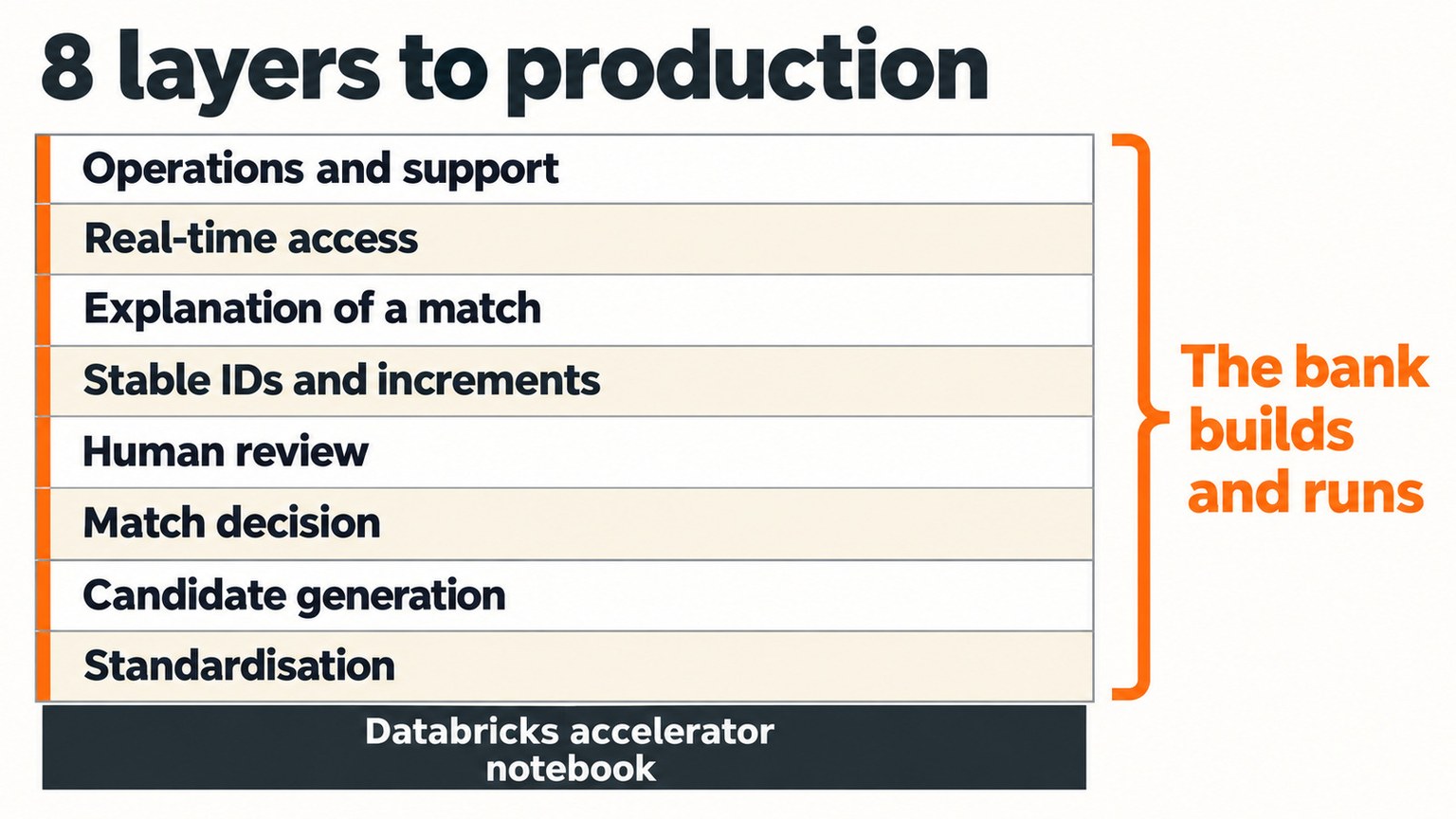
TL;DR: Not as shipped. The Databricks entity resolution accelerator is a prototype: notebooks from a series Databricks has described as educational material, under an as-is licence, with no support terms, on a runtime past end of support. A bank can learn from it, but going live means owning the licence review, the support and eight production layers.
Book a Demo · Try Tilores Studio (Free)
On this page
- Can a bank take the accelerator into production as it ships?
- Is the bank allowed to build on it?
- Who does the bank call when it breaks?
- What does the bank end up owning?
- Why is the business case about people, not compute?
- Who should carry the layers: your team, the library’s commercial edition or a matching engine?
- What steps take a bank to a go or no-go?
- Frequently asked questions
- Sources
The job the Databricks entity resolution accelerator creates for you runs on Databricks Runtime 12.2 LTS, which went out of support on 1 March 2026. Databricks says workloads on unsupported runtimes “might continue to run, but Databricks doesn’t provide support or fixes.” The notebooks are built to show matched records on a sample dataset, and a platform team brings that demo to the steering committee.
Then the committee asks the question that decides the project: can this go live in the bank? The demo cannot answer it. The answer sits in files a demo never opens: the licence text, the third-party licences in the README, the runtime the job pins and the notebook comments on what is left to build.
Read those files and the question changes. It stops being whether the model matches and becomes who owns everything around it. For a bank, that is where the cost and risk sit.
Can a bank take the accelerator into production as it ships?
No. As it ships, the accelerator is a prototype, and a good one. It is the customer-er repository on GitHub: five Python notebooks, a RUNME notebook that creates a multi-step job, and a setup file. It trains a Zingg model on record pairs that a person labels in notebook widgets, then links and matches new records in batch. Databricks announced it on 4 August 2022 as an ML-based Customer 360 built with Zingg, with retail personalisation as the use case.
The library inside it is capable. Zingg learns its own blocking model, trains on few labelled pairs and, in its own test, matched 9 million three-field records in 45 minutes on one 96-core AWS machine.
What a demo on it can prove is narrow. It runs on the North Carolina Voters 5M benchmark: real voter-register records with synthetic duplicates, in four fields (given name, surname, suburb and postcode). There is no date of birth and no national identifier. A result on that file is a result on a benchmark file, not on bank data, not how it would treat a bank’s customers. For batch deduplication of non-regulated analytical data, that is a credible start. For a production system in a bank, the deciding questions come next, and the first is whether the bank may build on the code at all.
Is the bank allowed to build on it?
Only inside a Databricks agreement, and on the point that matters most, modification, the two published licence texts disagree. Turning notebooks into a production pipeline means changing them, so this is the first thing legal has to settle.
The repository’s LICENSE file, dated 2022, allows use only in connection with Databricks Platform Services under an agreement, gives no warranty and treats the software as Databricks Confidential Information. The licensee may view, copy in limited ways and compile it, but may not make derivative works without separate terms. The licence ends on termination or breach, or at any time on Databricks’ notice.
The README and notebook footers point somewhere else: databricks.com/db-license-source, which now redirects to the DB licence page. That text allows copying and modification solely for use within or connecting to Databricks services, and caps Databricks’ liability at one thousand US dollars. A production pipeline is a modification on either reading, so the bank needs Databricks to say in writing which text governs.
The library underneath has its own terms. The README lists Zingg under the GNU Affero General Public License v3.0. Zingg’s own README says the AGPL allows unrestricted use by end users, solution builders and partners, and offers a different licence on request. Section 13 of the AGPL says that if you modify the program, your version must offer users who interact with it remotely over a network the chance to receive its source. Whether a bank’s internal use triggers that is a question for its open-source review, before anyone modifies Zingg.
Two smaller items belong in the same legal pack. The NOTICE file records consent to Databricks collecting usage and tracking information, and Zingg’s security note says it sends usage metrics to Google Analytics, without input or output data. Neither stops a project, but both belong in the data-protection review. And suppose legal clears everything: the next question is the one operations will ask the first time the job fails.
Who does the bank call when it breaks?
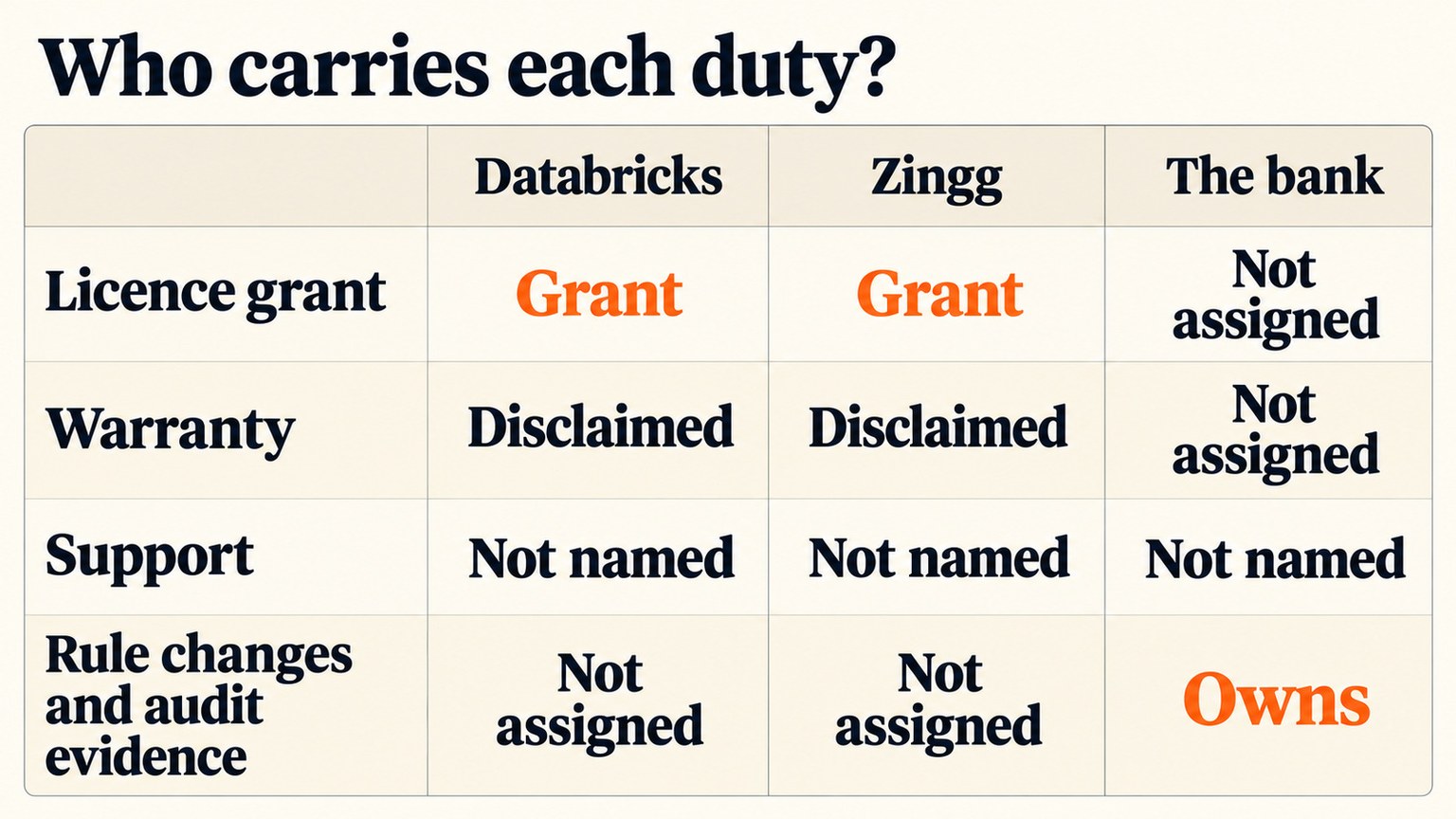
Nobody named. No support commitment appears in the repository or on the accelerator’s Databricks page. In October 2022 Databricks described its solution accelerators as available “with minimal support” and “not meant to be used as off the shelf products”. That is a fair statement of purpose, not a defect, and it means a bank that goes live becomes its own support desk.
The repository’s history shows what that desk would inherit. The latest commit dates from 23 October 2023. All three issues ever opened are still open: a failed data download (August 2022), unavailable source data (March 2023) and a training job ending in an internal error (March 2024). The last two have no reply.
Then there is the runtime from the opening. Databricks lists 1 March 2026 as the end of support for Runtime 12.2 LTS, and its support lifecycle gives no support or fixes after that date. The job also downloads the Zingg release of 4 August 2022, while Zingg published 0.7.0 on 10 August 2026. A bank can port both, since Zingg documents running its Community version on Databricks, but then it owns the port.
Whether Databricks platform support covers adapted notebooks or the Zingg library is not stated, so get that in writing. Zingg’s edition table lists open-source support for Community and enterprise-grade support for its proprietary editions, which is one way to put a name against support.
New posts on entity resolution, identity data and AI. No spam, unsubscribe any time.
What does the bank end up owning?
Support is the smaller inheritance. Going live means owning eight production layers, and the notebooks’ own comments name most of them. The README leaves the handling of matched and unmatched data to the application engineer, and the notebooks leave review, identifiers and incremental merging to the implementer.
Eight layers between the accelerator and a bank production system
| Layer | What the repository and Zingg documentation show | What a bank needs before go-live |
|---|---|---|
| Standardisation | Four raw benchmark fields go straight to fuzzy match types. | Rules for umlauts, transliteration and address and identifier formats, with the originals kept. |
| Candidate generation | Zingg learns a blocking model. | A recall check on bank data, because a pair that blocking never proposes cannot match. |
| Match decision | A classifier trained on labelled pairs. The notebook says precision is very hard to judge without ground truth. | A bank-owned labelled set, signed-off thresholds and change control for every retrain. |
| Human review | The notebook says low-score clusters would need manual review in a real implementation, and that a notebook is not a proper end user UI. | A review queue with roles and reversible, logged decisions. |
| Stable IDs and increments | The notebook assigns its own cluster IDs. The incremental notebook leaves multiple prior links and unmatched records to the engineer. Zingg lists incremental runs, ID reassignment, merge and unmerge as features of the commercial edition. | Entity IDs that survive merges, splits and reruns. |
| Explanation of a match | Zingg lists pair-level explanation as a feature of the commercial edition. | A field-by-field reason for every link, exportable for auditors. |
| Real-time access | Batch jobs. Zingg’s edition table lists Community as batch, and the commercial edition as batch and real time. | A lookup that answers while a customer waits. |
| Operations and support | A job on a runtime past end of support, running costs left to the user, no support terms. | Monitoring, incident response, upgrades and a party to call. |
Most of these are familiar engineering. Two of them carry more weight in a bank than anywhere else, because a supervisor or a screening team depends on them.
Is the matching model a model for model risk purposes?
Probably, and the bank’s model-risk function decides. SR 11-7 defines a model as a quantitative method that turns input data into quantitative estimates and puts vendor products under the same framework as in-house models. The PRA’s SS1/23 covers models built in-house or externally for firms with internal model approval. A classifier that scores record pairs plausibly falls within that wording. Either way it needs documentation, validation and monitoring, which the notebooks do not supply. Validation also has to look past single pairs: a peer-reviewed review shows that pairwise matching can produce impossible linkage configurations when dependencies between records are ignored.
How does this reach sanctions, PEP and adverse media screening?
Through the entity that screening receives. Screening customers against external lists is a different job from resolving duplicates, but both depend on the same name normalisation. OpenSanctions’ PEP dataset alone held 718,813 targets across 264 countries on 15 October 2026, and adverse-media signals come from separately governed sources. A resolved record gives screening one entity to check, not five spellings of it, which makes the standardisation and stable-ID rows above a compliance matter as well as an engineering one.
Why is the business case about people, not compute?
Because engineers build and run the eight layers, and next to them the cluster bill is small: about one per cent of the first year in the scenario below.
Take the platform lead whose team ran the demo. A week later the committee asks for a first-year cost before it will approve a build, and finance turns to the lead for the number, for a bank with 20 million customer records. The first draft is the compute line, because that is the cost the demo made visible, and it comes to under 3,000 US dollars a year. The project looks almost free. Then the lead adds the people who would build the layers in the table and run them afterwards, and the number grows a hundredfold.
Illustrative first-year cost of completing and running the accelerator, with assumptions
| Item | Arithmetic and assumption | Result |
|---|---|---|
| Batch run | Zingg publishes 45 minutes for 9 million records on one AWS m5.24xlarge. Assumption: linear scaling, so 20 ÷ 9 × 45. | 100 minutes |
| Compute | AWS list price of 4.608 US dollars an hour (Linux, us-east-1, effective 1 October 2026): 100 ÷ 60 × 4.608 a run, × 365 for a daily run. | 7.68 US dollars a run, 2,803 a year |
| Engineer rate | US median pay for software developers of 135,980 US dollars (May 2025), ÷ 52, × 1.3 assumed for employer costs. | 3,400 US dollars a week |
| Build | Assumed 56 person-weeks: standardisation 6, review 10, IDs 8, explanation 8, real-time 12, monitoring 6, model-risk papers 6. 56 × 3,400. | 190,400 US dollars |
| First year | Build 190,400, plus half an engineer to run it (0.5 × 135,980 × 1.3 = 88,387), plus compute 2,803. | 281,590 US dollars, of which compute is about 1% |
The weeks are our planning assumptions and the wage is a US yardstick, so replace both with your own. The shape survives any sensible substitution: a daily run costs less than a day of an engineer’s time. None of this is our pricing. It shows that the decision turns on who carries the build and the running, not on the cluster.
Who should carry the layers: your team, the library’s commercial edition or a matching engine?
That is the decision the committee is really making, and there are three serious ways to make it. Each puts the eight layers with a different owner.
Three ways to resolve customer records on Databricks
| Option | Licence and support | Where it fits | Where it falls short |
|---|---|---|---|
| The accelerator, completed by your team | Databricks licence, as is, no stated support. Zingg Community under the AGPL. | A prototype that shows what a labelled model does on your data, or a batch job your Spark team will own. | Runtime past end of support, batch only; your team builds review, identity and audit layers. |
| The library’s commercial edition | A commercial licence, with enterprise-grade support listed. | Teams that stay on Spark and buy support for the library. | Confirm each feature and its status in writing. Cluster approval is marked coming soon. |
| A matching engine next to the lakehouse (ours) | A commercial contract, with support scoped to the engagement. | Real-time lookup, explained matches, an audit trail, deployment in the bank’s cloud. | A second service to run. A one-off batch deduplication does not need it. |
The accelerator is the better call for a one-off batch deduplication of analytical data, with no real-time lookup and no per-decision explanation, where a Spark team wants to own the model. Paired with a supported Zingg edition, it fits that case, and a separate matching engine would be a second service the bank does not need.
The other case is a system that answers while a customer waits and explains every link to an auditor. For that case we built Tilores as the layer the notebooks leave to the implementer: a real-time entity resolution engine that runs fully managed on AWS, in the bank’s own AWS account, in another cloud or on premises. Databricks can stay the data platform beside it.
Against the gap table, we keep deterministic, fuzzy and probabilistic matching as three separate methods, and we normalise names, addresses and identifiers before matching while keeping the originals. Consistency rules, such as a date of birth that must agree across an entity, stop a merge however strong the other evidence, so an entity cannot hold records that contradict a rule the bank has set. We store each link with the rule that created it, and our deployment options list a full audit trail of queries, exports and deletions. Applications query a GraphQL API, with search in about 150ms on our managed cloud and about 1ms self-hosted. We hold SOC 2 Type I, and our support runs “from standard technical support to a dedicated customer success engineer”, scoped to the engagement.
We do not replace Databricks, the bank’s golden record policy or its screening, a boundary our build versus buy guide sets out. The quickest way to settle the choice is on the bank’s own data. Our Tilores Studio runs the same engine locally on up to 100,000 of your records, free, so a team can score one labelled sample in Studio and in the accelerator on the same day, using the protocol in our bake-off guide. Book a 30-minute demo and we will walk through the platform with your data.
What steps take a bank to a go or no-go?
By treating the accelerator as a prototype until written answers and a test on bank data say otherwise. Five steps get the committee there.
- Put five questions to Databricks and Zingg in writing: which licence text governs, whether support covers adapted notebooks and the Zingg library, which runtime and Zingg versions work together, who answers an incident and how fast, and what usage data leaves the cluster.
- Send both licences to legal and open-source review, including the commercial edition’s terms if you would buy them.
- Port it to a supported runtime and a current Zingg release, and record what breaks.
- Score it on bank data: a bank-owned labelled sample with a blind holdout, the accelerator and the alternative side by side. Our proof of concept guide lists the inputs.
- Name an owner and a date for each of the eight layers, and take the list to the risk function.
Go when the answers are in writing, the port runs on a supported stack, the score meets the agreed targets and every layer has an owner. Conditional go for internal analytics where a wrong merge is cheap. No-go for a customer-facing regulated decision while any licence or support answer is missing. These steps answer the question the committee asked.
Frequently asked questions
Is the Databricks entity resolution accelerator supported by Databricks?
No support commitment is stated in the repository, its LICENSE or the accelerator’s Databricks page. Ask Databricks in writing whether platform support covers a notebook you have adapted.
Can a bank modify the accelerator’s notebooks and the Zingg library?
The repository’s LICENSE file bars derivative works without separate terms, while the Databricks licence page the notebooks link to allows modification for use within Databricks services. Zingg Community is under the AGPL v3.0, whose section 13 applies to modified versions that users reach over a network. Both need legal review.
Can the accelerator match records in real time at account opening?
The accelerator runs as batch jobs, and Zingg’s edition table lists Community as batch. We run real-time resolution as a GraphQL service, with search in about 150ms on our managed cloud and about 1ms self-hosted.
Does the accelerator still run on current Databricks runtimes?
The README asks for Databricks Runtime 11.0 or later, and the job it creates pins 12.2 LTS, which reached end of support on 1 March 2026. Nothing in the repository says it has been tested on a newer runtime, and its last commit is from October 2023.
Sources
- customer-er README, Customer Entity Resolution solution accelerator, Databricks Industry Solutions, GitHub.
- LICENSE, customer-er repository, Databricks, Inc. (2022).
- NOTICE, customer-er repository, Databricks, Inc.
- RUNME notebook (job definition, Databricks Runtime 12.2 and Zingg 0.3.4), customer-er repository.
- 02 Initial Workflow Part A (candidate-pair labelling), customer-er repository.
- 02 Initial Workflow Part B (training, matching and cluster identifiers), customer-er repository.
- 03 Incremental Workflow (link and match of new records), customer-er repository.
- Commit history and issues, customer-er repository, checked 15 October 2026.
- Customer Entity Resolution, Databricks Solution Accelerators.
- New Solution Accelerator: Customer Entity Resolution, Luke Bilbro, Sonal Goyal, Bryan Smith and Mimi Qunell, Databricks blog, 4 August 2022.
- Creating a Community of Industry Practitioners With Databricks Solutions Accelerators, Databricks blog, 6 October 2022.
- DB license, Databricks.
- Databricks support lifecycles, Databricks documentation.
- End-of-support Databricks Runtime release notes, Databricks documentation.
- Zingg (README, AGPL v3.0 licence statement) and releases, Zingg AI, GitHub.
- Hardware Sizing, Zingg documentation.
- Adding Incremental Data, Zingg documentation (commercial edition feature).
- Explanation of Matches, Zingg documentation (commercial edition feature).
- Approval of Clusters, Zingg documentation (commercial edition feature, marked coming soon).
- Running on Databricks, Zingg documentation.
- Security and Privacy, Zingg documentation.
- Zingg MDM Compare Editions, Zingg.
- GNU Affero General Public License, version 3, Free Software Foundation.
- Benchmark datasets for entity resolution, Database Group Leipzig, Leipzig University.
- SR 11-7: Supervisory Guidance on Model Risk Management, Board of Governors of the Federal Reserve System and Office of the Comptroller of the Currency, 4 April 2011.
- SS1/23: Model risk management principles for banks, Bank of England, Prudential Regulation Authority (current version published 23 April 2026).
- (Almost) all of entity resolution, Olivier Binette and Rebecca C. Steorts, Science Advances 8(12), 2022.
- Politically Exposed Persons, OpenSanctions.
- Software Developers, Quality Assurance Analysts, and Testers, Occupational Outlook Handbook, US Bureau of Labor Statistics.
- Amazon EC2 price list, US East (N. Virginia), Amazon Web Services, publication date 12 October 2026.
- Deployment Options, Tilores.
- Download Tilores Studio, Tilores.
- Pricing, Tilores.
- Databricks or a Matching Engine? A Bank’s Build versus Buy Guide for 2026, Tilores.
- Entity Resolution Next to the Lakehouse, Tilores.
- How to Run an Entity Resolution Vendor Bake-Off With Real Bank Data, Tilores.
- Entity Resolution Proof of Concept: 7 PoC Inputs a Bank Needs in 2026, Tilores.
See what resolved entity data does for your business — and your AI.