Deduplicating Customer Records Before a Migration to a New Customer Data Platform: What to Decide Before Cutover (2026)

TL;DR: Deduplicate customer records before migrating to a new customer data platform with a matching layer that decides before the first load and keeps running after cutover. Settle match rules, uncertain-pair review, survivorship and a mapping from every source ID to one customer entity. At Tilores, we resolve records from every source into entities in real time, including after go-live.
Book a Demo · Try Tilores Studio (Free)
On this page
- Which software deduplicates customer records before a migration to a customer data platform?
- Why do duplicates surface at migration?
- What must be decided before the first load?
- How does the cutover run without creating new duplicates?
- What stops the new platform collecting duplicates again?
- What is decided before, during and after cutover?
- When is the target platform’s own duplicate check enough?
- Where does Tilores fit into the migration?
- What belongs on the checklist before cutover?
- Frequently asked questions
- Sources
Assume the second rehearsal of a migration loads customer data from three systems into the new customer data platform: CRM, the contract system and the customer portal. The programme expects 1.2 million customers, the number the deduplication exercise counted. The platform shows 1.35 million profiles. The 150,000 extra profiles, 12.5 per cent more than expected, are people arriving under more than one source key, and none of them is a new customer.
What gets loaded is the source systems, and their keys carry none of the decisions the clean-up made. The platform therefore links only what its own identifiers link.
So which software deduplicates customer records before a migration, and when? A matching layer that settles who is who before the first load. It maps every source ID to one customer entity and keeps running after cutover, because a one-off clean-up starts to age with the first new record.
Which software deduplicates customer records before a migration to a customer data platform?
Four kinds of software can do it, and each solves a different part of the job. For the migration, what counts most is which of them keeps running after go-live.
- Data quality tools check formats, mandatory fields and spellings, usually as a project run over an export. Their output is typically a cleaned file.
- MDM systems manage master data with stewardship workflows and approvals. They fit when a master data hub is already part of the programme, and for a migration alone they are often the bigger project.
- The customer data platform’s own identity function links profiles through the identifiers the platform knows. The CDP Institute gives a customer data platform primary responsibility for defining and maintaining customer identity over time.
- An entity resolution engine compares records from every source, groups them into entities and stays in place as a service other systems query. Record linkage, the method behind it, is one of the fundamental activities of a statistical agency at the US Census Bureau.
With several source systems, the fourth kind carries the migration, because it makes the same decision before the load and after cutover. Data quality tools stay useful for format errors, and the platform’s identity function for identifiers created inside the platform, such as a login. Whether data should be cleaned before buying a platform at all is a separate question, which we answer for teams about to buy a Customer 360 platform. Here the platform is bought and the cutover is scheduled.
Why do duplicates surface at migration?
Duplicates surface at migration because every source system issues its own keys and spells the same customer differently. While the systems run apart, this hardly shows. A platform that puts everything side by side turns each difference into a profile of its own.
- Keys: The CRM holds a customer number, the contract system a contract-party number, the portal a login ID or email address. None of these keys appears in all three systems.
- Spellings: Older systems store Müller as Mueller because they never fully supported umlauts. The German standard DIN 91379 sets out the Unicode characters IT procedures need for the names of people, places and streets. In a 2022 survey by Germany’s IT Planning Council, 65 per cent of 1,174 evaluated public administration procedures encoded their characters in UTF-8 throughout. No such count exists for a bank’s systems, but a migration brings together systems from several decades, each with its own encoding.
- Addresses: Musterstr. 12a, Musterstraße 12 a and Muster Str. 12A describe the same address and are three different values to an exact comparison.
- Life events: In 2025, 348,813 couples married in Germany, and marriage often changes a surname. In the same year the Federal Statistical Office recorded 996,000 moves across the borders of German states; moves within a state are not included in that figure, although the migration statistics also count every change of main residence across a municipal border.
A record from 2015 and one from 2026 can therefore show the same person with a different name and a different address. Our guide to how German banks should normalise names and addresses works through these variants in detail. A matching layer with German normalisation removes these variants before records are compared.
New posts on entity resolution, identity data and AI. No spam, unsubscribe any time.
What must be decided before the first load?
Four decisions must be settled before the platform sees its first rehearsal, because otherwise each rehearsal measures something different.
- Match rules: which attributes connect two records. Deterministic matching compares stable identifiers exactly, fuzzy matching measures how similar names and addresses are, and probabilistic matching weighs several weaker attributes together. This includes what keeps two records apart despite a similar name, such as a different date of birth.
- Review of uncertain pairs: who decides the pairs in the grey zone, and whether they stay apart or joined until then. One route is a review queue, where a person or an AI agent decides.
- Survivorship: which value goes into the platform when sources disagree, for example the most frequent name, the newest address and every known email address. Our article on survivorship rules for CRM merges goes deeper.
- Mapping of source IDs: a table, often called a crosswalk, in which every source ID with its system identifier points to exactly one customer entity. Through it, the platform inherits the decisions of the matching.
The fourth decision is the one most often missing, and it explains the 150,000 profiles in the rehearsal. When the platform receives the customer entity with every source record, it groups records of the same entity. Without the mapping it links only through its own identifiers, and an email address in the portal with no counterpart in the CRM becomes a new profile.
Accuracy here is more than a data quality question. Under Article 5(1)(d) GDPR, personal data must be accurate and, where necessary, kept up to date. Three profiles with three addresses for one customer make that harder, and a wrong merge puts one person’s data into another person’s profile. Why that can be a reportable incident is covered in a separate article.
How does the cutover run without creating new duplicates?
The cutover runs in five steps, and each one checks whether the number of profiles matches the number of entities.
- Rehearse with a preview. Send the extract through matching and count the entities before the platform loads anything. If the number is far from the expected customer count, check the rules first.
- Decide the uncertain pairs. Review the pairs in the grey zone and record every decision so that it applies again in the next rehearsal.
- Rehearsal load with entity mapping. Load the platform with the entity for every source record and count profiles per entity. Every extra profile points to a source ID without a mapping.
- Freeze window. Freeze match rules and survivorship, and collect every record created between the extract and go-live as a delta.
- Delta and go-live. Send the delta through the same matching, so a customer who opened an account during the freeze joins their entity and does not get a new profile.
Between rehearsals, one measure does most of the work: profiles in the platform divided by entities in matching. In the example that is 1.35 million to 1.2 million, or 1.125. The target is 1.0, and every deviation traces back to source IDs without a mapping.
Keep the old customer view running beside the new platform until go-live, and reconcile the two after every rehearsal so that each difference has a named cause. Keep the review decisions as an audit trail too: we return the decision history for any set of records, with who decided, when and why.
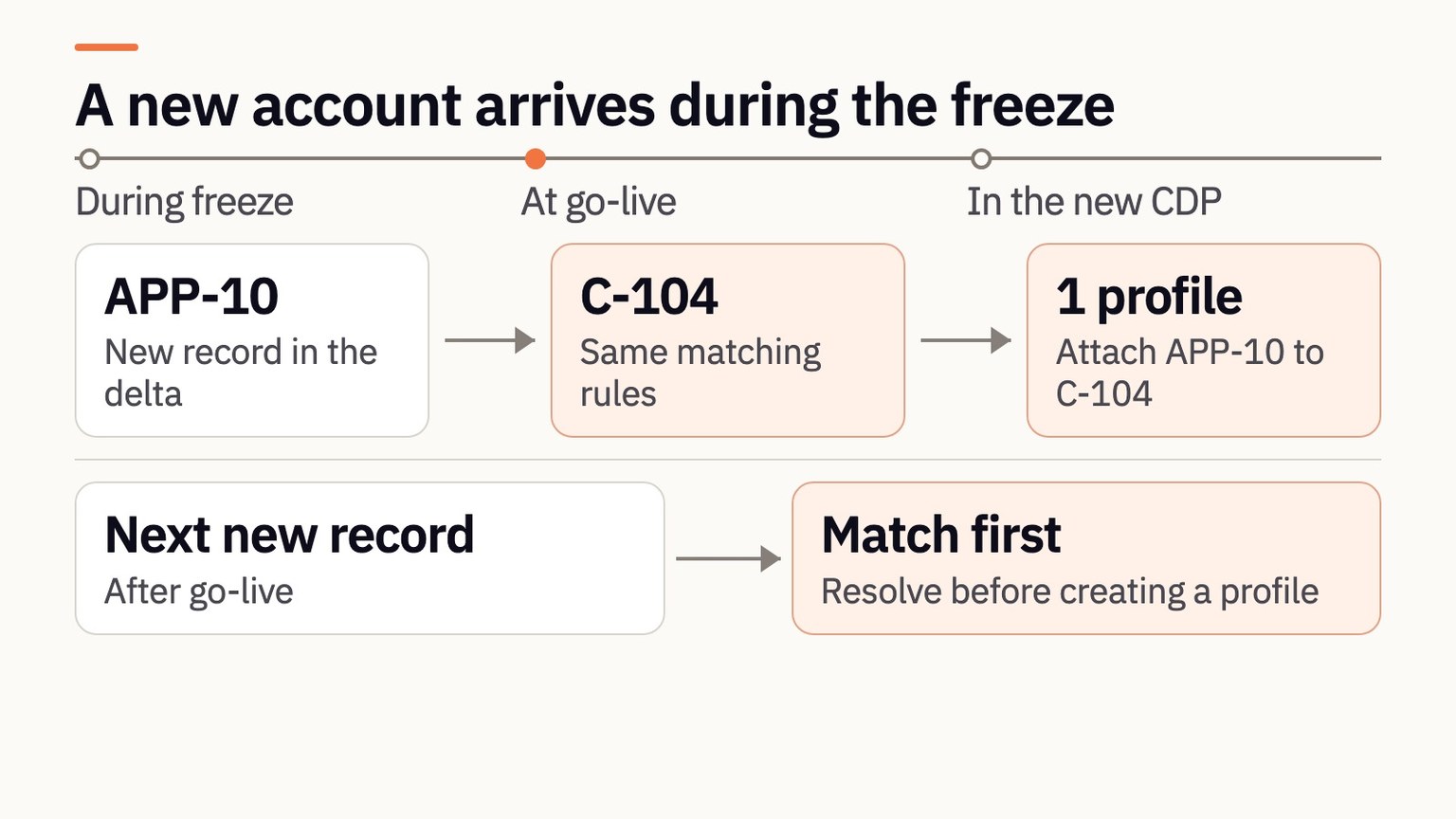
Collect new records as a delta during the freeze and apply the same matching rules before loading it. After go-live, match each new record before creating a profile.
What stops the new platform collecting duplicates again?
Matching that keeps running after cutover and assigns every new record to an entity before the platform creates a profile for it. A one-off clean-up is a snapshot. The day after go-live, an existing customer opens an account through a new app, and a house move changes an address in the contract system.
In practice, the platform stores each source record ID with the entity that matching currently returns for it, and every source system sends new and changed records to matching first. Because entities can merge and split, the mapping should hang off the source IDs and look up the current entity for each record. Our article on stable IDs through merges and splits shows how downstream systems handle that.
For banks and insurers, continuous matching is also the basis for screening against sanctions, PEP and adverse media lists, for example the OpenSanctions data on politically exposed persons. Screening is only as good as the customer view it runs against. Its thresholds and decisions remain separate controls.
What is decided before, during and after cutover?
One matching layer carries all three phases: it decides before cutover, processes rehearsals and the delta during it, and matches new records after it. Each phase has its own decision and its own evidence, and only together do they stop the duplicates coming back.
What is decided before, during and after cutover, and how it is measured
| Phase | Decision | Evidence |
|---|---|---|
| Before cutover | Match rules, review of uncertain pairs, survivorship, mapping of source IDs | Confirmed matches and non-matches from real data; documented rules |
| During cutover | Rehearsal loads, freeze window, processing the delta | 1.0 profiles per entity; delta mapped; old and new views reconciled |
| After cutover | Continuous matching of new and changed records | No new profiles without an entity; review queue cleared |
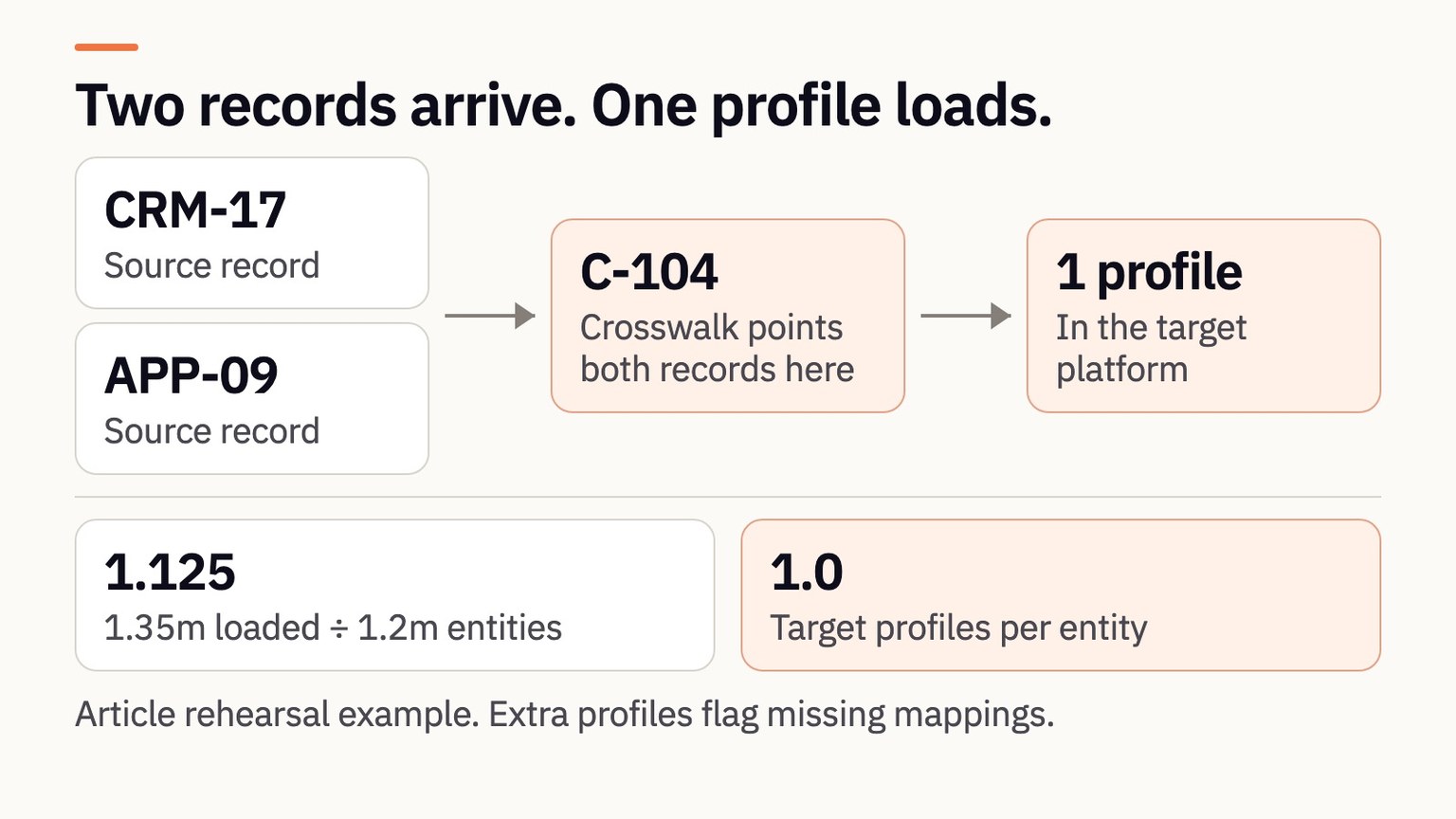
The crosswalk assigns both source records to one target profile. In the article’s rehearsal example, 1.35 million loaded profiles for 1.2 million entities yield 1.125 profiles per entity. The target is 1.0.
When is the target platform’s own duplicate check enough?
The target platform’s own duplicate check is often enough when only one source system is migrated and its customer number is clean. Then there are no competing keys, and the platform takes over an identifier that is already unique. When data from CRM, ERP and a data warehouse come together, a matching layer is needed.
One example is a marketing platform taking over a newsletter list keyed on email address. It needs no matching layer of its own. The sums change as soon as two systems with their own keys come together, or names and addresses are the only link between records. Then the platform lacks information its identifiers do not contain.
Where does Tilores fit into the migration?
We provide the matching layer that decides before the load and keeps running after cutover. We take in records from any source, resolve duplicates in real time and return unified entities through our GraphQL API. For German data, our transformers replace umlauts with their base letter, separate house numbers and expand abbreviations such as Str. to Straße. Our matchers can use Cologne phonetics, under which Müller and Mueller both map to the code 657.
We let you build the record ID from the source system and the source ID, so every record keeps its origin. The entityByRecord query then returns its current entity. On request, we put uncertain links into a review queue, where a person or an AI agent decides. With the defer strategy the records stay apart until then, and a decision still holds when the same record arrives again in the next rehearsal.
How do you use Tilores in each phase of the migration?
Each phase uses a different part of the same engine:
- Rehearsal: With submitWithPreview and the dryRun option, we show how the entities would look without storing the records.
- Bulk load: Records are sent concurrently, for example with our batch-graphql tool from a JSON lines file. A shuffled order keeps processing parallel, while a file sorted by customer slows it down.
- Golden record: You shape the values for the platform by query, such as the most frequent name and the newest address.
- After cutover: New and changed records go through the same API, and entities update in real time.
We built Tilores Studio so you can test this first on your own machine, in local mode with up to 100,000 records that never leave it. In production, we run the same engine fully managed on AWS or inside your own AWS account.
What remains your responsibility?
The decisions on which system leads, which survivorship rules apply and which attributes the platform may store remain yours, as does the data protection assessment as controller. You can buy the matching engine alone and keep the golden record in your own platform: our API returns every record of an entity, so survivorship runs in your system or in a golden record query you define against our API.
What belongs on the checklist before cutover?
Six points to tick off before the first rehearsal:
- Match rules with deterministic, fuzzy and probabilistic parts are documented.
- A test set of confirmed matches and non-matches from real data exists.
- For uncertain pairs, reviewers, deadlines and the interim handling are agreed.
- Survivorship is set for every attribute the platform stores.
- Every source ID carries its system identifier and points to one customer entity.
- The route for the delta and for ongoing records after go-live is built, not only planned.
With these in place, the next rehearsal in the example measures 1.0 profiles per entity. Any deviation that remains points to a specific source ID, and the puzzle of the 150,000 profiles is solved.
Frequently asked questions
Should you deduplicate before or after migrating to the customer data platform?
Both. The decision on which records belong together is made before the first load, and the same matching keeps running after cutover. Cleaning only beforehand collects duplicates again with every new record. Cleaning only afterwards loads errors into the platform that downstream systems have already taken over.
Is the new customer data platform’s identity resolution enough?
Often, with one source system and a clean customer number. With several source systems that each have their own keys, the platform links only what its identifiers connect. Names and addresses in different spellings then stay separate profiles unless a matching layer supplies the mapping.
What is a crosswalk in a data migration?
A crosswalk is a table in which every source ID, with its system identifier, points to exactly one customer entity. Through it, the new platform inherits the decisions of the matching. Because entities can merge and split, the mapping hangs off the source IDs and looks up the current entity.
What happens to records created during the freeze window?
They are collected as a delta and sent through the same matching before go-live. A customer who opened an account during the freeze then joins their existing entity and does not get a second profile. The delta can come from change data capture or an incremental extract of each source, and because the old system keeps running until go-live, the delta is reconciled against it before the switch.
Can the Tilores matching layer keep running after go-live?
Yes. We resolve new and changed records in real time through the same GraphQL API, with the same rules as in the rehearsals. Changed rules apply to new data; for existing records, you resubmit them with their original record IDs.
Sources
- What is a CDP? Customer Data Platform definition, CDP Institute.
- Record Linkage & Machine Learning, U.S. Census Bureau.
- DIN 91379: Characters and defined character sequences in Unicode for the electronic processing of names and data exchange in Europe, DIN Media.
- Stand der Umsetzung der Spezifikation DIN SPEC 91379 (2022 report, German), IT-Planungsrat.
- Eheschließungen, Ehescheidungen und Lebenspartnerschaften (marriages, divorces and civil partnerships, German), Federal Statistical Office of Germany (Destatis).
- Nettozuwanderung 2025 mit 235 000 Personen deutlich gesunken (press release, German), Federal Statistical Office of Germany (Destatis).
- Wanderungen (migration statistics, German), Federal Statistical Office of Germany (Destatis).
- General Data Protection Regulation, German text edition 2025, Berlin Commissioner for Data Protection and Freedom of Information.
- Find Politically Exposed Persons worldwide, OpenSanctions.
- Tilores product, Tilores.
- Transformers, Tilores documentation.
- Matchers, Tilores documentation.
- Schema Customization, Tilores documentation.
- API, Tilores documentation.
- Review, Tilores documentation.
- FAQ, Tilores documentation.
- How to Create a Golden Record?, Tilores documentation.
See what resolved entity data does for your business — and your AI.