Duplicate Customer Check at Account Opening: Link, Create or Hold When an Applicant Looks Like an Existing Customer (2026)


TL;DR: When an applicant resembles a current or former customer, choose link, create or hold before opening the account. Link when evidence clears a stated bar and nothing contradicts it, create when it shows a different person, and hold, with a clock, when it is thin. At Tilores, we return the candidates and evidence; the bank sets the thresholds.
Book a Demo · Try Tilores Studio (Free)
On this page
- Why does a verified passport not prove a new customer?
- What should the duplicate check return?
- How should the decision table work?
- What does a link to an existing customer not settle?
- How do you hold an applicant without losing them?
- How do you know the rules are working?
- What should a one-page duplicate check policy say?
- Frequently asked questions
- Sources
An applicant uploads a genuine passport, gives a new address and writes her surname as Schäfer. Assume the bank closed a card customer called Schaefer, with the same date of birth, after a financial crime review, and that the old record still carries the exit marker. Every verification check passes, because verification asks whether the document and the person are real. It does not ask whether the bank has met this person before.
That second question decides what the onboarding flow does next, and whether due diligence records sit on one customer or two: attach her to the old customer, open a new customer, or stop and look. Many flows answer it with one match score and one threshold. The cost of a wrong answer depends far more on what the old record carries than on the score, so the rules belong in a table the bank can defend to a supervisor and to the applicant.
Why does a verified passport not prove a new customer?
Because verification and the duplicate check answer different questions. Verification asks whether the identity evidence is authentic and belongs to the applicant. The duplicate check asks whether the bank already holds this person under another record. The bank needs both, in that order: a search on an identity not yet established returns noise, and opening the account before the search creates the duplicate.
Article 22(6) of the EU Anti-Money Laundering Regulation (AMLR) has banks verify identity with an identity document or passport, plus reliable independent sources where relevant, or with electronic identification at assurance level substantial or high. The EBA’s guidelines on remote onboarding go further into the document itself: security features, altered data and a replaced photo. None of them looks inside the bank’s own customer base.
Article 22(1) does supply the fields a search compares: all names and surnames, place and full date of birth, nationalities and residence. The AMLR applies from 10 July 2027; AMLA sent the Commission its final draft standards on 1 October 2026. Our AMLR readiness guide maps its other data duties.
What should the duplicate check return?
Candidates with evidence. A search for the applicant should return the existing customers who resemble her, which fields agreed and how strongly, so the bank can show a supervisor why records were linked or kept apart. From that evidence the flow reaches one of three outcomes:
- Link: the applicant is a current or former customer, and the new product attaches to that customer.
- Create: the evidence shows a different person, so the bank opens a new customer and records why each candidate was rejected.
- Hold: the evidence cannot decide, so the application pauses and goes to a named reviewer within a set time.
A flow that can only link or create pushes every uncertain case into one of them, so reviewer work turns into wrong links on busy days and duplicate customers on cautious ones. The hold is where that work belongs.
How we return candidates and evidence in Tilores
Our GraphQL search query compares the applicant’s details with existing entities using search rules and returns each candidate entity with its hits: the matching record IDs, the IDs of the rules that found them, and a hit score between 0 and 1. A search produces hits; only match rules create edges between records. A bank can configure different rule sets for searching and for linking, so a wide net for candidates never becomes a wide rule for merging.
Three features fit the moment of application:
- Preview without storing. The
submitWithPreviewmutation withdryRunset to true shows the entity the application would join, and the edge and rule that would join it, without ingesting the record. - Consistency rules. Our consistency rules check a new record against every record in the entity it would join. If one record conflicts on a governed field, such as date of birth, the whole entity is ruled out. With an empty-aware matcher, a record that has no value in that field counts as consistent, so a missing date of birth neither confirms nor blocks the link. The feature is marked new, so test it on your own edge cases.
- Review that can wait. Our review flags links that rest on few rules. With the
deferjoin strategy, records that match an entity only tentatively stay apart from it until a reviewer decides, and each decision is stored with its actor and reason.
We do not verify documents, run sanctions screening or decide whether earlier due diligence can be reused. Those stay with the bank’s verification provider, its KYC and AML checks and its compliance team.
New posts on entity resolution, identity data and AI. No spam, unsubscribe any time.
How should the decision table work?
Key the table to two things: how strong the evidence is and what the candidate record carries. The candidate’s markers decide which way the error costs tip. A wrong link on a plain record shows one person’s accounts and data to another, a failure of the accuracy and security principles in UK GDPR Article 5(1)(d) and (f) and of the security duty in Article 32. A missed link on a record with a risk marker, such as an exit for financial crime, a fraud marker or a vulnerability flag, lets that history vanish behind a fresh customer number. One global threshold hides the difference.
Define the evidence levels by which fields agreed after normalisation, never by score alone:
- Strong: a unique identifier agrees, such as a national ID or tax number, or name, full date of birth and place of birth all agree, and no consistency rule objects. Our search returns rule IDs and record IDs, so the bank maps each rule ID to the fields that agreed.
- Moderate: name and full date of birth agree; address or contact details differ.
- Weak: the name is similar, but a governed field such as date of birth is missing on one side.
- Contradicted: a governed field disagrees, such as a different date of birth.
Link, create or hold, by evidence strength and candidate marker
| Evidence | Plain candidate (active or closed) | Candidate with a risk marker |
|---|---|---|
| Strong | Link | Link, then the marker owner reviews before the product goes live |
| Moderate | Link if one active candidate with an uncommon name; hold if the candidate is closed, the name is common or there are several | Hold for the team that owns the marker |
| Weak | Create, and flag for a later merge review | Hold for the team that owns the marker |
| Contradicted | Create | Create, and tell the marker owner about the near miss |
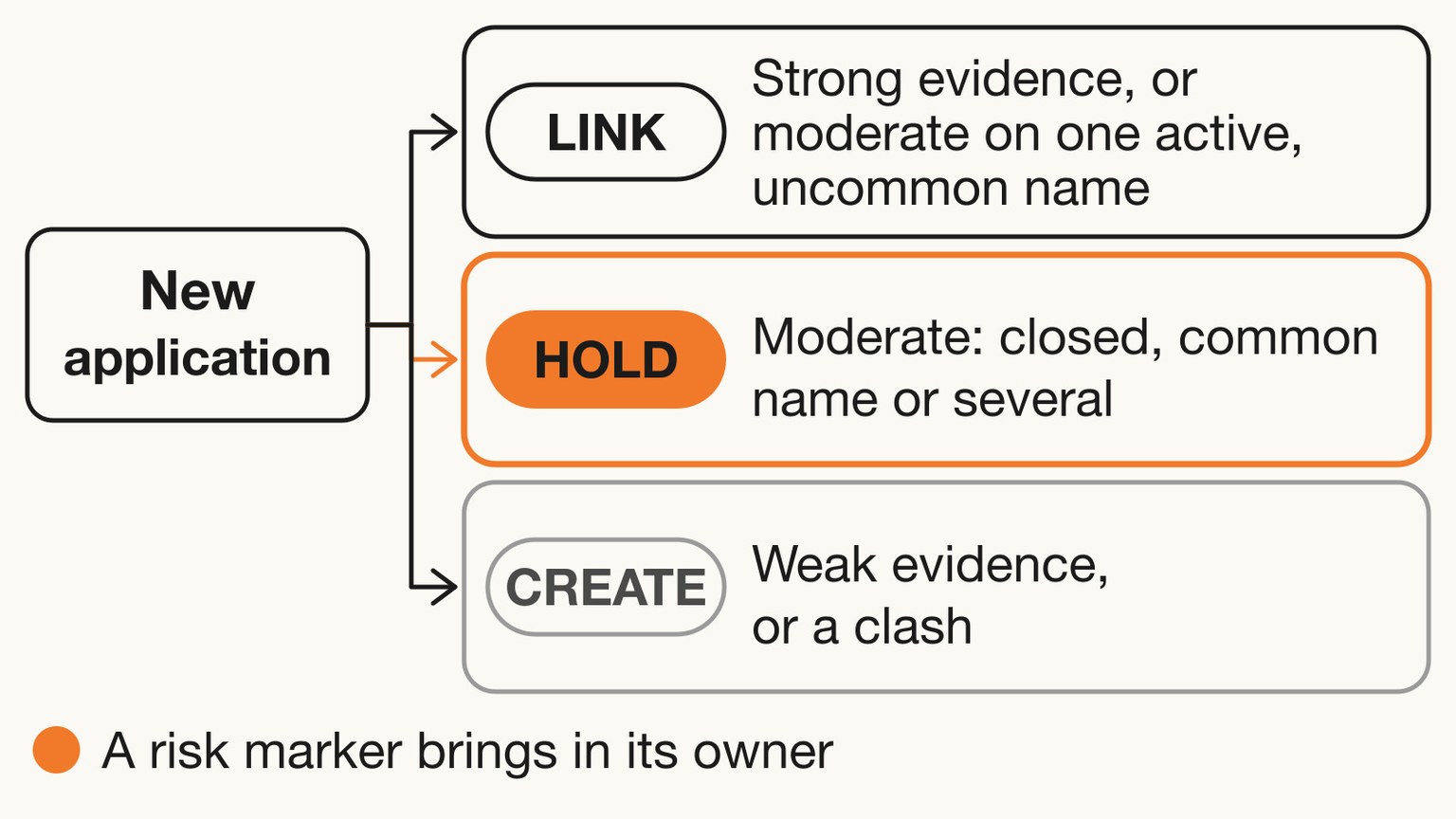
Strong evidence links, thin evidence on a closed or common-name record holds for a reviewer, and weak or clashing evidence creates a new customer.
The marker lives in the bank’s own systems. The onboarding service reads it for each candidate the search returns, then applies the row the evidence points to. With us the bank sets the tiers; consistency rules keep records that conflict on a governed field apart, and our defer strategy holds uncertain matches for review.
What does a link to an existing customer not settle?
Whether the bank can reuse the due diligence it already holds. A link answers who the applicant is. Reuse is a separate decision with its own conditions: how old the evidence is, what it covered and whether anything has changed.
Under the AMLR, customer information must be updated at least every year for higher-risk customers and every five years for others, and reviewed when a customer’s relevant circumstances change (Article 26(2) and (3)). Recital 69 names requests for new products of significantly different risk as a reason to review the file, and Recital 70 lets a customer with recent due diligence confirm that recorded information has not changed.
In the UK, Regulation 27(8) of the Money Laundering Regulations 2017 requires due diligence on existing customers at appropriate times on a risk basis and when their circumstances change. JMLSG guidance (paragraphs 5.3.18 and 5.3.27) says an identity already verified satisfactorily need not be re-verified unless doubts arise, and names an existing customer opening a new account as a trigger that might prompt fresh evidence.
So the link hands compliance the old file, with its date and scope, to judge. One check never carries over: sanctions, PEP and adverse media screening run on the resolved applicant at the door, across every name variant the link brings in. The AMLR lists the sanctions check and the PEP determination as due diligence measures in their own right (Article 20(1)(d) and (g)), and lists such as the OpenSanctions PEP collection change continuously.
How do you hold an applicant without losing them?
Treat hold as a state with an owner, a clock, a message and a default. Set each per product:
- Owner. Plain candidates go to onboarding operations; marked candidates go to the team that owns the marker.
- Clock. Hours for a debit card, a working day for a current account, longer for a mortgage.
- Message. A neutral line that the bank is completing its checks and will reply by a stated time, with no mention of the earlier record.
- Default at timeout. For plain candidates, create and flag for a merge review. For marked candidates, the account stays unopened until the owner decides.
Our defer join strategy provides this hold: uncertain matches stay apart until a reviewer decides. Where the bank wants the account open while the review continues, AMLR Article 23(3) and UK regulation 30(4) allow an account to be opened before verification is complete, provided no transactions run until it is. If the review leaves due diligence incomplete, Article 21(1) requires the bank to refrain from establishing the relationship, and UK regulation 31(1) bars transactions through the account and requires termination.
How should a small bank and a card issuer tune the table?
Differently, because how many uncertain customer matches wait for a reviewer is a staffing question. Assume each hold takes a reviewer 15 minutes, 3% of applications land in hold, and one reviewer has 150 productive hours a month:
Review load at a 3% hold rate, with stated assumptions
| Measure | Small bank | App-based card issuer |
|---|---|---|
| Applications a month | 2,000 | 200,000 |
| Holds at 3% | 60 | 6,000 |
| Review hours at 15 minutes | 15 | 1,500 |
| Reviewers at 150 hours each | 0.1 | 10 |
How much evidence a link needs sets the hold rate, and with us the bank sets that bar itself. The small bank can hold freely and automate little. The card issuer cannot hold at that rate, so it should create more on plain candidates, accept some later merges, keep holds for marked candidates and clear them within hours.
How do you know the rules are working?
Four monthly numbers, by product and marker, show where:
- Link rate: the share of applications attached to an existing customer.
- Hold rate: the share that waited for a reviewer.
- Time to resolve a hold: the median and the slowest case, against the clock.
- Later merges and unmerges of customers created or linked at the door: a merge means a missed link, an unmerge a wrong one.
A falling hold rate with rising later merges means the table creates too readily; rising unmerges mean it links too readily. Our review history returns each decision with its time, actor and reason, which shows a supervisor who decided and why, and our disassemble mutation splits a wrong link and can ban the two entities from reconnecting. When a wrong link is found, the ICO’s accuracy guidance expects the data corrected, and any record kept of the error to be clearly marked as a mistake.
What should a one-page duplicate check policy say?
Seven lines, adopted per product and reviewed each quarter:
- Evidence levels. Set the bar for strong, moderate, weak and contradicted by the fields that agree.
- Markers. List the risk markers that change the outcome and the team that owns each.
- Decision table. Set the tiers: link, create or hold for every evidence level and marker.
- Hold clock. Set the owner, time limit, applicant message and timeout default.
- Due diligence reuse. State that a link never decides reuse; compliance judges the existing file.
- Screening. Screen the resolved applicant for sanctions, PEP and adverse media.
- Measures. Report link rate, hold rate, time to resolve and later merges and unmerges monthly.
At the door, the applicant with the Schäfer spelling meets moderate evidence against a candidate with an exit marker. She is held for the financial crime team under a one-day clock. No score decides her case.
Frequently asked questions
Does AML law require a duplicate customer check at account opening?
No law names a matching method. The EU AMLR asks for due diligence that covers all of a customer’s products and services (Article 26(1)) and for records of the decisions taken (Article 21(3)), which a bank cannot show while one customer sits on two records.
Should a closed customer’s record be linked automatically?
Only on strong evidence, because two different people can share a name. With a risk marker, link first; the marker owner then reviews before the product goes live. For a closed record, anything short of strong is not linked: on a plain record, moderate evidence is held, weak evidence creates a new customer flagged for a later merge review, and contradicted evidence creates one. On a record with an exit, fraud or vulnerability marker, moderate or weak evidence goes to the team that owns it, because a fresh customer number would hide that history; contradicted evidence creates a new customer and tells that team.
Can a bank reuse an existing customer’s due diligence for a new account?
Sometimes. JMLSG guidance says an identity already verified satisfactorily need not be re-verified unless doubts arise, and AMLR Recital 70 lets a customer with recent due diligence confirm that recorded information has not changed. Age, scope and changed circumstances decide; the link only identifies the file.
What should an applicant see while the application is on hold?
A neutral message with a time: the bank is completing its checks and will reply by a stated point, without mentioning the earlier record.
Do we verify identity documents or screen sanctions lists?
No. We resolve the applicant against the bank’s existing customers and return candidates with their evidence. Document verification, sanctions, PEP and adverse media screening, and due diligence decisions stay with the bank and its providers, whose screening then covers every name variant the link brings in.
Sources
- Regulation (EU) 2024/1624 (Anti-Money Laundering Regulation), Articles 20 to 26 and Recitals 69 and 70, Official Journal of the European Union, via EUR-Lex.
- Guidelines on the use of remote customer onboarding solutions (EBA/GL/2022/15), European Banking Authority.
- AMLA finalises key standards for the private sector, 1 October 2026, Anti-Money Laundering Authority.
- UK GDPR Article 5: principles relating to processing of personal data, The National Archives.
- UK GDPR Article 32: security of processing, The National Archives.
- The Money Laundering, Terrorist Financing and Transfer of Funds Regulations 2017, regulation 27, The National Archives.
- The Money Laundering Regulations 2017, regulation 30, The National Archives.
- The Money Laundering Regulations 2017, regulation 31, The National Archives.
- Prevention of money laundering and combating terrorist financing guidance, Part I, October 2026, Joint Money Laundering Steering Group.
- Politically Exposed Persons datasets, OpenSanctions.
- Principle (d): Accuracy, Information Commissioner’s Office.
- GraphQL API Reference, Tilores.
- Rules Configuration, Tilores.
- Consistency, Tilores.
- Review, Tilores.
- What Does the EU Anti-Money Laundering Regulation Ask of a Bank’s Customer Data? A 2026 Readiness Check for July 2027, Tilores.
- Can Entity Resolution Tell Two Customers With the Same Name Apart? Consistency Rules for Banks, Tilores.
- Why Batch Entity Resolution Isn’t Enough for Real-Time KYC, Tilores.
- Entity Resolution Review Queues: How to Design Human Decisions for Ambiguous Matches in 2026, Tilores.
- Is a Wrong Customer Match a Reportable GDPR Incident, and What Must a Bank Document?, Tilores.
See what resolved entity data does for your business — and your AI.