How Should a Bank Test an Entity Resolution Vendor's Failure Behaviour Before Signing? Slow, Down and Recovering (2026)


TL;DR: Before the proof of concept, give each flow a degraded mode: stop, queue and reconcile, or proceed and flag. Test those modes with injected latency, a forced outage and a replay, and judge the vendor by the backlog left behind and how fast it clears. Our review and preview tools at Tilores cover that clean-up, so test them too.
Book a Demo · Try Tilores Studio (Free)
On this page
- Why does each flow need its own failure decision?
- What are the three degraded modes, and what does each leave behind?
- Which failure tests belong in the proof of concept?
- What should the bank get in writing from the vendor?
- How do you clear the records created while the matcher was degraded?
- How does this connect to DORA and UK operational resilience rules?
- What goes into the statement of work?
- Frequently asked questions
- Sources
On a Saturday morning, the matching service behind an app-based onboarding flow slows down for forty minutes. Assume nine applications a minute and that six in every hundred applicants look like someone the bank already holds or once held. That is 360 applicants, and about 22 of them need an answer to one question: is this a person we know?
Some of those 22 may be existing customers who would get a second record. One may be a former customer the bank exited. The availability figure in the vendor’s slides says nothing about them, and they are what an enterprise architect or operational resilience lead answers for on Monday.
So ask a different question in a vendor evaluation: what does each flow do while the matcher is slow or down, and what clean-up is left once it recovers?
Why does each flow need its own failure decision?
Because one matching service sits behind flows with very different risks, and each flow needs its own answer when that service is slow. The vendor controls how often and how long it degrades. The bank controls what its own applications do in the meantime.
A typical bank calls the same identity layer from several places: onboarding, the screening of new customers against sanctions, PEP and adverse media sources such as OpenSanctions, the check for previously exited customers, the payment journey, the contact centre’s customer lookup and CRM enrichment. In CRM enrichment it means a duplicate marketing record that a later batch can merge. At onboarding it can mean a sanctioned person or an exited customer gets a fresh account with no history attached.
AWS describes graceful degradation as components that keep working “although in a degraded manner” when a dependency is unhealthy, and Microsoft’s circuit breaker pattern stops an application from repeatedly calling an operation that is likely to fail. Google’s SRE book describes graceful degradation as “reducing the amount of work that needs to be performed”. They do not say which of a bank’s flows may continue without a resolved identity. That is a risk decision, and it has to be written down before the proof of concept starts.
What are the three degraded modes, and what does each leave behind?
Three modes cover almost every flow: stop, queue and reconcile, or proceed and flag. Each one leaves the bank a different clean-up afterwards.
Three degraded modes and the residue each one leaves
| Mode | During the outage | Left behind afterwards |
|---|---|---|
| Stop | The flow pauses and the applicant waits or returns later. | Abandoned applications; no records to repair. |
| Queue and reconcile | The request is accepted into a restricted state and waits for matching. | A queue to replay and a count of restricted records. |
| Proceed and flag | The flow completes and the record is marked unresolved. | Possible duplicates already in use downstream. |
Our position: fail open is acceptable where a missed link can be repaired later without harm. It is not acceptable where a missed link hides risk. Those flows stop.
A starting policy: one degraded mode per flow
| Flow | Mode while degraded | Reason |
|---|---|---|
| Sanctions, PEP and adverse media screening at onboarding | Stop | A missed link could hide a listed person. |
| Exited-customer check | Stop | A new record would detach the exit decision. |
| Account opening | Queue and reconcile | Open in a restricted state; no transactions until resolved. |
| Payment journey | Proceed and flag | A payment deadline leaves no time to stop; use the last resolved view and flag it. |
| Contact centre lookup | Proceed and flag | Show source records unresolved, with a visible warning. |
| CRM and marketing enrichment | Proceed and flag | A missed link is merged later without harm. |
Queue and reconcile has a legal shape in the EU already. From 10 July 2027, Article 23(3) of the AMLR lets a credit institution open an account provided there are safeguards so that “transactions are not carried out by the customer or on its behalf until full compliance with the customer due diligence measures” is obtained.
An account in that restricted state can wait for the identity layer to catch up. The bank’s legal team decides which flows may use it.
Where does the policy break down?
Two cases need their own design. First, flows with a hard deadline, such as the payment journey. Payment deadlines are set in law, so these flows run on the last resolved view of the customer and flag what changed, and customers created in degraded mode join the next sanctions run on the customer base. The FAQ below covers the deadlines. Second, a bank that runs the deployment in its own account carries part of the resilience work itself, because its infrastructure is now in the failure path.
New posts on entity resolution, identity data and AI. No spam, unsubscribe any time.
Which failure tests belong in the proof of concept?
Six tests, run on the PoC instance with the bank’s own client code in front of it, because a policy is untested until something breaks on purpose. AWS presents fault injection experiments as a way to make applications “behave as expected”. Here that means proving each flow switches to its agreed mode.
- Measure a baseline. Run the agreed peak load for an hour and record the latency distribution the bank’s clients see, not only the figure the vendor reports.
- Inject latency. Add delay in the bank’s own proxy in steps, for example two seconds and then ten, and confirm each flow times out and switches mode at the threshold the bank set.
- Force an outage. Block the endpoint for thirty minutes while test applications keep arriving. Seed a known number of them, say 30 in 300, with details of existing test customers.
- Fail one dependency. Keep search answering while ingestion lags behind, then check what a search returns for an applicant submitted seconds earlier.
- Restore and replay. Bring the service back and replay the queued requests from the bank’s side, in order, with no request lost and none sent twice by accident.
- Count the reconciliation. Report how many degraded-mode records joined an existing customer, how many went to review and how long the backlog took to clear.
The acceptance criteria belong to the bank. Write them as measures before the test, in the same way the accuracy targets for the PoC are agreed up front.
Acceptance measures the bank sets before the failure tests (example figures)
| Test | Measure | Pass when |
|---|---|---|
| Injected latency | Time until each flow switches mode | Every flow switches within the bank’s timeout. |
| Forced outage | Accounts released for transactions before screening finished | Zero. |
| Partial failure | Stale results served without a warning | Zero. |
| Replay | Requests lost or duplicated by the replay | Zero. |
| Reconciliation | Seeded duplicates joined to the existing customer or sent to review after recovery | All 30 of 30. |
| Backlog | Time from recovery to an empty queue | Within the bank’s stated limit. |
The seeded duplicates turn the clean-up into a number. If reconciliation joins or sends to review only 27 of the 30, three customers would have been left with two records, and the bank sees why before signing.
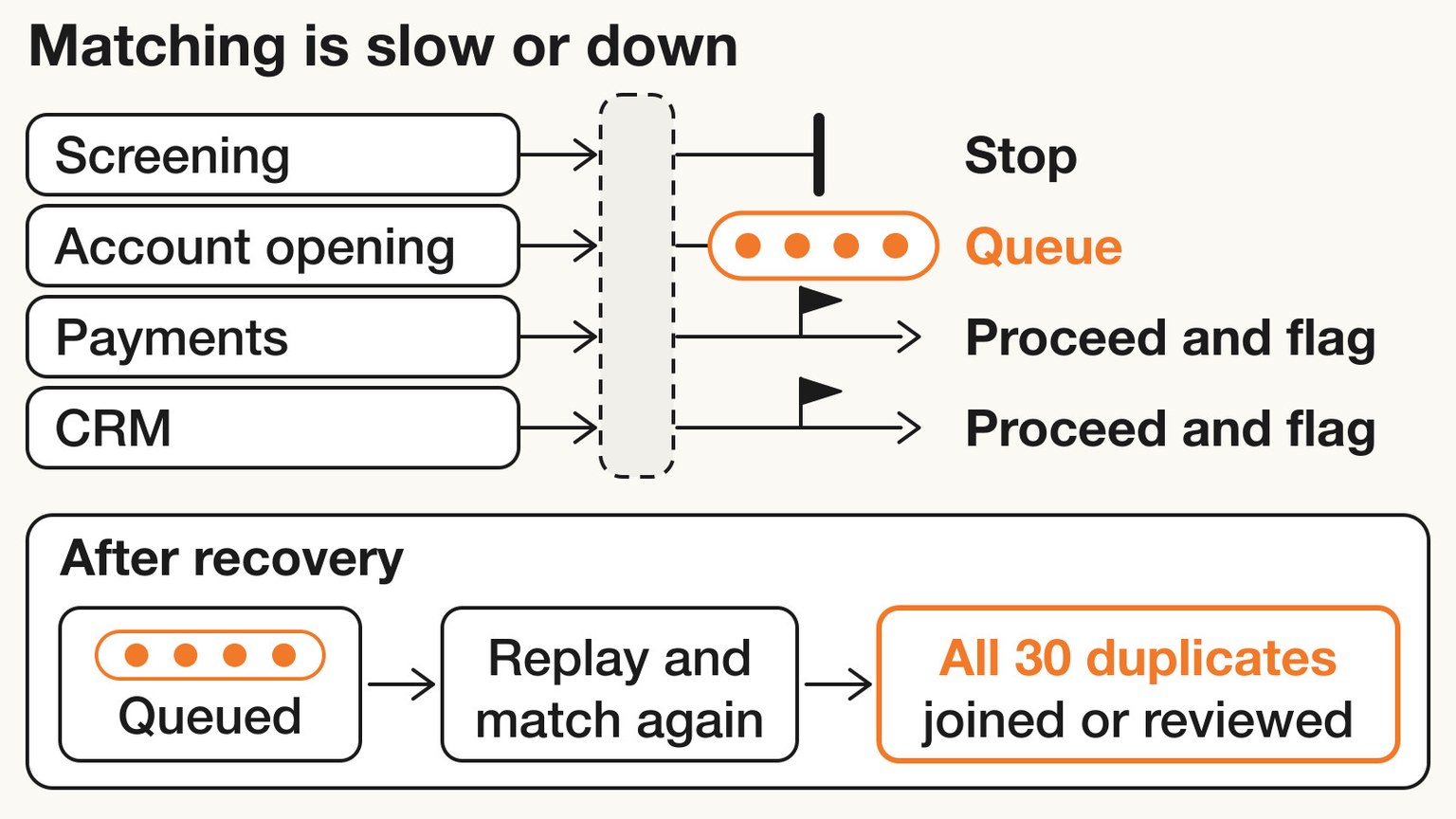
Each flow has its own mode while matching is down. After recovery the queue is replayed, and the example test passes when all 30 seeded duplicates are joined or sent to review.
What should the bank get in writing from the vendor?
Six things, so the contract describes the behaviour the PoC measured:
- Latency terms: which figures are contractual, at what load, and measured where.
- Service levels and support: availability commitment, support hours and response times by severity.
- Incident communication: who tells the bank, how fast, and through which channel.
- Maintenance windows: notice periods and whether ingestion or search can pause during them.
- Recovery objectives: how long until service returns and how much in-flight work may need resubmitting.
- Exit: how the bank takes its rules and data with it, which our article on running in the bank’s own cloud account covers in detail.
What do we document at Tilores, and what stays with the bank?
We publish query latency of about 150ms and ingestion under 300ms on AWS, and about 1ms and 2ms on premise in the bank’s own data centre, and our deployment page states that “Latency figures are typical, not contractual.” We agree service levels per customer: on our pricing page, “Uptime guarantees, data residency requirements, SOC 2 / GDPR compliance commitments, and dedicated support all factor into the overall package”, and on-premise deployments carry custom SLAs. Put the figures you need in the contract and test against them.
The deployment model decides who carries the infrastructure. On our managed cloud we operate it. In the bank’s own AWS account the bank provides it and we manage the deployment, so the bank’s failure tests also cover its own queue, key-value store and file storage.
For the tests themselves, we give the bank four tools in our GraphQL API:
- Assembly status. We assemble records into entities asynchronously, and our
assemblyStatusquery returnsREADYorIN_PROGRESSwith an estimate of minutes remaining. It works only where SQS is the raw data queue, and the estimate can be highly inaccurate while records arrive at variable rates or are updates, so treat it as rough. It is the signal to watch in the partial-failure test. - Dry-run preview. Our
submitWithPreviewwithdryRunshows how the entities would look if a record were ingested, without ingesting it, so the bank can preview its replay before running it. - Entity stream. We publish every data change as an event, such as create, update or merge, so downstream systems see each link the replay makes.
- Review queue. Our review puts weak links in front of a reviewer, and a reviewer can raise a case for two entities that no rule connects.
What stays with the bank: the degraded-mode policy, the timeouts and retry logic in its own applications, the screening decisions, its impact tolerances and the tests. Book a demo to scope these tests for your evaluation.
How do you clear the records created while the matcher was degraded?
Replay the queue, let matching find the duplicates, and send the uncertain ones to review, in that order. The backlog is the expensive part, because every duplicate created in degraded mode may already hold a product, a consent or a screening result.
- Preview the replay. Run the queued records through a dry-run preview and count how many would join an existing entity.
- Submit and watch the events. Submit the records, then read the update and merge events to see which degraded-mode records joined known customers.
- Review the uncertain links. With the defer strategy, our review keeps the records of a weak link apart until the review decides. Size that queue in advance with the method in our review queue sizing guide.
- Repair downstream systems. Every downstream system that received a degraded-mode record links it to the resolved customer and reruns screening where the customer changed.
- Close with a reconciliation report. Records created in degraded mode, records joined, records reviewed, records still open, and the time each step took.
Stable identifiers make step four possible. When a record matches several entities, we keep the ID of the oldest entity, and our FAQ notes that re-ingesting a record does not restore a deleted entity ID. Downstream systems should therefore hold source record IDs and follow merges, as our guide to merges, splits and stable IDs explains. When a decided record is submitted again, our review applies the newest past verdict for that pair, so a replay does not reopen settled cases.
Test the bank’s event handling too: our entity stream can deliver an event twice and out of order, so the bank’s consumer has to process an event more than once safely.
How does this connect to DORA and UK operational resilience rules?
Both regimes ask the bank to plan for disruption and test the plan. Whether the matcher behind onboarding falls inside that scope depends on how the bank maps its critical functions and important business services.
For EU banks, DORA has applied since 17 January 2025, and where an ICT service supports a critical or important function, Article 30(3) asks for “full service level descriptions” with “precise quantitative and qualitative performance targets”, and for the provider to “implement and test business contingency plans”.
For UK banks, the PRA’s SS1/21 defines an impact tolerance as “the maximum tolerable level of disruption to an important business service”, and firms had to be able to remain within those tolerances by 31 March 2025. The FCA’s rules in PS21/3 require scenario testing of “severe but plausible” disruption. If onboarding is an important business service, its impact tolerance caps the backlog-clearance measure in the acceptance table.
What goes into the statement of work?
A one-page test plan and a three-line policy. The test plan lists the six tests, the load, the seeded duplicates and the acceptance measures from the table above. The policy can be pasted in as written:
- Screening at onboarding and the exited-customer check stop while identity resolution is unavailable, and no account leaves the restricted state until both have run.
- Account opening proceeds into a restricted state, with no transactions until the record is resolved and screened.
- The payment journey, contact centre lookup and CRM enrichment proceed on the last resolved view, flag each unresolved record, and are reconciled within the bank’s stated limit.
A bank that signs with these answers has measured its degraded modes before it needs them. Our rollout guide covers cutover and parallel running after the PoC, and our bake-off guide covers comparing vendors on accuracy.
Frequently asked questions
Should entity resolution fail open or fail closed in a bank?
It depends on the flow. With Tilores or any matcher, fail open only where a missed link can be repaired later without harm, such as CRM enrichment. Screening against sanctions, PEP and adverse media sources and the exited-customer check should stop.
Does Tilores publish an uptime SLA?
We agree uptime guarantees and support per customer as part of the package we quote, on-premise deployments carry custom SLAs, and our published latency figures are typical, not contractual. Put the figures you need in the contract and test against them in the PoC.
How long should a matching outage at onboarding be tolerated?
The bank sets the limit from its own impact tolerance for the service. In the PoC, measure the time from recovery to an empty backlog and compare it with that limit. Our assembly status query reports READY once the assembly queue is idle, where SQS is the raw data queue; treat its estimate of minutes remaining as rough.
Can an account be opened while identity resolution is unavailable?
From July 2027 the AMLR lets a credit institution open an account if no transactions are carried out until customer due diligence is complete, and the FATF’s Recommendation 10 allows verification after the relationship starts only where the risks “are effectively managed”. An account with no transactions can wait while the identity layer catches up, and the bank’s legal team decides which flows may use it.
Why can a payment not wait for identity resolution?
Because the deadlines are fixed in law. PSD2 requires member states to oblige the payer’s provider to ensure the amount reaches the payee’s provider “by the end of the following business day”, as Article 83 sets out, and an instant payment leaves no time to stop. For instant credit transfers in euro, the Instant Payments Regulation moves sanctions checks onto the customer base, run “at least once every calendar day”, so customers created in degraded mode must be in the next daily run.
Sources
- Regulation (EU) 2022/2554 on digital operational resilience for the financial sector (DORA), Official Journal of the European Union, 27 December 2022, Articles 11, 28, 30 and 64; Article 11 requires ICT business continuity plans that are periodically tested.
- SS1/21 Operational resilience: Impact tolerances for important business services, Prudential Regulation Authority, Bank of England, updated 11 March 2022.
- PS21/3 Building operational resilience, Financial Conduct Authority, March 2021.
- Regulation (EU) 2024/1624 on the prevention of the use of the financial system for money laundering or terrorist financing (AMLR), Official Journal of the European Union, Articles 23 and 90.
- The FATF Recommendations, Financial Action Task Force, Updated June 2026, Recommendation 10.
- Directive (EU) 2015/2366 on payment services in the internal market (PSD2), Official Journal of the European Union, Article 83.
- Regulation (EU) 2024/886 on instant credit transfers in euro, Official Journal of the European Union, Article 1 inserting Article 5d into Regulation (EU) No 260/2012.
- REL05-BP01 Implement graceful degradation to transform applicable hard dependencies into soft dependencies, AWS Well-Architected Framework, Reliability Pillar.
- Circuit Breaker pattern, Azure Architecture Center, Microsoft.
- What is AWS Fault Injection Service?, AWS documentation.
- Addressing Cascading Failures, Site Reliability Engineering, Google.
- OpenSanctions, open database of sanctions, watchlists and politically exposed persons.
- Deployment Options, Tilores.
- Pricing, Tilores.
- API reference: assembly status, submitWithPreview and entity stream, Tilores documentation.
- Review, Tilores documentation.
- FAQ: entity IDs, Tilores documentation.
- What an Entity Resolution Rollout Actually Looks Like in 2026, End to End, Tilores.
- How to Run an Entity Resolution Vendor Bake-Off With Real Bank Data, Tilores.
- How to Handle Entity Merges, Splits and Stable IDs Downstream, Tilores.
See what resolved entity data does for your business — and your AI.