Can We Hash Personal Data Before Sending It to an Entity Resolution Vendor? What Hashing Protects and What It Breaks for Banks (2026)


TL;DR: Yes, a bank can hash personal data before an entity resolution vendor sees it, but the result is still personal data, and a hash destroys the spelling that name and address matching needs. Keep keyed hashes for stable identifiers. At Tilores, we can run our matcher inside the bank’s own environment, so names never need hashing.
Book a Demo · Try Tilores Studio (Free)
On this page
- Is a hashed name still personal data?
- What does a keyed hash protect?
- What does hashing break in entity resolution?
- What are the alternatives to hashing before matching?
- Which protection fits which field?
- What should the DPIA record about hashing?
- Frequently asked questions
- Sources
A data protection officer is asked to approve a trial file in which every customer name is a 64-character SHA-256 string. It looks safe: nobody can read it. But the hash of Müller starts a78429 and the hash of Mueller starts bfb3c6, so two spellings of one customer now share nothing a matcher can compare. And anyone with a list of surnames can hash the list and read the column back.
The question data teams ask before a vendor trial, can we hash personal data before sending it to an entity resolution vendor, has an awkward answer. You can, but it protects less than it seems and costs most of the matching the bank wanted to test. For names, addresses and dates of birth, the stronger control is to keep the data in place and bring the matcher to it. Hashing still suits a short list of stable identifiers.
Is a hashed name still personal data?
Yes, for the bank in every case, and usually for the vendor too when the file holds a plain hash of a name. UK GDPR Article 4(5) defines pseudonymisation as processing data so that it can no longer be attributed to a person without additional information kept separately. A hash is one way to pseudonymise. The ICO’s pseudonymisation guidance asks the same question and answers it: “Pseudonymised data is personal data in the hands of someone who holds the additional information.” The bank holds the clear-text names, so for the bank the hashed file never stops being personal data. The ICO notes that this guidance is under review after the Data (Use and Access) Act 2025.
EU banks get the same answer from the EDPB’s Guidelines 01/2025 on pseudonymisation, adopted for public consultation on 16 January 2025. They also describe the attack that matters here: if the transformation is only a SHA-256 hash of a name, anyone can hash all the names they hold elsewhere and see which hashes match.
The vendor’s position is more nuanced since the Court of Justice ruled in EDPS v SRB on 4 September 2025. The case applied Regulation 2018/1725, which covers the EU institutions. The Court held that pseudonymised data is not automatically personal data for every person, because pseudonymisation can stop people other than the controller from identifying anyone. On the duty to inform data subjects, it held that identifiability is assessed from the controller’s point of view when the data is collected. A bank’s duties therefore do not shrink because the vendor cannot read the file. For a UK bank the ruling is persuasive, not binding: UK courts may have regard to later EU case law but do not have to follow it. And a plain hash of a name rarely stops anyone, since any public list of names rebuilds it.
Dates of birth fail fastest. A century holds 36,525 possible dates. Hashing all of them with SHA-256 takes well under a second on an ordinary laptop, and a hashed date-of-birth column turns back into dates. The joint AEPD and EDPS paper on hashing makes the general point: when the type of attribute is known, a hashed value can be found by hashing every possible input and comparing.
What does a keyed hash protect?
A keyed hash protects stable identifiers from anyone who does not hold the key, and little more. FIPS 198-1 defines HMAC, the keyed-hash message authentication code, as a hash function used together with a shared secret key. Without the key, the dictionary attack above fails, because an outsider cannot reproduce the function. The ICO guidance points the same way: avoid hashing that adds no extra data such as a salt, pepper or encryption key, and avoid outdated algorithms such as MD5 and SHA-1.
Two limits remain. The key is itself the additional information, so if the bank shares it with the vendor to hash the vendor’s side, the vendor can run the dictionary attack again. The ICO makes this point about salts: consistent hashes need the salt shared, which brings back the risk of brute force. And a keyed hash still answers only one question: are these two values identical?
That suits a tax identifier, a national insurance number or an internal customer number, written the same way in every system. It suits anything a person types far less. For a bank, the useful case is narrow: joining two systems on a stable identifier, with the key held and rotated under the bank’s own key management.
New posts on entity resolution, identity data and AI. No spam, unsubscribe any time.
What does hashing break in entity resolution?
Hashing breaks every comparison that looks at characters, and customer matching in a bank is mostly made of those. The same person appears as Müller and Mueller, at Musterstr. 12 and Musterstrasse 12, as Ma. for Maria, with a maternal surname in one system and a married name in another. One changed character produces a completely different hash, so each variant arrives as an unrelated string.
Normalisation fails first. Before any rule can fire, we clean values so matching compares like with like: names cased, phone numbers to E.164, addresses parsed. Our transformations include a step that replaces characters such as the German umlaut with their base character, and our matchers can use phonetic encodings such as Cologne phonetics, Soundex and Metaphone. Under Cologne phonetics, Müller and Mueller produce the same code. None of these steps can run on a hash, because the letters are gone. Our guide to name and address normalisation for German banks shows how much of the work happens here.
Fuzzy comparison fails next. Edit distance, Jaro-Winkler and q-gram similarity measure how many characters two values share, and the hashes of two similar names share no more than the hashes of two different names. What survives is exact equality, the deterministic part of matching. The fuzzy and probabilistic parts, which find the same customer written two ways, are lost.
Screening suffers as well. Sanctions, PEP and adverse media sources publish names in clear text, as the OpenSanctions PEP datasets do, and screening against them is a fuzzy name match. A trial on hashed names can therefore only find records whose names were already spelled identically, which tells the bank little about how any engine would handle its real data. Our guide to proof-of-concept data makes the same point for trial extracts.
What are the alternatives to hashing before matching?
There are three, and each suits a different situation: encode the data so similarity survives, replace values with tokens, or keep the data where it is.
- Bloom-filter linkage. In privacy-preserving record linkage using Bloom filters, Schnell, Bachteler and Reiher (2009) split each identifier into q-grams, short overlapping pieces of text, and encode them into a bit array with keyed hash functions. Similar names then give similar arrays. Their tests gave linkage results comparable to unencrypted identifiers.
- Tokenisation. A service the bank controls swaps each value for a random token and keeps the lookup table. The EDPB guidelines note that such tables are personal data and must be protected. Like a hash, a token supports exact joins only.
- Not sending the data. The bank runs the matching engine inside its own environment, so names and addresses never leave it in any form.
Bloom filters carry a security cost. Christen, Ranbaduge, Vatsalan and Schnell showed an attack that re-identifies attribute values from large real-world databases in a few minutes. A later evaluation on North Carolina voter records re-identified up to 20.7% of plain-text values from Bloom filters with no hardening; some hardening methods cut that sharply. An encoded file is pseudonymised data, not anonymous data.
Hashing or a Bloom-filter method is still the right tool in two cases. The first is when two organisations must link records and neither may see the other’s clear text, as in a consortium or a research linkage through a trusted third party. There, a keyed hash on stable identifiers or a hardened Bloom-filter method is reasonable. The second is when the bank needs only exact joins on a high-entropy identifier, and a keyed hash is enough. The case neither fits is the common one: a bank that wants a vendor to find its duplicate customers.
How we keep names and addresses unhashed in Tilores
We built Tilores so a bank does not have to trade privacy for match quality. With Tilores Studio, we run entity resolution locally on the evaluator’s own machine, for up to 100,000 records in local mode, and store everything there; the data never leaves that machine. A data team can test our normalisation and fuzzy rules on clear-text names before any file goes anywhere. Our guide to running entity resolution on your own machine first walks through that evaluation.
For production, we run the same engine inside the bank’s own AWS account, on DynamoDB, SQS and S3 in its VPC. The data stays in the bank’s environment and none of our staff can access its records, while we manage and update the deployment remotely. We also deploy to another cloud or on-premise, including air-gapped networks, and the matching rules tuned in Studio are the rules we run in production. Our data compliance controls add provenance on every record, access controls, retention rules and an audit trail.
Some decisions stay with the bank: the DPIA, the lawful basis, who can reach the deployment inside its account, and the key management for any identifier it still chooses to hash. Our guide to a DPIA before an entity resolution trial covers what the data protection officer records.
Which protection fits which field?
The right protection depends on the field, because fields differ in how guessable they are and in how much fuzzy matching they need. A bank that applies one control to the whole file either over-protects its identifiers or loses its names.
Which protection fits which customer field, and what matching keeps
| Field | Protection | What matching keeps |
|---|---|---|
| Tax ID, account number | Keyed hash (HMAC), key held by the bank | Exact match only |
| Date of birth | Keep in the bank’s environment; never a plain hash | Exact match and consistency checks |
| Name | Keep in the bank’s environment | Normalisation, phonetic and fuzzy matching |
| Name, across two organisations | Hardened Bloom filter with the bank’s key | Approximate matching, with a stated re-identification risk |
| Address | Keep in the bank’s environment | Parsing and normalisation, then fuzzy matching |
| Email, phone | Keep in place, or keyed hash after normalisation | Exact match on the cleaned value |
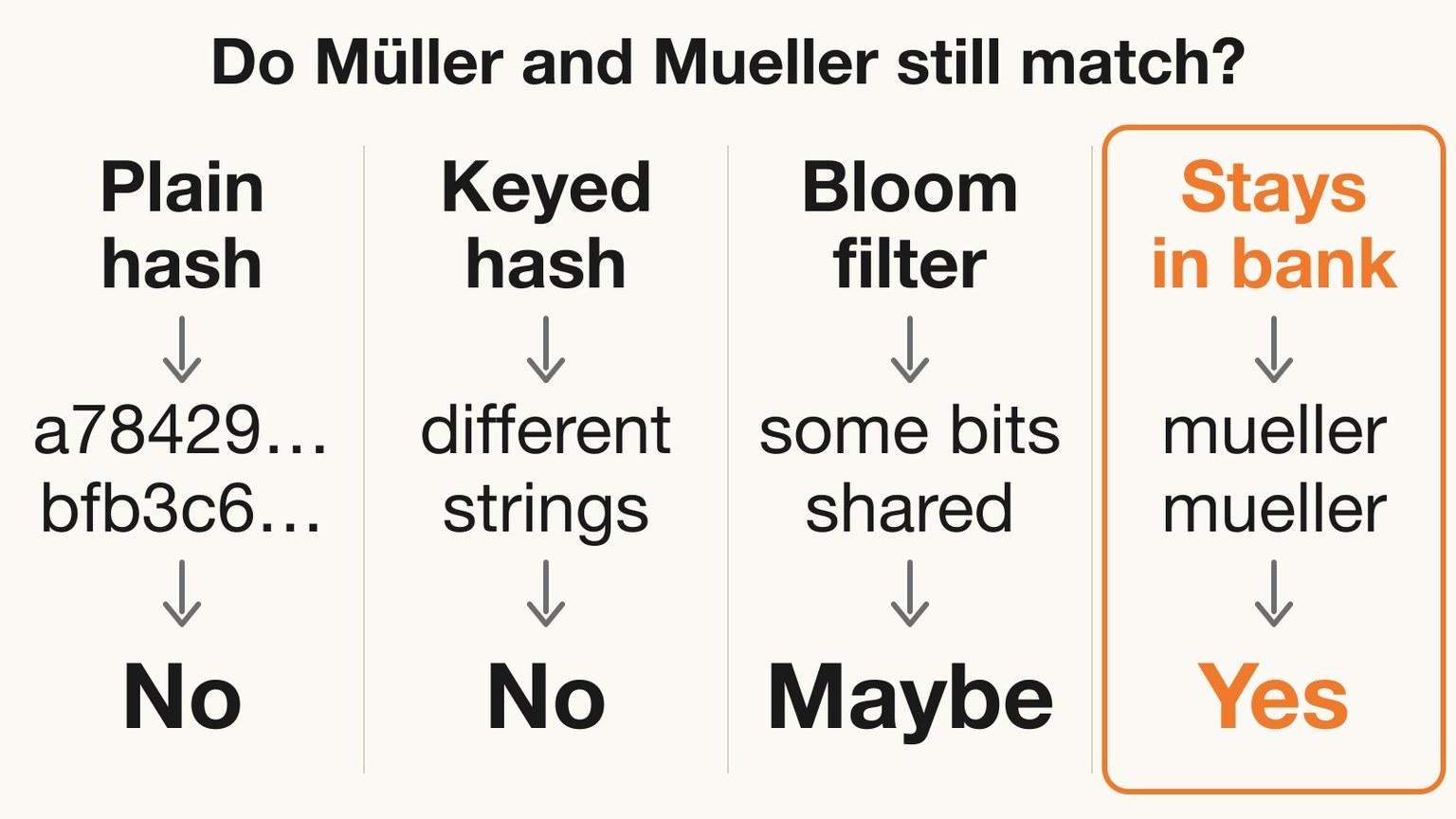
Two spellings of one customer after each protection: only data that stays in the bank still pairs Müller with Mueller. A Bloom filter gives a partial match at best, and a plain hash can also be reversed with a list of names.
Email and phone sit in the middle. A keyed hash can work once each value is normalised the same way on both sides. Cleaning is only possible while the value is still readable, so normalise first and hash second.
What should the DPIA record about hashing?
One decision per field, made before any extract is cut and recorded with its reason:
- Stable identifiers: a keyed hash is acceptable; the bank holds and rotates the key, and no plain SHA-256 is used.
- Dates of birth: never hashed on their own; they stay in the bank’s environment.
- Names and addresses: matched in the bank’s environment; a Bloom-filter method with the bank’s key only where records must cross organisations, with its re-identification risk recorded.
- Screening: sanctions, PEP and adverse media checks run on clear-text names inside the bank.
- Status: every transformed field is recorded as pseudonymised personal data, not anonymous data.
Back to the trial file of 64-character names. The data protection officer could approve it, but it would protect less than it looks and show the bank little about matching. The same records run through Tilores Studio on a bank laptop, or through our engine in the bank’s own AWS account, stay readable to the matcher and never reach us.
Frequently asked questions
Is salted or keyed hashing enough to make customer data anonymous?
No. A salted or keyed hash is pseudonymisation, so the data stays personal data for the bank, which holds the clear text and the key. It lowers the risk of exposure to outsiders who lack the key, which is useful, but it does not take the file outside data protection law.
Can an entity resolution vendor match on hashed data at all?
Only on exact equality. Two hashed values match when the original values were identical, normalised the same way and hashed with the same key. That works for stable identifiers. Fuzzy, phonetic and address matching need the original characters, so they do not work on hashes.
Does the EDPS v SRB judgment let a bank treat hashed data sent to a vendor as non-personal data?
Not on its own. The Court of Justice held that pseudonymised data is not automatically personal data for every person. But the case applied Regulation 2018/1725 for the EU institutions, and the Court judged the duty to inform from the controller’s point of view at collection. For UK GDPR the ruling is persuasive, not binding. A plain hash of a name can also be rebuilt by anyone with a list of names. The bank’s data protection officer decides how the ruling applies.
Does Tilores Studio send our customer data to Tilores?
No. We built Tilores Studio to run on your own machine and store everything there, for up to 100,000 records in local mode. Connecting Studio to our Tilores Cloud is a separate step that needs a cloud plan.
Does hashing remove the need for a DPIA before a matching trial?
No. Hashing does not change whether the data is personal, so it does not settle whether a DPIA is needed. It is one control the DPIA can record, field by field, alongside the decision to keep names and addresses in the bank’s environment.
Sources
- UK GDPR Article 4: definitions, The National Archives.
- Pseudonymisation (anonymisation and pseudonymisation guidance), Information Commissioner’s Office.
- Guidelines 01/2025 on Pseudonymisation, version adopted for public consultation on 16 January 2025, European Data Protection Board.
- Press release No 107/25: Judgment in Case C-413/23 P, EDPS v SRB (concept of personal data), 4 September 2025, Court of Justice of the European Union.
- European Union (Withdrawal) Act 2018, section 6: interpretation of retained EU law, The National Archives.
- Introduction to the hash function as a personal data pseudonymisation technique, AEPD and European Data Protection Supervisor.
- FIPS 198-1, The Keyed-Hash Message Authentication Code (HMAC), National Institute of Standards and Technology.
- Privacy-preserving record linkage using Bloom filters (Schnell, Bachteler and Reiher, BMC Medical Informatics and Decision Making, 2009), PubMed Central.
- Precise and fast cryptanalysis for Bloom filter based privacy-preserving record linkage (IEEE Transactions on Knowledge and Data Engineering, 2019), Macquarie University research portal.
- Evaluating hardening techniques against cryptanalysis attacks on Bloom filter encodings for record linkage (2018), International Journal of Population Data Science.
- Politically Exposed Persons datasets, OpenSanctions.
- Tilores product, Tilores.
- Transformers, Tilores documentation.
- Matchers, Tilores documentation.
- Download Tilores Studio, Tilores.
- Deployment options, Tilores.
- Data compliance, Tilores.
- Entity Resolution Proof of Concept: 7 PoC Inputs a Bank Needs in 2026, Tilores.
- Does a Bank Need a DPIA Before an Entity Resolution Trial in 2026? What the Data Protection Officer Must Record, Tilores.
- Run Entity Resolution on Your Own Machine First: A Developer’s Ten-Minute Evaluation, Tilores.
- How German Banks Should Normalise Names and Addresses Before Entity Resolution, Tilores.
See what resolved entity data does for your business — and your AI.