Monitoring Large Loan Exposure using Graphs and Identity Resolution


TL;DR: EU banks must report individual loans above €1 Million under Article 394 CRR, but without identity resolution they can miss cumulative exposure spread across business units. A graph-based identity resolution system links fragmented customer records automatically, so over-indebted borrowers surface before a reporting deadline and before a regulatory fine.
| Challenge | Without identity resolution | With graph-based identity resolution |
|---|---|---|
| Same customer, multiple business units | Treated as separate borrowers; cumulative debt invisible | Records linked into one identity graph; total exposure calculated automatically |
| Name and format variations across systems | Manual reconciliation or missed matches | Probabilistic and deterministic matching handles name variants, different DoB formats, etc. |
| Article 394 CRR quarterly reporting | Risk of unreported exposure above €1 Million threshold | Automated flagging of customers with cumulative credit above reporting threshold |
| Regulatory fine exposure | Financial penalties under national law (see Article 394 CRR reporting) | Resolved identities surfaced before the reporting deadline |
On this page
- Large Loan Reporting
- Deutsche Bank Example
- The Risk for Banks without Identity Resolution
- Fancy a €100,000 Fine?
- FAQ: Frequently Asked Questions
One of the biggest risks to banks is over-exposure to individuals, or related groups of individuals, who themselves are over indebted and therefore represent an existential credit risk to the stability of the entire bank.
In order to mitigate this risk, banks in the EU must comply with Article 394 of the Capital Reporting Requirements (CRR), which requires them to report their large exposures, and loans of over €1 Million, to the local regulator (e.g. the Bundesbank in Germany) on a quarterly basis.
Here is where graphs and identity (or “entity”) resolution can help. In identity resolution, a graph is a data structure that connects entities (nodes) through relationships (edges) to help identify when multiple data records actually represent the same real-world entity, or highly related entities.
Let’s focus on the individual loans here, as we have covered large exposures and “connected clients guidelines” previously.
Large Loan Reporting
When the local regulator receives information about loans of over €1 Million to individuals, it compares the data from all other lenders to look for individuals who may be over-indebted to more than one financial institution, and then reports this information back to the lenders. This data is also transmitted from the local regulator, to the European Central Bank (ECB) and the European Banking Authority (EBA), where the same exercise is performed, so that individuals with large debts across the EU are known to all.
This means that the banking authorities themselves are conducting identity resolution. In a large body of customer data records (e.g. 1400 banks in Germany regularly sending data), with similar but non-exact record attributes (e.g. name, address, date of birth etc), the regulator must identify which two or more records from different sources belong together in one identity, to establish their total-indebtedness.
New posts on entity resolution, identity data and AI. No spam, unsubscribe any time.
Deutsche Bank Example
Let’s look at a simple, hypothetical example representing Deutsche Bank in Germany and Austria and a customer that has four different accounts:
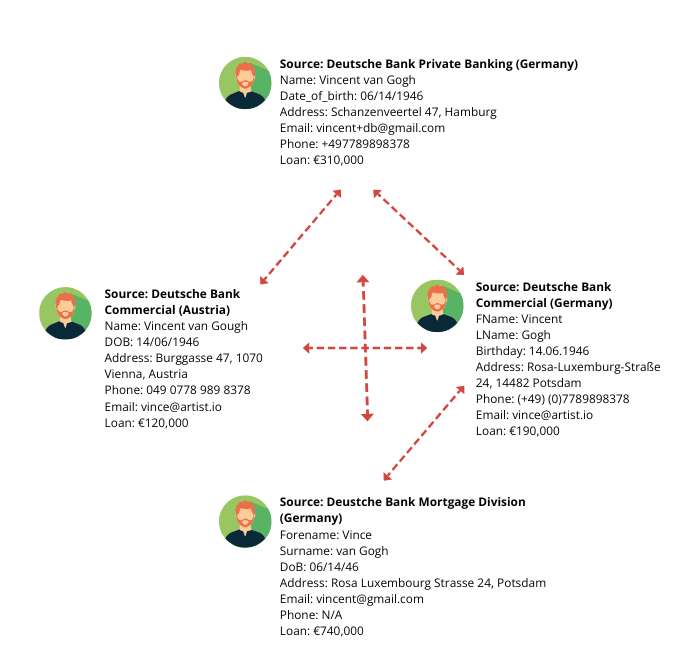
Firstly, you can see that each bank has a different format for storing the customer record data: e.g. Name vs Forename + Surname; Birthday vs DoB. That is the reality of real-world data across large organisations.
Nevertheless, using identity resolution techniques, these customer records could be linked together as belonging to the same person (a so-called “identity graph”) based on 1) name variations that follow standard patterns (Vincent van Gogh vs. van Gogh, Vincent), 2) consistent date of birth (albeit in different formats), 3) consistent contact information over some records.
The Risk for Banks without Identity Resolution
So while the central banking authorities are actively conducting identity resolution on the data sent to them by thousands of banks, the problem for the individual banks is when they do not do the same with their own customer data.
A bank, such as Deutsche Bank, may have many business units, or group companies across different countries. Since it is difficult for a bank to keep unified profiles of their customers, it is quite possible that a bank may have unknowingly given several sub-million euro loans to an individual, the sum of which is over €1 Million and hence should be reported. As the bank does not know that they have given so much credit to one person, they never report the individual - creating a credit risk not only for the bank itself, but for other banks that may also have lent money to this individual.
In the above Vincent van Gogh example, none of the individual loans are over €1 Million, so this individual’s total indebtedness might never be reported to the authorities, when in fact his total indebtedness is €1,360,000. Even if the German side of Deutsche Bank knew that their three Vincents were the same person, the Austrian division might think that they have a customer with a relatively risk-free credit of only €120,000, who would therefore never be reported to the authorities.
The solution to this would be for the bank to use an identity resolution solution, like Tilores, where the connections between customers in different business units can be established and the customers with >€1 Million credit easily identified.
Whether this was a persistent system, continuously updated in real-time, or a system that is run once a quarter and then wiped clean would not really matter. What matters is fast, and accurate data showing which customers are related - without the bank having to do more than press a button to ingest some data.
Fancy a €100,000 Fine?
That’s how much a bank has to pay as a fine if they fail to notify the relevant authorities about a customer with cumulative loan exposure of >€1 Million. That means a simple identity resolution failure - the inability to link the same customer(s) over multiple business units within a banking group - could get very costly. A strong justification for investing in sophisticated identity resolution technology.
The EU large exposure framework is broadly aligned with the Basel Committee’s 2014 supervisory framework for measuring and controlling large exposures (BCBS, 2014).
What else should you read on identity resolution?
- EBA Connected Clients Guidelines: what they mean for identity resolution
- What is entity resolution? AI, KYC, and Customer 360 explained
- Precision and recall in entity/identity resolution
- Entity resolution technology for master data management
FAQ
Why do banks need identity resolution for large loan monitoring?
Banks may have multiple business units or subsidiaries in different countries, each holding separate loan records for the same customer. Without identity resolution to link those records, a customer’s cumulative debt can exceed the €1 Million EU reporting threshold without the bank knowing, creating regulatory and credit risk.
What is Article 394 of the Capital Requirements Regulation (CRR)?
Article 394 of the EU Capital Requirements Regulation (CRR) requires banks to report large exposures and loans of over €1 Million to their local regulator on a quarterly basis. That data is also passed to the European Central Bank and the European Banking Authority for cross-institution analysis.
How do graphs help banks detect connected borrowers?
A graph connects entities (nodes) through relationships (edges), making it possible to link multiple loan records belonging to the same individual or related group across business units. Once linked into an identity graph, the bank can sum total credit exposure for each person and flag those above the €1 Million reporting threshold.
What fine can a bank face for missing a large loan report?
Penalties are set in national law. Under the German Banking Act, failing to report a loan of one million euros or more can carry a fine of up to one hundred thousand euros, and failing to report a large exposure under Article 394 of the Capital Requirements Regulation can carry a fine of up to five million euros. The exact penalty depends on the breach and the national regulator. Bundesbank documentation.
Does an identity resolution system for large loan monitoring need to run continuously?
Not necessarily. What matters is fast, accurate data showing which customers are related. The system could be persistent and continuously updated in real time, or run quarterly and then cleared. Either approach satisfies the reporting cycle as long as the underlying linking is accurate.
See it on your own data: book a demo for a walkthrough on your records, or get the evaluation build to try resolved entity data locally.
See what resolved entity data does for your business — and your AI.