How Does a Bank Answer a Subject Access Request When One Customer Sits in Five Systems? (2026)

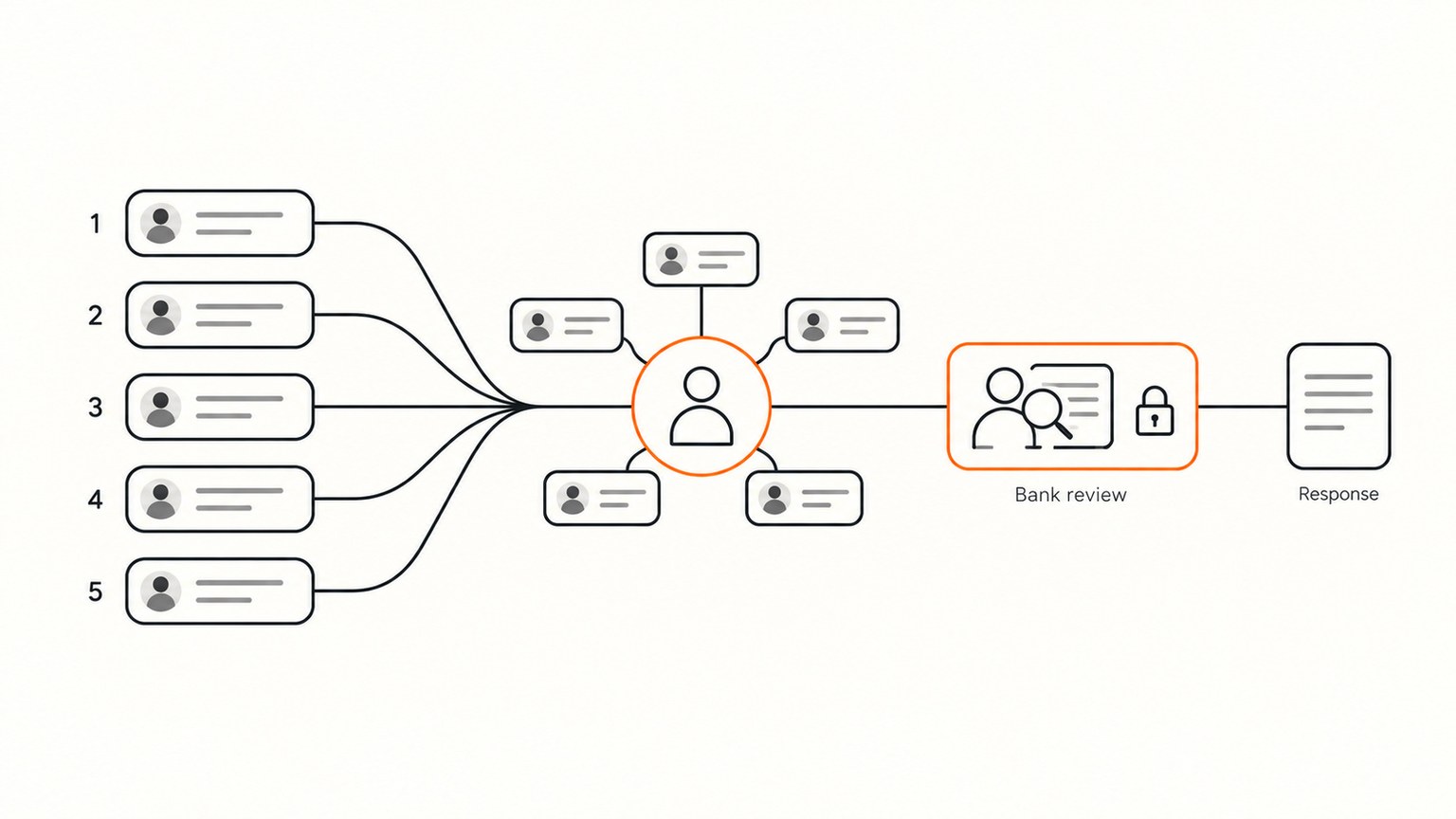
TL;DR: A bank should map the customer’s records, retrieve the linked personal data and review it before disclosure. With Tilores, we link records belonging to the same person and return their identifiers and connecting rules for checking. The bank still controls wider searches, redaction, the intelligible response and the applicable deadline.
Book a Demo · Try Tilores Studio (Free)
On this page
- How do you find the right records before retrieving the data?
- How long does the bank have to answer?
- How do you confirm that each record belongs to the customer?
- What must the bank exclude or review before disclosure?
- What does the final response need beyond the record map?
- Where does Tilores fit in the access response?
- What four-stage record should the DPO keep?
- Frequently asked questions
- Sources
A customer asks for the information the bank holds about them. Core banking has their current name, the card system has an earlier surname, and a complaint sits under a case number. A search for today’s name misses part of that history. Broadening it brings back another customer with the same name. The response team has two problems before it has opened a single attachment.
The useful starting point is a person-to-record map: the source identifiers that belong to this customer, the evidence connecting them and the unresolved candidates. That map makes retrieval more reliable. It does not decide which passages can be disclosed, or prove that every relevant store has been searched. Those checks follow, inside the response window.
How do you find the right records before retrieving the data?
Start with verified identifiers and the bank’s information inventory, then trace the customer into each relevant store. A single name is a search clue. It is weak evidence of record ownership when names change or two people share one.
The ICO’s preparation guidance recommends information asset registers and systems that allow retrieval and redaction. Use that inventory to assign an owner to core banking, cards, CRM, mortgages and complaints. Extend it to relevant processors, correspondence, recordings, archives and filing systems. The controller remains responsible for obtaining information held on its behalf by processors, as the ICO explains in its description of the right of access.
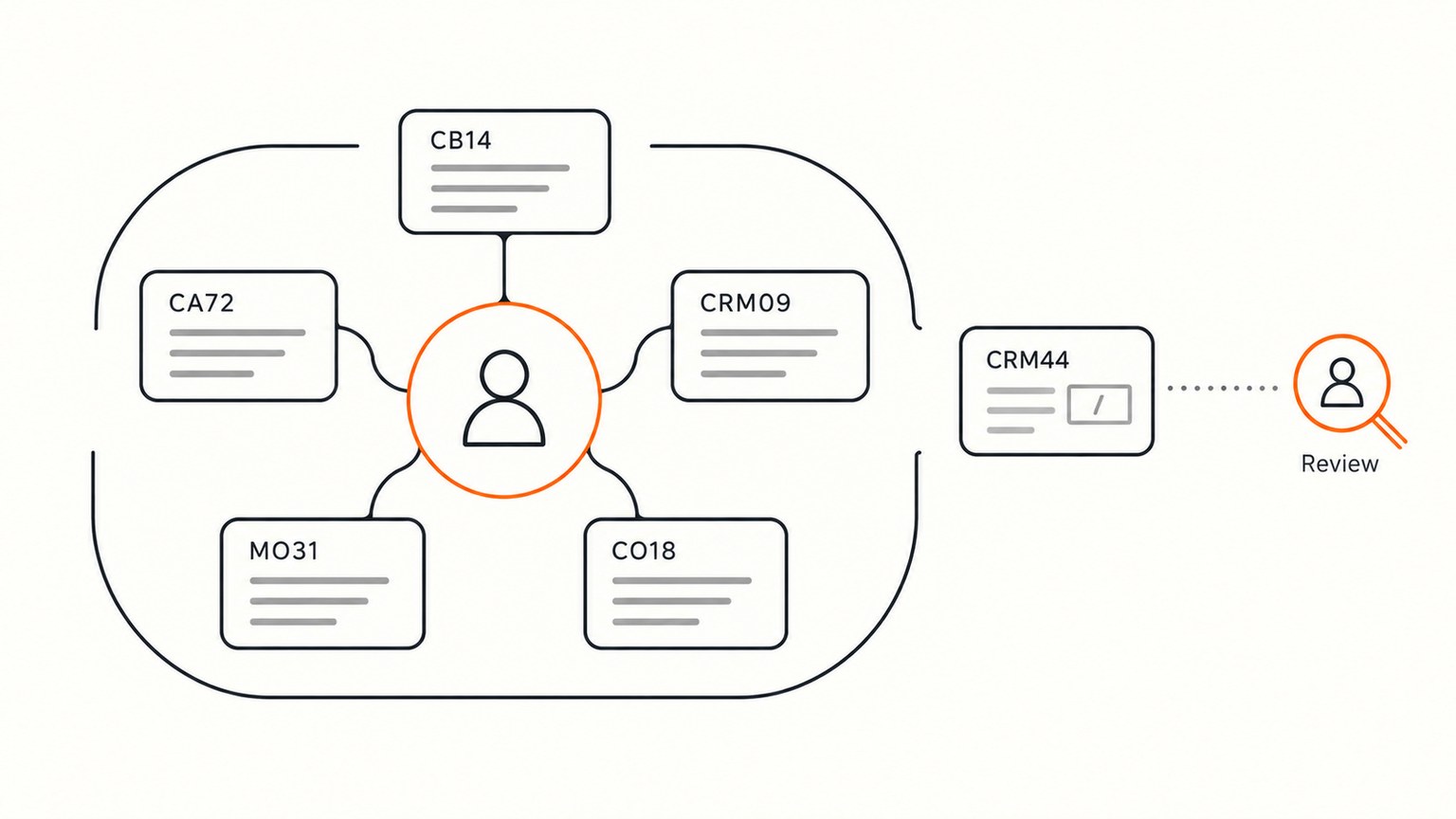
Consider a request from Leah Morgan, who previously used the surname Patel. The bank has verified that history and her birth date, 14 June 1981. These six candidate records require six decisions:
Five records concern Leah; one belongs to a namesake
| System and record | Evidence to check | Retrieval decision |
|---|---|---|
| Core banking CB14 | Leah Morgan; verified customer reference and birth date | Use as the confirmed starting record |
| Cards CA72 | Leah Patel; verified previous surname and birth date | Include the linked card record |
| CRM CRM09 | Leah Morgan; verified link to CB14 | Include the CRM record |
| Mortgages MO31 | L. Patel; verified mortgage-to-customer reference | Include the mortgage record |
| Complaints CO18 | Case reference linked to CA72 | Retrieve the complaint and assess its contents |
| CRM CRM44 | Leah Morgan; birth date 3 February 1988; confirmed different person | Exclude the unrelated customer record |
The result is five included records and one excluded candidate. Matching only the current surname would miss the card and mortgage records; accepting every identical name would include CRM44. Neither error is fixed by putting the results into a well-formatted PDF.
For a small, verified record set, a controlled manual map can do this job. A bank does not need to buy an entity resolution system to answer a request. The case for a maintained resolution layer grows when the same identity work recurs across products, historical records and incoming updates. If that is the gap, test our Tilores matching configuration on known same-person and different-person records before using its results for retrieval.
How long does the bank have to answer?
The normal period is one month, with a requirement to act without undue delay. Under EU GDPR Article 12(3), two further months are available where necessary, taking account of the complexity and number of requests; the person must receive notice and reasons within the first month. Five source systems do not create an automatic extension.
For UK requests, current Article 12 points to the applicable period in Article 12A. The 2025 Act’s section 76, in force since 5 February 2026, sets out that period, including its starting point, extension and reasonably necessary clarification provisions. Apply the current UK calculation to a UK request.
For a UK request, count the month from the latest applicable receipt of the request, necessary identity or authority information, or a permitted fee. The deadline falls on the same date next month; use that month’s final day if the date is missing, and the next working day if the deadline is a weekend or public holiday. The ICO’s calculation guidance also explains the clarification pause.
For example, assume a request arrives on 12 May 2026, identity is already confirmed and no fee applies. The ordinary deadline is 12 June. If reasonably necessary clarification is requested on 13 May and received on 15 May, exclude those three calendar days: the clock resumes on 16 May and the deadline moves to 15 June. This UK pause does not defer supplementary information the bank can reasonably provide without clarification; that remains due within one month of receiving the request. Asking only about the response format does not pause the clock.
What should the response team put in its calendar?
Record receipt, the applicable starting point, the due date and the reason for any change to it. The ICO’s response guidance calculates the UK month by the corresponding date in the following month, with adjustments for shorter months and non-working days. It also warns that volume alone does not automatically make a request complex.
That calendar starts with recognition of the request. In the UK, a customer can make a valid request verbally or in writing without using a prescribed form or naming Article 15, as the ICO’s recognition guidance explains. Routing it to the privacy team later must not hide its original receipt date.
New posts on entity resolution, identity data and AI. No spam, unsubscribe any time.
How do you confirm that each record belongs to the customer?
Separate requester authentication from record attribution. Establishing that Leah made the request does not establish that every Leah Morgan in CRM is her. Equally, a strong record link does not authenticate the person asking for the response.
Identity checks should be proportionate. The bank can often use its existing verification measures; asking every established customer for a fresh passport copy creates work and collects more information. Check whether additional evidence is necessary, and record why it was requested.
Once the requester is verified, examine the record links. In our GraphQL entity response, source records are returned with their connecting edges. An edge such as CB14:CRM09:R7 identifies the two records and the linking rule. The operator can inspect R7 and the source fields to explain the inclusion. A rule identifier supports an explanation; it does not prove the rule produced the right result.
What happens when the fields conflict?
Investigate the conflict before accepting the candidate. Our configured consistency rules check a proposed record against the records in the candidate entity. A bank-defined birth-date rule can keep CRM44 outside Leah’s entity even when its name agrees. A missing birth date supplies no confirming evidence and should remain visible to the reviewer.
Validate that behaviour on the deployed version and configuration, including record updates and missing fields. Our 16 October 2026 release notes describe an update-consistency fix whose changed behaviour is initially opt-in. Test the bank’s actual installation before relying on the control for an export. Our explanation of entity-level consistency gives the underlying distinction from pairwise matching.
We assemble entities at ingestion and retrieve their current context at query time. Keep original source values alongside the normalised matching values so the operator can see both the customer’s earlier spelling and the representation used to match it. The wider processing controls are covered in our real-time identity resolution under GDPR guide.
What must the bank exclude or review before disclosure?
Exclude an unrelated namesake’s record from the customer’s retrieval set, then assess mixed information within the records that remain. A complaint about Leah can also identify a joint account holder, a complainant or a member of staff. Correct entity membership does not settle those people’s rights.
The ICO’s guidance on information about other people requires consideration of consent or whether disclosure without consent is reasonable. Redaction can preserve access to the requester’s information. A refusal of third-party consent does not by itself settle the assessment; the bank must record its reasoning.
How should wrongly attributed screening information be handled?
A second boundary matters for sanctions, politically exposed person (PEP) and adverse media material. A screening result wrongly attributed to Leah can itself be information the bank processes about her. Keep it for assessment instead of hiding it because the underlying allegation is wrong. The EDPB’s access guidelines make clear that incorrect personal data are also within scope. The bank’s privacy team must separately assess any applicable restriction.
Financial-crime information is not automatically exempt from access. For UK requests, the ICO’s exemptions guidance explains the conditions, including the likely-prejudice test for the crime and taxation exemption. A screening label is not an exemption decision. EU requests require the applicable EU and national restrictions to be assessed on their own terms.
If an unrelated record has already joined the entity, preserve the case evidence and correct the membership before continuing retrieval. Our GraphQL disassemble operation can remove connecting edges and split an entity when connectivity breaks. Check the resulting records and any affected downstream extracts. A suspected previous disclosure belongs in the bank’s separate wrong-match incident assessment.
What does the final response need beyond the record map?
The response needs an intelligible copy of the relevant personal data and the required information about its processing. EU GDPR Article 15 covers purposes, recipients, retention information and the other specified rights and disclosures. A list of five customer identifiers does not fulfil that job.
In its official summary of case C-487/21, the EU Court explains that document extracts, or entire documents, can be necessary where essential to make access effective. Keep context that allows the customer to understand a complaint or an inferred classification. A table of isolated field values can lose that context.
The ICO’s guidance on supplying information also addresses explanations, accessible formats and secure delivery. Explain internal codes where necessary, check the destination and agree a suitable delivery method. A secure portal helps only if the person can use it or obtain a reasonable alternative.
How do you check for data the entity graph does not contain?
Reconcile the record map with the search inventory. The graph only covers the data connected to it. Use the verified identifiers, historical names and case references to search relevant correspondence, archives, recordings and other stores outside the resolver.
The ICO’s retrieval guidance includes dispersed stores, archived material and inferred information. Current UK Article 15(1A) expressly limits entitlement to what a reasonable and proportionate search can provide. That UK wording must not be treated as an EU-wide effort exemption: the EDPB guidelines take a different position on a general proportionality reservation.
Where does Tilores fit in the access response?
We provide the identity layer between the bank’s source records and its response team. Our data-compliance approach uses connected identifiers to find related records, while our GraphQL API can retrieve an entity from a known record ID and return its member records and connecting edges. Preserve the source-system references in the ingested records. In Leah’s case, the team can start from CB14, inspect the other linked record IDs and investigate why CRM44 remains outside the result.
Use that mapping to request the relevant material from each source owner, then reconcile it with the search inventory. For a repeatable evaluation, ask us to demonstrate the earlier surname, the namesake, a missing identifier and a corrected link using the bank’s agreed test records. Check the result against independently verified ownership rather than treating the match score as disclosure approval.
The privacy team still decides the scope of the search, third-party redaction, any applicable restriction and what the customer receives. An entity response does not complete the SAR workflow or supply a legal conclusion. A reliable existing customer map may already cover the identity task; where it does not, evaluate our financial-services resolution layer against those specific gaps.
What four-stage record should the DPO keep?
Keep a case record connecting the search performed to the response approved. It should let a colleague reconstruct why a source record was included, why a candidate was excluded and how the retrieved information was assessed.
- Find. Log the request, applicable deadline, system owners, identifiers and searches, including stores outside the entity graph.
- Confirm. Record requester verification and the evidence connecting each source record, with unresolved conflicts assigned for review.
- Exclude. Record unrelated candidates separately from disclosure restrictions, redactions and decisions on shared information.
- Explain. Assemble the intelligible response, required processing information, approval and secure delivery record.
Evidence that makes each stage reviewable
| Stage | Question to resolve | Evidence retained |
|---|---|---|
| Find | Where did we search? | Stores, query terms, dates, owner responses and justified search limits |
| Confirm | Why is this the customer’s record? | Source IDs, linking rule, relevant field values and reviewer decision |
| Exclude | Why is this information outside the response? | Separate identity-exclusion and disclosure-restriction reasons |
| Explain | Can the customer understand and receive it? | Response copy, processing information, approval, destination and delivery |
The record map gives the bank a defensible route into its data. The search inventory checks its reach, and disclosure review controls what leaves. Keeping those decisions connected is how five systems become one response the bank can explain.
Frequently asked questions
Must a bank merge source records to answer an access request?
No. A bank can keep its source systems separate and maintain a verified map between their identifiers. We support a resolved view, while source retrieval and disclosure approval remain the bank’s responsibilities.
Does a match rule prove that a record can be disclosed?
No. Our linking rule identifies why records joined an entity. The bank still needs to verify the attribution and assess shared information, exemptions and the response format before disclosure.
Can the UK clock pause while the bank asks for clarification?
Yes, where further information is reasonably required to identify the information or processing activities requested. Exclude the interval from the day clarification is requested through the day the answer arrives; the clock resumes the following day. Supplementary information reasonably provided without clarification remains due within one month of receiving the request. This UK rule is not a blanket pause for every request or an EU-wide rule.
Can an entity export prove that the search is complete?
No. Our entity response covers the records held in that entity. The bank must reconcile it with relevant stores, processors and records outside the resolution layer, and document any search limits under the applicable regime.
Sources
- How can we prepare for a subject access request (SAR)?, ICO.
- What is the right of access?, ICO.
- GDPR Article 12: original EU text, official reproduction, The National Archives.
- UK GDPR Article 12: current revised text, The National Archives.
- Data (Use and Access) Act 2025, section 76: time limits and inserted Article 12A, The National Archives.
- What should we consider when responding to a request?, ICO.
- How do we recognise a subject access request (SAR)?, ICO.
- GraphQL API Reference, Tilores.
- Consistency: configuration and limitations, Tilores.
- Release Notes, v0.99.0, 16 October 2026, Tilores.
- Eliminating Data Inconsistencies, Tilores.
- Real-Time Identity Resolution Under GDPR: How Regulated Institutions Do It (2026), Tilores.
- When can an exemption apply to information about other people in a SAR?, ICO.
- Guidelines 01/2022 on data subject rights: Right of access, version 2.1, European Data Protection Board.
- What exemptions are relevant for SARs?, ICO.
- Is a Wrong Customer Match a Reportable GDPR Incident, and What Must a Bank Document?, Tilores.
- GDPR Article 15: original EU text, official reproduction, The National Archives.
- Case C-487/21: official Court summary, 4 May 2023, Court of Justice of the European Union.
- How can we supply information to the requester?, ICO.
- How do we find and retrieve the relevant information?, ICO.
- UK GDPR Article 15, including paragraph 1A: current revised text, The National Archives.
See what resolved entity data does for your business — and your AI.