Where Should Entity Resolution Sit in a Bank's AML Alert Pipeline? (2026)


TL;DR: Resolve the customer before monitoring scores anything, so aggregate rules and thresholds see the person and not three fragments. Keep every alert tied to its source record IDs and link rules, and consolidate again at case creation as a safety net. At Tilores, we supply the resolved party and link evidence; the bank keeps scenarios, thresholds and SAR decisions.
Book a Demo · Try Tilores Studio (Free)
On this page
- Why does one customer on three records produce too many alerts and too few?
- Where can entity resolution sit in the alert pipeline?
- What must every alert carry once identity is resolved?
- How do we at Tilores feed the resolved customer into monitoring?
- How do you guard against a wrong merge in monitoring?
- How will the bank know the change worked?
- Does the same resolved party help sanctions, PEP and adverse media screening?
- What does a one-page placement decision look like?
- Frequently asked questions
- Sources
One customer held on three records can produce three alerts and three analysts. The cost they do not see is the alert that never fired, because each record stayed below a threshold the person crossed.
Whether to merge alerts, merge customers or give the analyst a combined view is a question of where the bank resolves identity. Only resolution before the scenarios run improves detection, and it is also where a wrong merge does most damage, because it changes the amounts measured against thresholds for two people.
Why does one customer on three records produce too many alerts and too few?
Because the monitoring system scores each record as if it were a separate customer. Duplicate alerts are the visible symptom; the missed aggregate is the costly failure, with the same cause.
Take a worked scenario. The amounts and the rule are our assumptions, not drawn from any bank:
- Record 1: a current account with full name, date of birth, current address and mobile number.
- Record 2: a savings account opened at a previous address, with no date of birth but the same full name and mobile number.
- Record 3: a card account under a shortened first name, with the same date of birth and current address.
- Links: we assume the bank’s rules accept both links outright.
- Bank rule: alert when incoming transfers to one customer exceed EUR 10,000 in seven days.
- Activity: each record receives EUR 9,000 in the same week and sends one payment to the same overseas beneficiary, which a destination rule flags.
The aggregate rule sees three customers at EUR 9,000 each and stays silent, although one person received EUR 27,000 that week. The destination rule fires three times, so three analysts open three alerts and write three partial narratives.
Regulators describe the same pattern for customer due diligence thresholds on occasional transactions. The EU anti-money laundering authority warns in its final report on linked transactions that “Not identifying linked transactions properly can lead to circumvention of the AML/CFT framework by criminals operating just below the relevant threshold”. An effective monitoring system “relies on up-to-date customer information”, in the words of the EBA risk factor guidelines.
The duty attaches to the relationship: UK regulation 28(11) requires ongoing monitoring of the business relationship, and Germany’s section 25h(2) KWG requires systems that detect unusual relationships and transactions.
Where can entity resolution sit in the alert pipeline?
It can sit in three places: before the scenarios run (A), between alert and case (B), or in the investigator’s view (C).
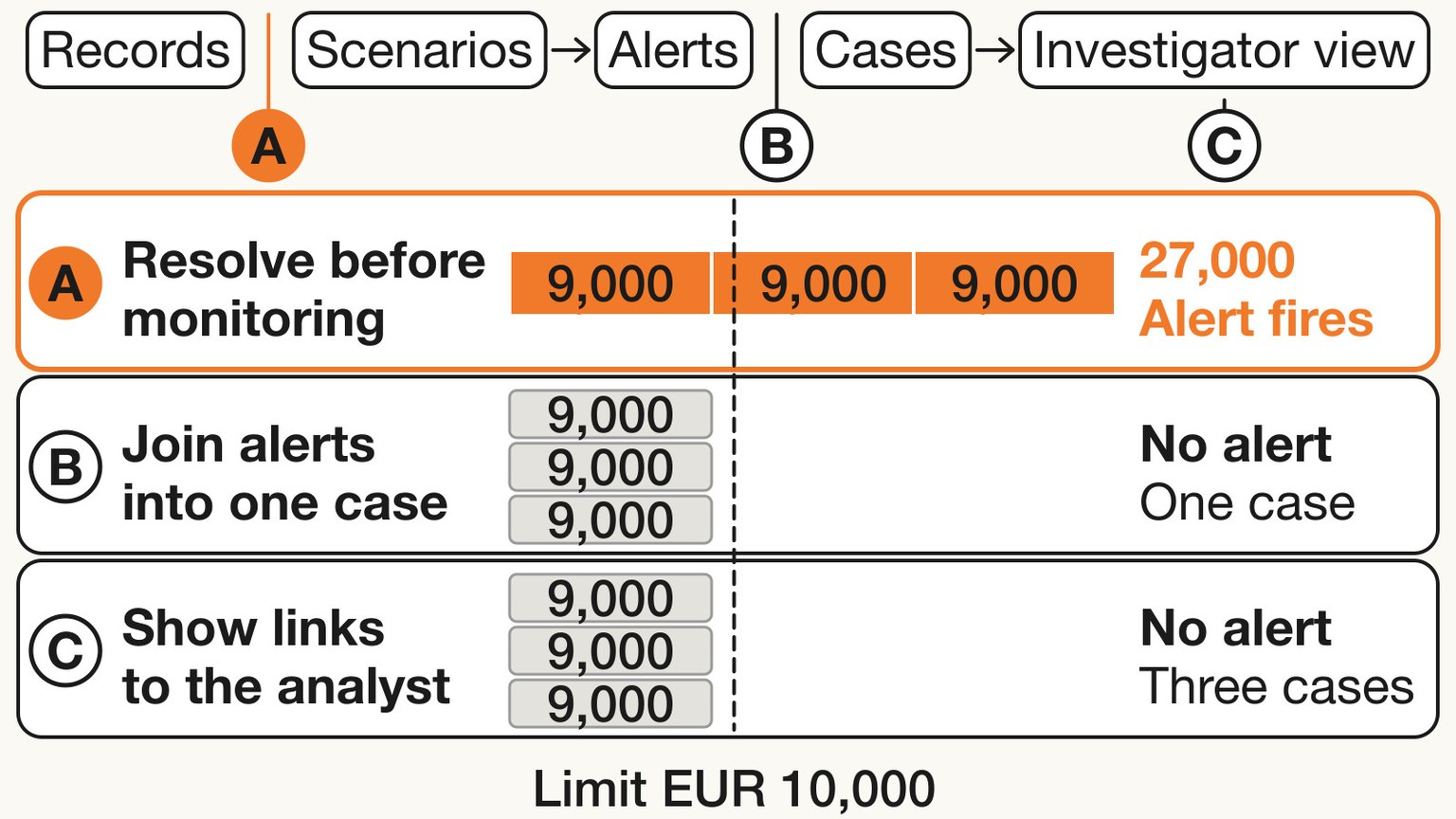
Resolved first (A), three EUR 9,000 payments total EUR 27,000 and pass the limit. At B and C they never add up.
What each placement fixes and what it cannot
| Placement | What it fixes | What it cannot fix |
|---|---|---|
| A. Before scenarios run | Aggregates, thresholds and counterparty views run on the person | Nothing upstream; a wrong link changes the amounts measured for two people |
| B. At case creation | Alerts on linked records join one case | Missed aggregates; no alert means nothing to join |
| C. Investigator view | The analyst sees linked records | Duplicate alerts, duplicate cases, missed aggregates |
What each placement needs and what a wrong link costs
| Placement | What it needs | Risk if a link is wrong |
|---|---|---|
| A. Before scenarios run | A monitoring system that accepts an external customer key; merge and split events | High: wrong amounts measured, suspicion on the wrong person |
| B. At case creation | Record-to-party lookup when a case opens | Medium: two people’s alerts in one case |
| C. Investigator view | A read-only lookup by record ID | Low: a misleading screen the analyst can question |
Placement C is cosmetic: it changes no counts. Placement B is a patch. It cuts duplicate work, but an alert that never fired has nothing to join.
Placement A is where detection improves: with the customer resolved before scoring, the EUR 10,000 rule sees EUR 27,000 and fires once. The destination rule still fires per payment (three payments still raise three alerts, now on one party), and, with case-level consolidation (B) as the safety net, the three destination alerts join one case. A is also the most exposed to a wrong merge, so it needs the guard rails below; B is the sensible interim while the bank proves its link quality. The Wolfsberg Group’s 2024 monitoring statement points the same way, describing entity resolution and graph networks as “linking internal customer, account, transaction and external data to provide a network-based contextual view of a customer”.
Two cases favour B plus C: a monitoring system that cannot accept an external customer key, and low-risk segments, where the added control may not justify it. The EU AMLR, Article 26(1), which applies from 10 July 2027, expects due diligence on a relationship to cover “all those products and services”, so multi-product segments are where A earns its cost first. Our guide to what the AMLR asks of a bank’s customer data covers more.
New posts on entity resolution, identity data and AI. No spam, unsubscribe any time.
What must every alert carry once identity is resolved?
Four fields: the resolved party ID, the source record IDs, the rule that linked them, and the state of the link when the alert fired. Without them, nobody can explain the alert to a supervisor a year later. At Tilores, our entity query returns the first three, and the bank stores the fourth, so every merge can be traced to its rule.
- Resolved party ID. The entity the transaction was scored against. It groups alerts but is not a stable reference on its own.
- Source record IDs. The account, card or customer records the transactions came from. These do not change when entities merge or split.
- Link rules. Which rule connected each pair of records, so a reviewer can see why the person was treated as one.
- Link state at alert time. A copy of the links as they stood, with a timestamp and the rule configuration release the bank had deployed.
In our review documentation we tell clients to “Ask with the records of an entity, because entity IDs change when entities merge or split.” An alert that stores only an entity ID can point at a different group of records next month, as our guide to merges, splits and stable IDs downstream explains.
The fourth field makes the alert evidence. UK regulation 40 requires records that enable a monitored transaction “to be reconstructed”, and JMLSG paragraph 5.7.15 expects a firm to “understand the reasons for its output of alerts, as it may be asked to explain this to its regulator.” If the links behind an aggregate have changed since, the reason must come from the copy kept with the alert. Our article on merge audit evidence lists what it should hold.
How do we at Tilores feed the resolved customer into monitoring?
We supply the identity layer beside the monitoring and case systems. Record lookup and edges return the first three fields; the event stream and entity score support the bank’s copy for the fourth:
- Record lookup. Our GraphQL API returns the entity for any source record ID through
entityByRecord, so monitoring can key a transaction to its resolved party at scoring time. - Edges with rule IDs. Each entity lists its edges as record, record and rule, for example
record-a:record-b:R1EXACT. Copy them onto the alert and the link rule travels with it. - Entity event stream. Profiles update in real time, and every data change is published as a create, update, merge, split or delete event, so monitoring can re-key when parties merge or split. Since our 4 November 2026 release, an enabled SQS based stream can be read through the GraphQL API, which must then be its only consumer. Your consumer must handle events that arrive twice or out of order, within the queue’s four-day retention.
- Entity score. The score reflects the overall quality of matches within the entity. Store it with the edge copy.
Exiger, a due diligence and supply chain risk company, runs us as a pure entity layer: records arrive through the GraphQL API and a Kafka event stream carries cluster events back downstream.
We do not score transactions, raise alerts, manage cases, hold sanctions lists or decide on reports; our anti-money laundering use case covers the identity side only. Our deployment options run the identity layer managed on AWS, in the bank’s own cloud account or on-premise, so the bank decides where customer data sits.
How do you guard against a wrong merge in monitoring?
Use three controls together to keep two customers with the same name from sharing a monitoring key: our Tilores consistency rules, a review band for medium-confidence links, and an unmerge path that reopens or splits affected cases.
Which merges should never happen automatically?
Any merge that contradicts an identifier which must agree across the whole entity, such as date of birth or a tax ID. Our consistency rules let a bank “guarantee uniqueness within a single entity”, checked against every record in the candidate entity. Weaker links go to the review queue below. We mark the consistency feature as new; it “might not work in every case”, so test it on the bank’s own same-name and household records, as in our article on telling two customers with the same name apart.
Our 16 October 2026 release makes a record update a single operation, so “the record leaves an entity it contradicts”. That behaviour is off by default for now; enable single_assembly_update before relying on consistency rules for monitoring keys.
How should medium-confidence links be handled?
Keep them out of the monitoring key until someone decides. Our review queue marks a link as weak when at most a set number of rules matched (maxWeakRules), and the defer strategy will “keep the records apart until the review decides.” The default merges automatically and reviews afterwards, which suits placement B. For placement A, choose defer, so a medium-confidence link cannot change what a threshold measures before an analyst has seen it.
What happens to alerts and cases after an unmerge?
A review verdict that rejects a link removes the edge, and records no longer connected split off. Our GraphQL disassemble operation does the same for an edge or record found wrong later, with an optional connection ban that stops the parts merging again.
The bank’s side is case handling: re-attribute each alert by its stored source record IDs, reopen any closed case whose disposition depended on the merged view, and record why. A wrong merge may also be a reportable data protection incident.
How will the bank know the change worked?
By measuring its own base before and after on the segment it moved. We offer no vendor reduction figure, because the bank’s alert mix, thresholds and data quality decide the result.
Four measures the bank collects itself
| Measure | What it shows | Expected under A |
|---|---|---|
| Alerts per resolved customer | Duplicate alerting on one person | Falls for split customers; new aggregate alerts count separately as detection gain |
| Case merge rate | Cases joined after opening | Falls as A takes over from B |
| Time to disposition | Analyst effort per case | Falls if context arrives with the alert |
| SAR conversion | Share of cases reported | Read with report quality |
The Wolfsberg Group’s 2024 statement counts alert-to-SAR/STR ratios among metrics that “are limited in their ability to measure actual effectiveness”.
A short parallel run, scoring the same transactions on the old and the resolved key, shows the difference before a segment switches over. The Wolfsberg Group’s 2025 Part II statement treats comparing report quality between old and new approaches as relevant “if the FI already rates SAR quality, and has used this method as a success indicator”.
Does the same resolved party help sanctions, PEP and adverse media screening?
Yes. Sanctions, PEP and adverse media screening ask the same question about the same person, and screening one fragment compares the list against partial information. The AMLR also requires credit institutions and financial institutions to verify customers against targeted financial sanctions “upon any new designation” (Article 26(4)).
Our Tilores Studio resolves a customer list into one entity per real customer, then screens each entity against OpenSanctions data on sanctions, PEPs and watchlists. The bank’s screening system still decides each hit, and parties changed by a merge or split need screening again.
What does a one-page placement decision look like?
One decision per customer segment, plus the four alert fields. In the worked scenario, placement A, with case consolidation (B) as the safety net, turns three silent records and three scattered alerts into one case holding the EUR 27,000 aggregate alert and the destination alerts. Write it down in this order:
- Segment. List segments by products per customer and risk, starting where one person often holds several records.
- Placement. Choose A where the monitoring system accepts an external customer key and links are proven; B plus C where it does not, or while link quality is measured.
- Fields. Require all four alert fields on every alert.
- Guard rails. Turn on consistency rules, defer weak links to review for placement A, and agree how a split reopens or re-attributes cases.
If the four measures do not move, the placement stays where it was. For the wider case, read our overview of entity resolution for anti-money laundering.
Test the placement on your own records. Load one segment’s customer records into Tilores Studio to see which resolve to one person, or book a demo to walk through merge and split events with your monitoring team.
Frequently asked questions
Should a bank merge alerts or merge customers?
Merge customers first. We resolve the customer with entity resolution before AML monitoring scores anything, so aggregate rules see the person. Then consolidate alerts at case creation as a safety net.
Can entity resolution replace a transaction monitoring system?
No. We supply the resolved party and the evidence for each link. The bank’s monitoring system keeps scenarios, thresholds and alerts, its case system keeps case policy, and the bank decides every suspicious activity report.
Does resolving customers first mean changing the bank’s thresholds?
No. The bank keeps its transaction monitoring thresholds; the key we supply changes what they are applied to. Expect more aggregate alerts for customers who were split, and review the thresholds through the bank’s normal governance.
Does placement A require real-time monitoring?
No. Batch monitoring can use the resolved key too. The key must stay current, so the monitoring system should consume our merge and split events and store the link state on each alert.
Sources
- Final Report: Draft RTS on business relationships, occasional and linked transactions under Article 19(9) AMLR, 30 September 2026, Anti-Money Laundering and Countering the Financing of Terrorism Authority (AMLA).
- Guidelines on ML/TF risk factors (EBA/GL/2021/02), paragraph 4.73, European Banking Authority.
- Prevention of money laundering/combating terrorist financing, Part I, October 2026, section 5.7, Joint Money Laundering Steering Group.
- Money Laundering Regulations 2017, regulation 28: customer due diligence measures, paragraph (11), The National Archives.
- § 25h KWG: Interne Sicherungsmaßnahmen, Federal Ministry of Justice, gesetze-im-internet.de.
- Statement on Effective Monitoring for Suspicious Activity, Part I: Moving Beyond Automated Transaction Monitoring (2024), The Wolfsberg Group.
- Regulation (EU) 2024/1624 (AMLR), Official Journal text, Article 26: ongoing monitoring, Publications Office of the European Union.
- Money Laundering Regulations 2017, regulation 40: record-keeping, The National Archives.
- Statement on Effective Monitoring for Suspicious Activity, Part II: Transitioning to Innovation (2025), The Wolfsberg Group.
- OpenSanctions: the open database of sanctions, PEPs and watchlists, OpenSanctions.
- Review, Tilores documentation.
- GraphQL API Reference, Tilores documentation.
- Consistency, Tilores documentation.
- Release Notes, v0.99.0 to v0.102.0, Tilores documentation.
- How to Handle Entity Merges, Splits and Stable IDs Downstream (2026), Tilores.
- How Exiger built a 60-million-cluster company entity graph across 110 million source records, Tilores.
- Anti-money laundering use case, Tilores.
- Can Entity Resolution Tell Two Customers With the Same Name Apart? Consistency Rules for Banks, Tilores.
- Is a Wrong Customer Match a Reportable GDPR Incident, and What Must a Bank Document?, Tilores.
- Resolve First, Then Screen: Tilores Studio Now Checks Your Customer List Against OpenSanctions, Tilores.
See what resolved entity data does for your business — and your AI.