Beneficial Ownership Across Company Chains: How Does a Bank Know Two Shareholders Are the Same Person? AMLR and UK Rules in 2026

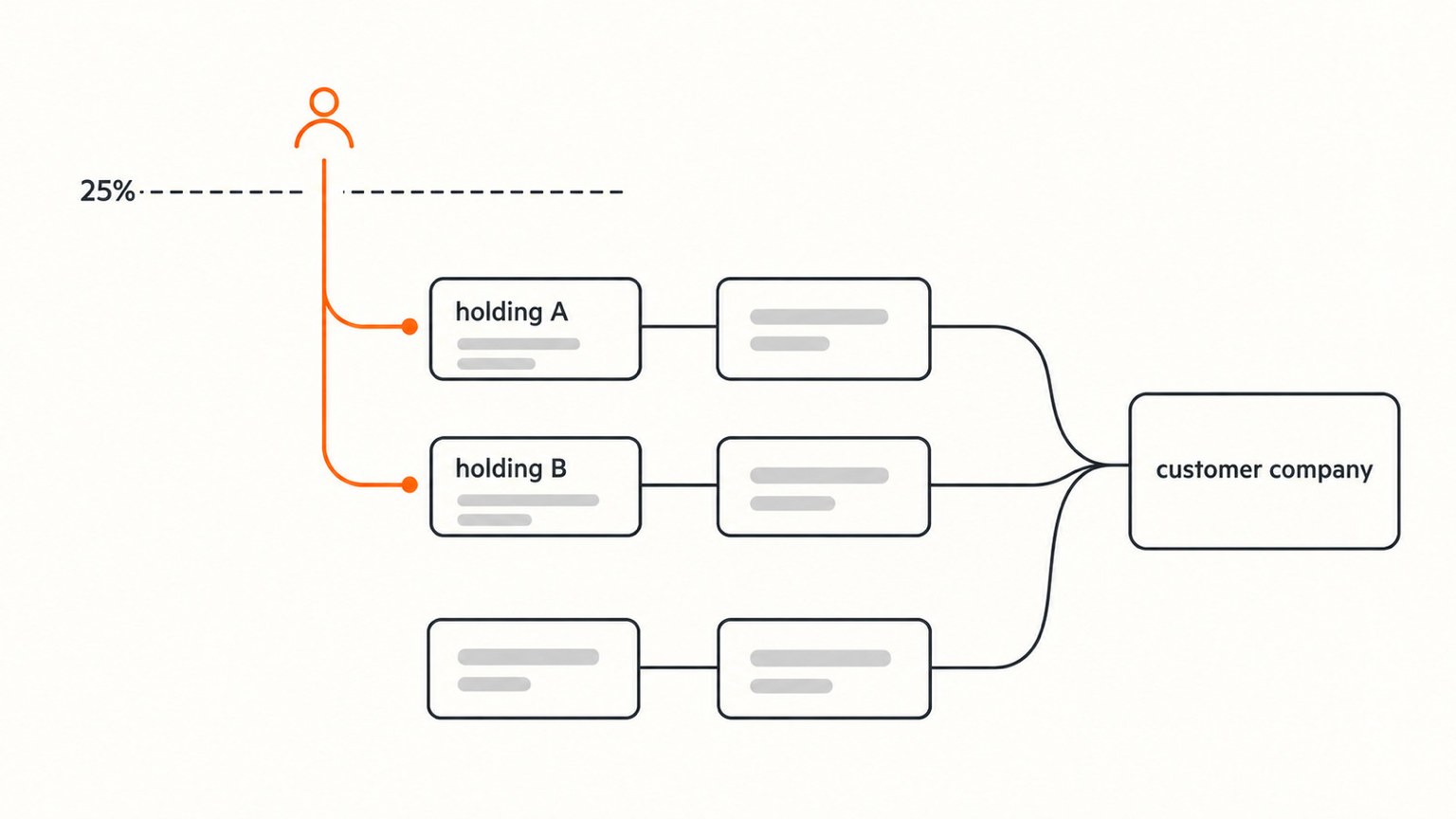
TL;DR: A bank knows two shareholders are one person only after resolving them on evidence that cannot conflict, then multiplying and adding holdings along each chain. A split identity can hide a 32% owner as 18% and 14%. With Tilores, we resolve the people and keep the rule behind every link; the ownership decision stays with the bank.
Book a Demo · Try Tilores Studio (Free)
On this page
- Why can a name-keyed count miss a 32% owner?
- What counts as a beneficial owner under the AMLR and UK rules?
- How does the chain arithmetic work on this scenario?
- Why does one person appear as two people in the registers?
- What evidence should a link between two register entries carry?
- Where does Tilores fit in a beneficial ownership check?
- Which ownership cases should go to a human reviewer?
- When is beneficial ownership not a matter of arithmetic?
- What should a vendor demonstrate on your own ownership data?
- Further questions about beneficial ownership chains
- Sources
A corporate onboarding file reaches the KYC desk with a routine ownership chart: two holding companies and a handful of individual shareholders. Each name sits below the 25% threshold, so the analyst moves on.
The catch: the threshold applies to a person, while registers supply names. One individual can sit in two holding companies’ records under two name forms, with only a month and year of birth. Count names and that person disappears; merge the wrong names and a namesake is flagged.
The EU Anti-Money Laundering Regulation applies from 10 July 2027 and tells banks to multiply holdings down every chain and add the chains together. Every percentage downstream inherits the identity step’s errors.
Why can a name-keyed count miss a 32% owner?
A name-keyed count misses the owner because an ownership percentage is arithmetic over identities. One person split across two spellings becomes two people below the line. Resolve the people first, then multiply and add along the chains.
Take a neutral scenario built on these assumptions:
- A customer company is owned 45% by holding company A, 40% by holding company B and 15% by unconnected investors.
- One individual holds 40% of A and 35% of B. There are no other rights or agreements.
- No one holds more than 50% at any layer, so no chain contains control through ownership.
- A’s records show the individual’s full forename and middle name; B’s show an initial and a double-barrelled surname. Both carry the same month and year of birth and nationality, with different service addresses.
A count keyed on names sees one shareholder at 18% and another at 14%, and flags nobody. Counted as one person, the holdings add up to 32%, a beneficial ownership interest under the EU rules. That addition needs evidence that the two entries are one person.
What counts as a beneficial owner under the AMLR and UK rules?
Both regimes start from a quarter of the shares or votes plus control by other means, but they draw the line on different sides of 25% and count chains differently.
What does the AMLR say?
Under Article 51 of Regulation (EU) 2024/1624, beneficial owners hold an ownership interest or control, with control via other means identified “independently of and in parallel to” ownership. Article 52(1) sets the interest at “25 % or more”: indirect ownership “shall be calculated by multiplying the shares or voting rights or other ownership interests held by the intermediate entities in the chain” and “by adding together the results from those various chains, unless Article 54 applies.” Article 54 covers chains where control, defined in Article 53(2)(c) as 50% plus one, sits on another layer; our scenario keeps every holding below that to isolate the multiply-and-add rule. It applies from 10 July 2027 (Article 90); our AMLR readiness check for bank customer data covers its wider demands.
What do the UK rules say?
Regulation 5 of the Money Laundering Regulations 2017 covers any individual who ultimately owns or controls, directly or indirectly, “more than 25% of the shares or voting rights”. It sets no method for indirect holdings, so the bank’s policy decides how “indirectly” applies. Regulation 28 requires the bank to identify the beneficial owner, take reasonable measures to verify them and understand the structure; regulation 30A requires a register excerpt and a report of material discrepancies. The register follows Schedule 1A to the Companies Act 2006, summarised in Companies House’s PSC guidance, where paragraph 18 counts an indirect holding only through a majority stake.
Beneficial ownership rules for a corporate customer (texts checked 1 November 2026)
| Question | EU: AMLR | UK: MLRs 2017 and PSC regime |
|---|---|---|
| Ownership threshold | ”25 % or more” (Art. 52(1)) | “more than 25%” (MLR reg. 5(1)(b); Sch. 1A para. 2) |
| Indirect holdings | Multiply down each chain, add the chains (Art. 52(1)) | MLR: “directly or indirectly”, no method stated in reg. 5 |
| Register test | Not applicable | PSC: only through a majority stake (Sch. 1A para. 18) |
| Control | 50% plus one, or via other means (Art. 53) | Ultimate control, or Sch. 1A conditions (reg. 5(1)(a), (c)) |
| Lower threshold | Possible by delegated act, at most 15% (Art. 52(2)) | None in reg. 5 |
New posts on entity resolution, identity data and AI. No spam, unsubscribe any time.
How does the chain arithmetic work on this scenario?
Multiply down each chain, then add the chains that end in the same person; the only contested input is the identity.
Worked arithmetic for the scenario, using the assumptions stated above
| Step | Calculation | Result |
|---|---|---|
| Chain through A | 45% × 40% = 0.45 × 0.40 = 0.18 | 18% |
| Chain through B | 40% × 35% = 0.40 × 0.35 = 0.14 | 14% |
| Counted on names | 18% and 14%, each checked alone | No one at 25% |
| Counted on one person | 18% + 14% | 32% |
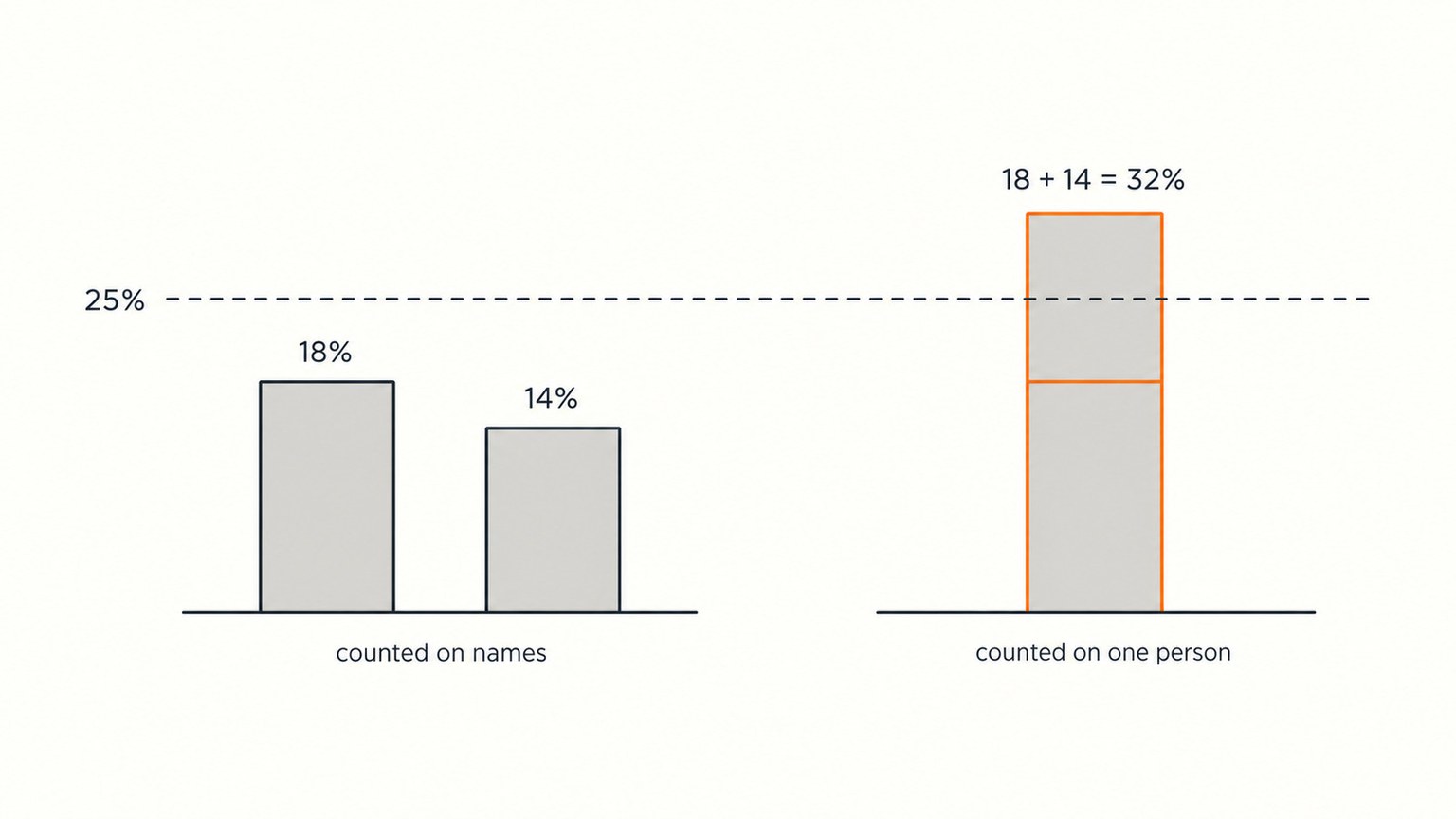
Under the AMLR, 32% is “25 % or more”. Under regulation 5, it is more than 25% if the bank’s policy multiplies in the same way. The PSC test differs: neither 40% nor 35% is a majority stake, so the customer company’s PSC entries will not show the combined 32%. The bank meets the individual on the two holding companies’ registers, one entry each.
What happens at 25 per cent precisely?
Take 50% of a holding company that owns 50% of the customer: 0.50 × 0.50 = 25%. Under the AMLR, that is “25 % or more”. Under regulation 5, it is not “more than 25%”.
Can a bank multiply PSC bands?
No. PSC entries record bands such as “more than 25% but not more than 50%” (Companies House PSC descriptions). Two chained entries in that band give anything from just over 0.25 × 0.25 = 6.25% up to 0.50 × 0.50 = 25%, so use actual holdings from the register of members or the structure chart.
Why does one person appear as two people in the registers?
Registers record entries, not resolved persons, and publish less than a bank collects, so one individual can look like two people and two people like one.
A Companies House officer record shows only month and year of birth, and an individual PSC record carries name elements, nationality, country of residence and a service address. Companies House does not publish a person’s full date of birth or home address, unless a company keeps its directors’ register there. Officer appointments are listed per officer ID.
The bank’s KYC file holds more: Article 22(2) of the AMLR, read with Article 62(1)(a), asks for all names, place and full date of birth, nationality and an identity document number for each beneficial owner. When we resolved a July 2023 snapshot of Companies House director records, 10,108,807 records formed 9,494,686 entities, with 614,121 records linked as duplicates (published as experimental).
Fragments follow initials, missing middle names, married surnames, partial dates and service addresses. The same fields cause the reverse error, when a loose match merges two people with a common name and birth month.
What evidence should a link between two register entries carry?
A link should carry the rule that made it, the fields that agreed and a check that nothing conflicts anywhere in the resolved person.
A date of birth that cannot agree stops the merge, however close the names. With register data, compare at the precision both sides carry: a different month or year blocks the link; the same month and year only permits it. See our consistency rules for same-name bank customers.
What register evidence can and cannot prove
| Evidence | What it shows | What it cannot show |
|---|---|---|
| Different month or year of birth | Cannot be one person | Nothing more; the link is blocked |
| Same month and year of birth | Consistent | That they are the same person |
| Name variant, such as an initial | Fuzzy support | Identity on its own |
| Same nationality or service address | A weak hint | Identity; many people share them |
Keep the methods distinct: deterministic rules link on exact agreement, fuzzy rules on similarity, probabilistic models on likelihood. Keep original values beside normalised ones and make every link reversible with a logged reason.
Where does Tilores fit in a beneficial ownership check?
We resolve the natural persons behind register entries and your KYC records, so your ownership arithmetic runs on resolved people with evidence for every link.
- Normalisation with originals kept. We normalise names, dates and addresses for comparison and persist them beside the original values.
- Deterministic and fuzzy rules. Matching combines deterministic rules and fuzzy matching. Search rules are separate from match rules: a search returns candidates with a hitScore, and only a match rule creates a link.
- Entity-level consistency. A consistency rule checks a new record against every record already in the person, so one conflicting date of birth stops the entity forming.
- The rule behind every link. Our GraphQL API returns each entity with its records and edges, and each edge carries the ID of the rule that created it.
- Reversible, previewable.
disassembleremoves a wrong edge with a logged user and reason, optionally banning a re-merge;submitWithPreviewwithdryRunshows what a new register extract would change before ingesting it.
In practice, load register extracts and KYC records into one engine, configure the consistency check on the date of birth values both sources carry, test how it treats month-and-year entries on your own data, and pass each shareholding’s resolved person ID into your own calculation. We run managed on AWS or in your own AWS account, another cloud or on-premises; see our deployment options.
Screening comes after resolution: the sanctions check in Article 20(1)(d) of the AMLR covers beneficial owners, so it is only as complete as the identity behind it. Screen the resolved person for sanctions, PEP status and adverse media; Tilores Studio now screens resolved customers against OpenSanctions data. Groups that cannot pool data: see one customer across many legal entities. We do not hold register data, compute percentages, decide beneficial ownership or file discrepancy reports; those stay with your bank.
Which ownership cases should go to a human reviewer?
Any case where one uncertain link decides which side of the line a person lands on goes to a reviewer. In our scenario, removing the link turns 32% back into 18% and 14%.
- Resolve the people first. Resolve natural persons across the register extracts and your KYC file, with a date of birth consistency rule, before calculating any percentage.
- Multiply and add along every chain. For each resolved person, multiply down each chain and add the chains, recording the source of every percentage.
- Run a flip test on uncertain links. Recalculate with each fuzzy link removed and each blocked near match added. Flag the person if the result crosses the threshold either way.
- Apply a review band. Flag every result inside the band your policy sets, for example 20% to 30%, and every structure with control at some layer or by other means.
- Send flagged cases to a named reviewer with the evidence. Give the KYC analyst, with escalation to the MLRO, the entries, original values, rule behind each link and the arithmetic, and record the decision with its reason.
The band is a policy choice, not a legal figure. The reviewer sees both entries, the KYC record, each link’s rule and the arithmetic, and records a reason.
When is beneficial ownership not a matter of arithmetic?
Ownership stops being arithmetic where control does not follow shares, and resolution shrinks where a register carries a verified unique identifier.
Article 53(3) and (4) of the AMLR list control via other means, including board appointment rights, vetoes, agreements, family relationships and nominee arrangements; Articles 55 and 57 reach through trusts and foundation-like entities. In the UK, regulation 5(1)(a) and (c) do the same.
Identity verification for Companies House became a legal requirement on 18 November 2025, and a verified person’s personal code connects their identity to each role. Companies House tells holders to keep that code secure, so it is no public matching key. Where a reliable identifier does appear on both sides, the link becomes deterministic; resolution still matters for the bank’s own records and other registers.
What should a vendor demonstrate on your own ownership data?
Ask every vendor, whether graph tool, screening service or matching engine, to run your own structures and show its evidence.
- The split person. Two entries with different name forms and the same birth month and year: show the link and its rule.
- The namesake. The same name with a different birth month: show which rule keeps them apart.
- The handover. Pass resolved person IDs into your calculation and reproduce 18% + 14% = 32% on your own structure.
A graph database stores the edges it is given, so ask who decides each one (why graph databases fail at entity resolution); our financial services page shows where banks use us.
Count people, not names. Resolve the individuals, keep the evidence for each link and send the near-threshold cases to a person.
Further questions about beneficial ownership chains
Does the AMLR change the 25% beneficial ownership threshold?
The AMLR keeps 25% or more as the general test in Article 52(1). Under Article 52(2) the Commission may set a lower threshold, at most 15%, for higher-risk categories of corporate entity after an assessment due by 10 July 2029.
Can a bank rely on the Companies House PSC register for the ownership calculation?
Not on its own. The register records ownership in bands, reaches through a holding company only where there is a majority stake and publishes month and year of birth only. Regulation 28 still requires the bank to identify each beneficial owner and take reasonable measures to verify them.
Does Tilores calculate beneficial ownership percentages?
No. We resolve which register entries and KYC records belong to one natural person and store the rule behind every link. The calculation, the beneficial ownership decision and any discrepancy report remain the bank’s responsibility.
What should a bank do when two register entries cannot be confirmed as one person?
Keep them as two people, record why and run the arithmetic both ways. If the answer changes with the link, ask the customer for evidence such as a full date of birth or an identity document, and send the case to a reviewer.
Sources
- Regulation (EU) 2024/1624 on the prevention of the use of the financial system for money laundering or terrorist financing, Articles 20, 22, 51 to 55, 57, 62 and 90, EUR-Lex
- The Money Laundering Regulations 2017, regulation 5, legislation.gov.uk
- The Money Laundering Regulations 2017, regulation 28, legislation.gov.uk
- The Money Laundering Regulations 2017, regulation 30A, legislation.gov.uk
- Companies Act 2006, Schedule 1A, Part 1, legislation.gov.uk
- Companies Act 2006, Schedule 1A, paragraph 18, legislation.gov.uk
- Officer summary resource, Companies House Public Data API
- Individual person with significant control resource, Companies House Public Data API
- Officer appointment list, Companies House Public Data API
- PSC descriptions enumeration, Companies House api-enumerations
- Restricting the disclosure of your information, Companies House, GOV.UK
- People with significant control (PSCs), Companies House, GOV.UK
- Verifying your identity for Companies House, Companies House, GOV.UK
- Companies House directors deduplicated, Tilores
- Can Entity Resolution Tell Two Customers With the Same Name Apart? Consistency Rules for Banks, Tilores
- Consistency, Tilores documentation
- API Reference, Tilores documentation
- Deployment options, Tilores
- Resolve First, Then Screen: Tilores Studio Now Checks Your Customer List Against OpenSanctions, Tilores
- One customer, many legal entities, Tilores
- Why graph databases fail at entity resolution, Tilores
- Entity resolution for financial services, Tilores
- What Does the EU Anti-Money Laundering Regulation Ask of a Bank’s Customer Data?, Tilores
- Entity Resolution, Explained, Schmitdy Gadget, YouTube, 2026
See what resolved entity data does for your business — and your AI.