Is an Entity Resolution Engine a Model Under PRA SS1/23, and What Will a UK Bank's Model Risk Team Ask in 2026?

TL;DR: Often, yes. Under PRA SS1/23, the parts of an entity resolution engine that score how likely two records are one customer meet the model definition, while exact-match rules usually sit under the bank’s management controls. We built Tilores so the bank configures every rule and sees which rule linked each pair, and validation tests evidence on its own data.
Book a Demo · Try Tilores Studio (Free)
On this page
- Is an entity resolution engine a model under SS1/23?
- Which parts of a matching engine meet the model definition?
- How does tiering decide how much validation the matcher gets?
- What do the five SS1/23 principles ask of a matching engine?
- What must the vendor supply, and what does the bank own?
- How can the proof of concept produce the validation evidence?
- Where does Tilores fit in a model risk review?
- What goes in the evidence pack before procurement?
- Frequently asked questions
- Sources
On 6 February 2023, a person designated under UK Russia sanctions opened a Halifax account with a passport spelling of their name that the automatic screen never matched. For 18 days the account stayed unrestricted while Bank of Scotland processed 24 payments totalling £77,383.39, and in November 2025 OFSI fined the bank £160,000. The penalty notice found the screening system did not reconcile the two spellings.
That is a matching decision: are two spellings one person? When a UK bank brings in an entity resolution engine to make such decisions at volume, its model risk team asks first whether the engine is a model, then who approved the threshold that turns similarity into a link.
Our answer: the scoring parts usually are a model, exact rules usually are not, and the evidence validation wants is cheapest to produce in the proof of concept, on the bank’s own data.
Is an entity resolution engine a model under SS1/23?
Often, yes, because SS1/23 defines a model broadly. Principle 1.1 of SS1/23 asks firms to adopt one definition for the scope of their model risk framework: a model is “a quantitative method, system, or approach that applies statistical, economic, financial, or mathematical theories, techniques, and assumptions to process input data into output”. The output can be qualitative, so a decision that two customer records are one person counts.
The statement covers models whose output informs business decisions, and it defines those widely, including decisions about operational banking activities. Onboarding checks, sanctions screening and customer due diligence are operational banking decisions in that sense, and a matching engine sits upstream of each.
Check scope first. The current version of SS1/23, effective 23 April 2026, applies to UK-incorporated banks, building societies and PRA-designated investment firms with internal model approval for regulatory capital. It carries forward expectations that have applied since 17 May 2024, the date set in policy statement PS6/23. Other firms are outside its expectations, but the statement says they “may find the proposed principles useful”, and a bank without internal model approval can adopt them as its own standard for a matching engine.
Within scope, classification is the bank’s decision, and it turns on what each part of the engine does.
Which parts of a matching engine meet the model definition?
The scoring parts usually meet it and the exact rules usually do not, because an entity resolution engine is several methods in one pipeline. A validator who asks “is the engine a model?” will get a split answer:
- Normalisation. Casing names, parsing addresses and folding Müller and Mueller into one form are deterministic transformations. They produce no estimate, so ordinary data quality and change controls cover them.
- Exact rules. A rule that links two records with the same date of birth and the same national insurance number is a deterministic quantitative method. SS1/23 expects “sound and clearly documented management controls” for such methods, and for material, complex rule sets says firms “should consider whether to apply the relevant aspects of the MRM framework”.
- Fuzzy comparisons with a cut-off. Phonetic codes, edit distance and token ratios are mathematical techniques, and someone chose the cut-off that turns a similarity into a match. That cut-off is an assumption about how much spelling drift still means the same person. Document who set it and test it as you would a model threshold.
- Probabilistic or machine learning scores. Probabilistic record linkage weighs agreement across fields with weights estimated from data and sorts each pair into link, possible link or non-link, as Binette and Steorts’ review of entity resolution describes. A trained classifier does the same with learned weights. Both meet the definition, and the threshold on the score is a model parameter.
The counter-case is real. A deterministic, exact-key matcher that deduplicates a marketing list, where a wrong link costs a duplicate letter, may sit under the bank’s tool and end-user computing governance with no model risk tier at all. The same engine feeding sanctions screening is a different matter, which is why tiering, not the technology, decides the workload. Our comparison of rules and machine learning on time to a validated release shows how this split changes the approval timeline.
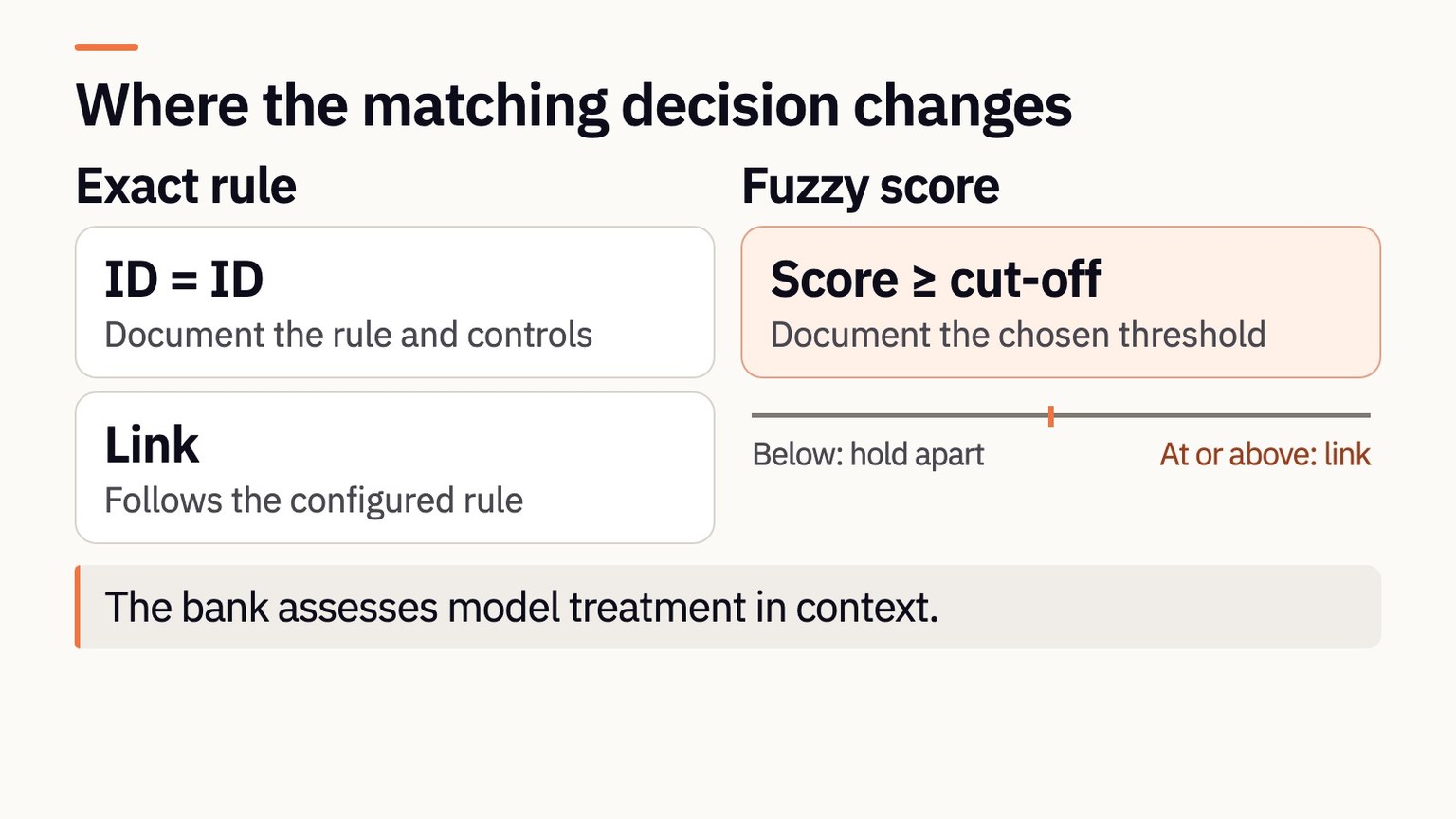
An exact rule applies a documented condition. For a fuzzy score, the bank reviews the assumption behind the cut-off and validates the threshold on its own data. Model treatment depends on the bank’s assessment.
How does tiering decide how much validation the matcher gets?
Tiering sets the intensity of validation, and for a matcher it depends mostly on what the links feed. Under Principle 1.3, materiality looks at size, such as the number of customers a model applies to, and at the purpose of the model and its weight in business decisions. Complexity can take in the input data, the method, and measures of interpretability, explainability, transparency and possible bias.
A matcher that resolves every retail customer before sanctions and PEP screening scores high on materiality. One that merges duplicates in a campaign list scores low. SS1/23 also expects higher model risk for “more complex models that are difficult to understand or explain in non-technical terms”. That sentence is the practical reason to want a reason for every link that a reviewer can read: it can lower the complexity rating and with it the validation burden.
Record the dependencies too. A matcher’s output becomes the input of screening, risk rating and reporting, and Principle 1.2 asks the inventory to show model inter-dependencies so aggregate risk is visible.
New posts on entity resolution, identity data and AI. No spam, unsubscribe any time.
What do the five SS1/23 principles ask of a matching engine?
The five principles turn into concrete questions for a matcher, and each question has an artefact that answers it.
What each SS1/23 principle asks of an entity resolution engine
| Principle | What the model risk team asks | Evidence that answers it |
|---|---|---|
| 1. Identification and classification | Is the matcher in the inventory, with purpose, boundaries and tier? | Inventory entry, tier rationale, linked downstream uses |
| 2. Governance | Who owns it, and is the vendor arrangement covered? | Named owner, approval route, outsourcing assessment |
| 3. Development, implementation and use | Was it tested on our customers and our name variants? | Rule and threshold documentation, own-data test results |
| 4. Independent validation | Can someone who did not configure it challenge it? | Rerunnable test files, sampled link reasons, monitoring pack |
| 5. Model risk mitigants | What happens when it underperforms or a person overrides it? | Override log, review queue, use restrictions |
Principle 3.3 asks three things that bite hardest on matching. First, it asks for sensitivity analysis to find the operating boundaries, which for a matcher means showing how precision and recall move as the threshold moves. Second, it asks for comparison with challenger models where practicable, and the bank’s current matcher is the obvious challenger. Third, it asks that material changes be tested by comparing output before and after the change against actual outcomes, which is how a rule release should be judged; our guide to changing entity resolution rules without breaking production sets out the release gates.
Principle 4.4 lists analysis of overrides among the monitoring tests, and Principle 5 defines post-model adjustments to include model overrides. When a data steward splits a merge or links two records by hand, that decision is an adjustment to the matcher’s output. Log it, count it, and treat a rising trend as a sign that a rule needs fixing.
What must the vendor supply, and what does the bank own?
The vendor supplies transparency; the bank keeps responsibility. Principle 2.6 is explicit that boards and senior management remain ultimately responsible for model risk under an outsourcing or third-party arrangement, in line with the PRA’s SS2/21 on outsourcing and third party risk management. For vendor models, Principle 2.6 says banks should satisfy themselves that the models were validated to their own internal standards, check the relevance of vendor data and assumptions, and “validate their own use of vendor products and conduct ongoing monitoring and outcomes analysis of vendor model performance using their own outcomes”.
Principle 3.5 adds that the documentation of a vendor model must be “sufficient to validate the firm’s use of the model”. A matcher whose rules or scores the bank cannot see fails that test before any data is loaded. Ask for it during vendor selection, with the other questions in our guide to evaluating identity resolution vendors for banking.
The vendor should supply:
- documentation of every rule, comparison function and cut-off, or of the scoring method and its training data;
- a reason for each link that a reviewer can read, down to the case level described in our guide to the audit evidence behind a merge;
- a way to rerun the bank’s test files and preview a change before it is released;
- release notes for every engine change, and the configuration in a form the bank can export.
The bank owns:
- classification, tier and the inventory entry;
- the labelled test files built from its own records;
- approval of thresholds and of the review bands described in our guide to confidence scores, thresholds and audit trails;
- monitoring, outcomes analysis, overrides and any restriction on use;
- every decision made with the resolved customer, including screening outcomes, due diligence and reports to authorities.
How can the proof of concept produce the validation evidence?
The proof of concept is the cheapest place to produce validation evidence, because the bank’s own data is loaded, the vendor is engaged and no customer is affected yet. Bring the model risk team in at vendor selection and let the PoC create the artefacts validation will ask for later:
- Fix the pass mark first. Agree precision and recall targets and the operating threshold with the validator before any result exists.
- Build a known-pairs file. Take pairs from your own records that you know are one customer, including spelling and transliteration variants, and measure the share the engine links at the threshold you will use. That share is recall.
- Build a look-alike file. Take different customers who share a name, an address or a date of birth, and count the pairs the engine wrongly links. Those errors pull down precision.
- Move the threshold. Rerun both files at several thresholds and record how recall and precision change. This is the sensitivity analysis that sets the operating boundaries.
- Run a challenger. Put the same two files through the matcher the bank uses today and compare the results.
- Change one rule. Make one rule or threshold change, rerun both files and compare the output before and after.
- Sample the reasons. Hand ten links and ten near misses to someone who did not configure the engine and ask them to state why each pair did or did not link.
The known-pairs file is where the Bank of Scotland case belongs. OFSI’s own lesson from the case is plain: “Ask whether your screening can cope with spelling and transliteration variants.” The Schmitdy Gadget film A £160K Sanctions Miss: How to Test Entity Resolution on Your Own Data Before You Buy walks through building the two files from a bank’s own records.
These seven steps produce the core of the development testing Principle 3.3 describes, and they come from the bank’s own data, which answers the vendor-data question in Principle 2.6. How to agree the rules themselves round by round is covered in our guide to agreeing matching rules before a PoC, and running several vendors on the same files in our guide to a vendor bake-off with real bank data.
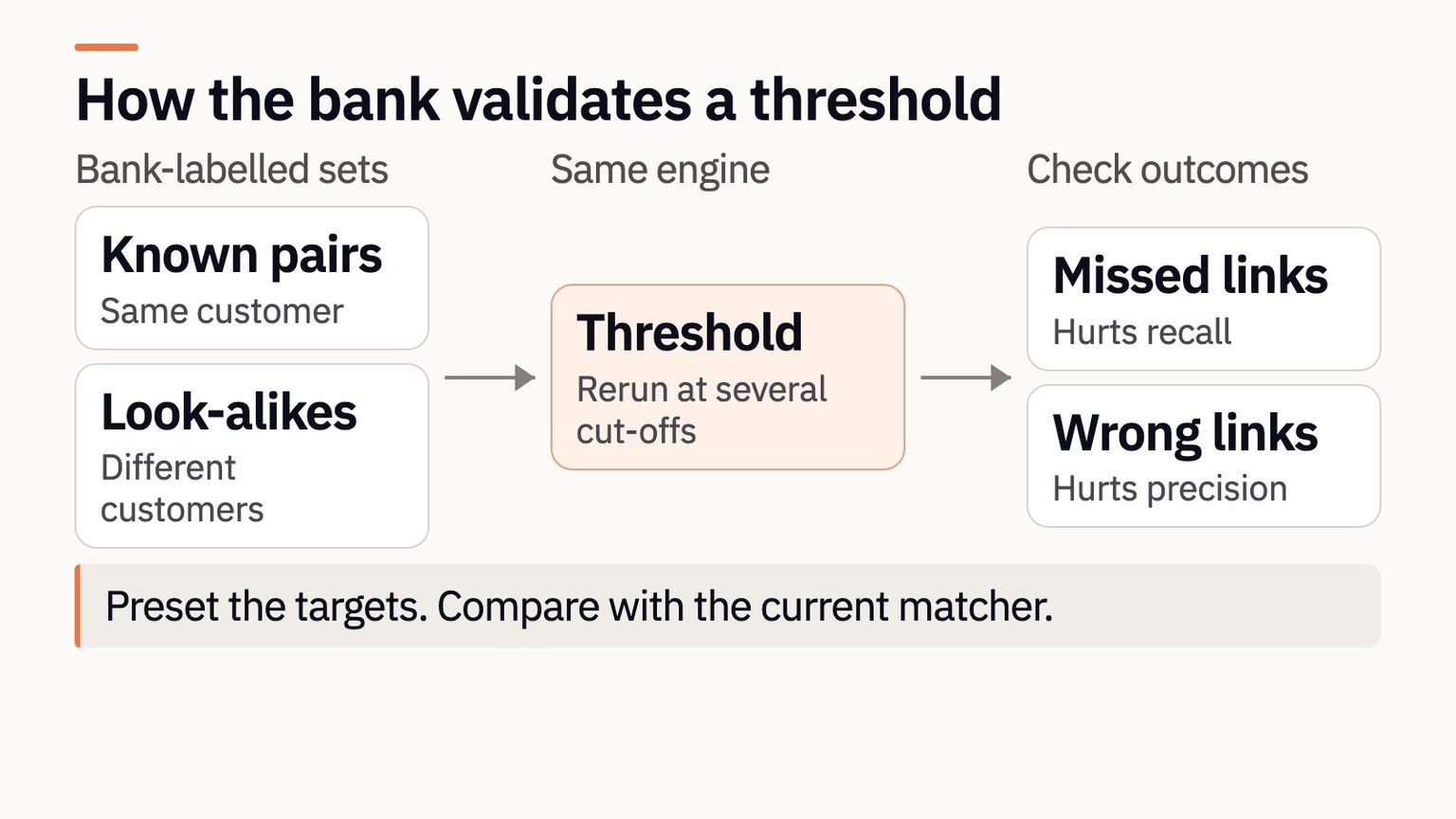
The bank labels known matches and look-alikes before the proof of concept. Repeating the same tests at several thresholds shows how the operating choice affects missed links and wrong links.
Where does Tilores fit in a model risk review?
We built Tilores so that the evidence a validator asks for is part of how the engine stores its results. Our matching engine combines deterministic rules with fuzzy and phonetic matching, with probabilistic scoring available, and the bank’s team configures and can read every rule.
The threshold question has a named answer. In our rules configuration, each fuzzy matcher carries its own settings, such as the comparison method and the ratio a name must reach, and rules combine matchers into named rule sets. A validator can see which cut-off applies to which field and which rule.
Every link carries its reason. We store each link as record A, record B and the ID of the rule that created it, so the reason is part of the data. Our GraphQL API returns an entity’s records, its links and a score for the overall quality of its matches; a search also returns a hitScore for each result. Since our 2 November 2026 release, a link a reviewer creates by hand carries the rule ID MANUAL, so overrides can be counted apart from rule links. Since 23 October 2026, a rule configuration can keep a record that matches an entity only weakly apart from it until a reviewer decides.
Changes can be compared before release. The submitWithPreview mutation with dryRun set to true shows how entities would form without ingesting anything, so a rule change can be run against the known-pairs and look-alike files first.
Testing starts on the bank’s own data. Tilores Studio runs our engine locally on up to 100,000 records, free, and the data never leaves that machine. The rules tuned in Studio are the rules that run in production, which we can deploy inside the bank’s own AWS account, on another cloud or on premises. Our data compliance controls log every query, export and deletion, and we have completed a SOC 2 Type I audit.
The bank keeps the classification and tiering of our engine under its own policy, validation and approval, the choice of thresholds and review bands, monitoring and override policy, and every screening, due diligence or reporting decision that uses a resolved customer. We supply the evidence; we do not validate or approve on the bank’s behalf.
What goes in the evidence pack before procurement?
A pack that answers the five principles before the contract is signed holds nine items:
- Inventory entry: purpose, intended uses, downstream systems, data sources and operating boundaries.
- Classification: which components are models, which are deterministic methods under management controls, and why.
- Tier rationale: materiality from the customers and decisions affected, complexity from the method and its explainability.
- Rule and threshold documentation: every rule, comparison and cut-off, with who set it and when.
- Own-data test results: recall on known pairs, precision on look-alikes, the sensitivity runs and the challenger comparison.
- Validation report: findings from someone who did not configure the engine, including the sampled link reasons.
- Monitoring metrics: link and review volumes, override counts and a rerun of the known-pairs file after every rule change and sanctions list update.
- Change control: how a rule change is tested, compared before and after, approved and rolled back.
- Outsourcing assessment: the third-party review the bank already runs, with the vendor’s documentation attached.
Back to the Halifax account. The spelling the screen missed is the kind of pair a known-pairs file holds, and a matcher tested on such a file before go-live gives the model risk team an answer to its first question: who approved the threshold, and on what evidence.
Frequently asked questions
Does SS1/23 apply to a UK bank without internal model approval?
No. Its expectations apply to UK banks, building societies and PRA-designated investment firms with internal model approval for regulatory capital. The PRA says other firms may find the principles useful, and a bank can adopt them as its own model risk standard for a matching engine.
Is a rules-only matching engine outside model risk management?
Not automatically. Deterministic rules usually fall outside the SS1/23 model definition, but the PRA expects sound and clearly documented management controls for them and asks firms to consider applying parts of the framework to material, complex rule sets. Fuzzy cut-offs deserve the same testing as a model threshold.
Can the vendor validate its own matching engine for the bank?
No. SS1/23 leaves responsibility with the bank’s board and senior management when a vendor is involved, and the bank validates its own use of the engine on its own outcomes. We supply rule documentation, the rule behind every link and change previews; validation and approval stay with the bank.
Does a rule or threshold change need revalidation?
Yes, if the change is material. SS1/23 asks for testing that compares output before and after a material change, and the model tier sets how often the whole matcher is revalidated. Rerun the same known-pairs and look-alike files after each change, compare recall and precision with the last run, and record the result in the inventory as part of ongoing monitoring.
Which guidance applies to US banks instead?
SR 26-2, issued on 17 April 2026 by the Federal Reserve, the OCC and the FDIC, superseded SR 11-7 as the US guidance on model risk management. It is expected to be most relevant to banking organisations with over $30 billion in total assets. For a vendor model such as a bought matching engine, it treats understanding the model’s conceptual soundness, design, development data and performance as sound practice, together with ongoing monitoring and outcome analysis, and validation generally occurs before a model’s first use.
Sources
- Supervisory Statement SS1/23: Model risk management principles for banks, April 2026 version (updating 17 May 2023), Prudential Regulation Authority, Bank of England.
- SS1/23 publication page and version history, Prudential Regulation Authority, Bank of England.
- PS6/23: Model risk management principles for banks, 17 May 2023, Prudential Regulation Authority, Bank of England.
- SS2/21: Outsourcing and third party risk management, Prudential Regulation Authority, Bank of England.
- Imposition of Monetary Penalty: Bank of Scotland PLC (penalty notice), Office of Financial Sanctions Implementation, HM Treasury.
- Imposition of monetary penalty: Bank of Scotland PLC, 26 January 2026, GOV.UK.
- Sanctions compliance in practice: lessons from OFSI’s £160,000 Bank of Scotland penalty, 23 February 2026, OFSI blog.
- SR 26-2: Revised Guidance on Model Risk Management, 17 April 2026, Board of Governors of the Federal Reserve System.
- Revised Guidance on Model Risk Management (attachment to SR 26-2), Federal Reserve, OCC and FDIC.
- Binette and Steorts, (Almost) All of Entity Resolution, Science Advances (2022), arXiv.
- Video: A £160K Sanctions Miss: How to Test Entity Resolution on Your Own Data Before You Buy, Schmitdy Gadget, YouTube.
- Product, Tilores.
- Rules configuration, Tilores documentation.
- GraphQL API reference, Tilores documentation.
- Release notes, Tilores documentation.
- Download Tilores Studio, Tilores.
- Deployment options, Tilores.
- Data compliance, Tilores.
See what resolved entity data does for your business — and your AI.