Rules or Machine Learning: Which Matching Approach Gets a Bank to a Validated Production Release Fastest? (2026)

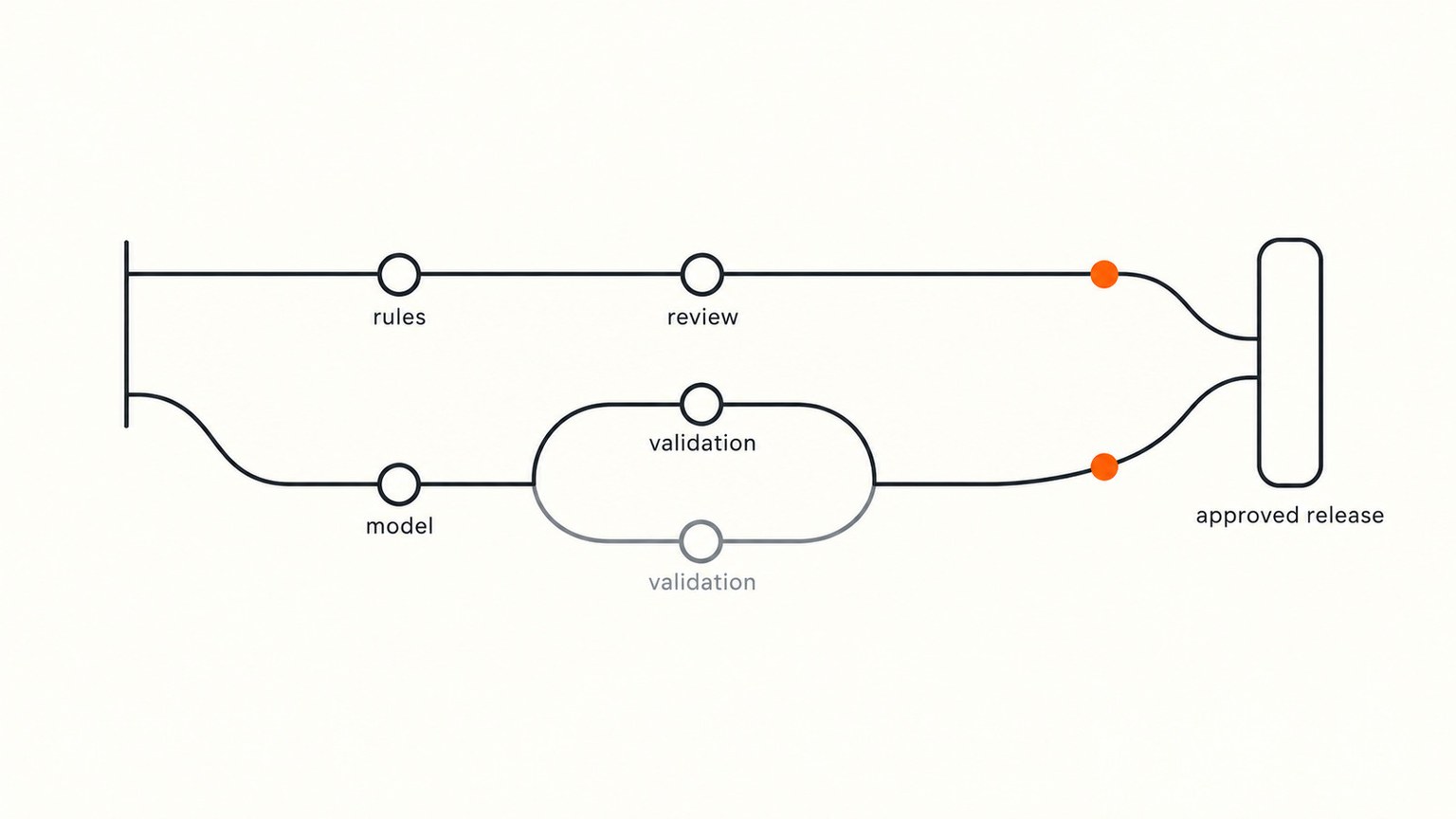
TL;DR: For matching that changes customer records, a rules-led approach usually reaches a validated production release first. Machine learning often gives a first result sooner, but each learned link then needs explaining, validating and revalidating after every model change. With Tilores, we run rules-led matching and store the rule behind every link; validation and approval stay with the bank.
Book a Demo · Try Tilores Studio (Free)
On this page
- Which matching approach reaches a validated release first?
- What are the three matching approaches, and how do they differ?
- What does a model risk committee need before it approves a matching release?
- How much rule writing does a rules-led approach really need?
- Where does machine learning help without owning the decision?
- Where does Tilores fit in a rules-led release?
- How do the approaches compare on time to approved release?
- Which approach should your bank choose?
- Frequently asked questions
- Sources
Two proofs of concept finish on the same Friday. One vendor shows a high precision score from a model trained on the bank’s sample. The other shows a lower headline figure, but beside every link sits the rule that made it: same date of birth, surname within one spelling edit, postcode equal after normalisation.
The model risk committee meets once a quarter, and its papers close weeks before each meeting. Which of the two can it approve next time? Usually the second, and accuracy is not the reason. The reason is the work that sits between a first result and an approved release.
So count that work before choosing: rules to write, pairs to label, documents to produce and the cost of each later change.
Which matching approach reaches a validated release first?
For links that change a customer record, a rules-led configuration seeded from the bank’s own labelled pairs usually reaches an approved release first. Machine learning earns its place beside the rules, proposing candidates and ordering the review queue, without owning the decision to link.
Time to first match and time to approved release are two different clocks. A learned matcher shortens the first: no rules to write, only labelled pairs to train on. It lengthens the second, because a validator has to understand a learned decision, test it on outcomes it never saw, trace its training data and test it again after each retrain. Rules move the effort earlier, and their inventory, per-link reasons and change log come out of the configuration itself.
So for records that change a customer, measure time to validated production, not time to first match. We say usually, not always: one proof of concept can test the claim on the bank’s own data.
What are the three matching approaches, and how do they differ?
- Rules-led matching. Named rules combine deterministic comparisons, where values such as a date of birth must agree, with fuzzy comparisons that tolerate spelling, phonetic and format variants, such as Katharina and Katarina. A fuzzy comparison is still a fixed test, as our guide to fuzzy matching techniques explains. The rule’s name is the link’s explanation.
- Learned scoring. Probabilistic record linkage weighs agreement across many fields with weights estimated from data, the framework Fellegi and Sunter set out in 1969 with three outcomes, link, possible link and non-link, as Binette and Steorts’ review of entity resolution describes. Supervised machine learning trains a classifier on labelled pairs. A threshold turns the score into a decision.
- An LLM-assisted step. A language model judges whether two records describe the same person. Our article on LLMs for entity resolution covers where that breaks.
Fuzzy and probabilistic are different methods. A fuzzy comparison measures how similar two values are; a probabilistic score estimates how likely two records are one entity. A rules-led engine can use fuzzy comparisons and stay deterministic.
New posts on entity resolution, identity data and AI. No spam, unsubscribe any time.
What does a model risk committee need before it approves a matching release?
It needs evidence that the method works, a record of each decision and control over change. How much depends on whether the method counts as a model, and supervisors draw that line close to where fixed rules end and statistical estimation begins.
United Kingdom: PRA SS1/23
The PRA’s Supervisory Statement SS1/23 took effect on 17 May 2024 and was last updated on 16 April 2026. It applies to UK-incorporated banks, building societies and PRA-designated investment firms with internal model approval for regulatory capital. Its model definition covers methods that apply “statistical, economic, financial, or mathematical theories, techniques, and assumptions to process input data into output”. For material and complex deterministic methods “such as decision-based rules or algorithms” not classified as models, firms “should consider whether to apply the relevant aspects of the MRM framework”; otherwise they need “sound and clearly documented management controls”. Under Principle 3.3, testing of a material model change compares output before and after the change.
United States: SR 26-2
On 17 April 2026 the Federal Reserve, the OCC and the FDIC issued SR 26-2, revised guidance on model risk management, which supersedes SR 11-7 and SR 21-8, the 2021 statement on models in Bank Secrecy Act and anti-money laundering systems. It is most relevant to banking organisations with more than $30 billion in assets.
The revised guidance defines a model as a “complex quantitative method, system, or approach that applies statistical, economic, or financial theories to process input data into quantitative estimates”, and excludes “deterministic rule-based processes and software where there are no statistical, economic, or financial theories underpinning their design or use”. On those words, a deterministic matching rule set appears to sit outside the definition, while a probabilistic or learned match score, which rests on statistical theory, sits inside. Validation “generally occurs prior to a model’s first use”, and for vendor products a bank may not receive “the underlying code, data, or methodology”.
European Union: EBA and the AMLR
No single EU text sets model risk rules for a matching engine outside regulatory capital, but two sources shape what a validator asks. The EBA’s August 2023 follow-up report on machine learning for internal ratings-based models states: “A higher level of complexity may lead to better model performance but at the cost of lower explainability”. From 10 July 2027, Article 76(5) of the Anti-Money Laundering Regulation requires decisions to enter or refuse a relationship, or to change the extent of due diligence, to be “subject to meaningful human intervention”, and lets the customer “obtain an explanation of the decision”. Article 21(3) requires records of due diligence decisions with their justifications.
What goes into the validation pack?
Classification is the bank’s call. None of these texts exempts rules from governance; learned scores carry more of it.
What each approach puts in the validation pack
| Evidence | Rules-led | Learned scoring |
|---|---|---|
| Method description | Rule inventory: each rule, its fields and comparisons | Model documentation: features, training method, assumptions |
| Labelled data | Adjudicated pairs to test precision and recall | Training pairs plus a separate held-out test set |
| Reason per link | The rule ID stored on the link | A score plus an attribution method, such as Shapley values |
| Development data | The bank’s own sample | Often includes vendor or pooled data |
| Change control | A versioned rule change, tested before and after | Retraining, then a material-change assessment |
| Monitoring | Rule hit rates and review outcomes | Score drift and calibration |
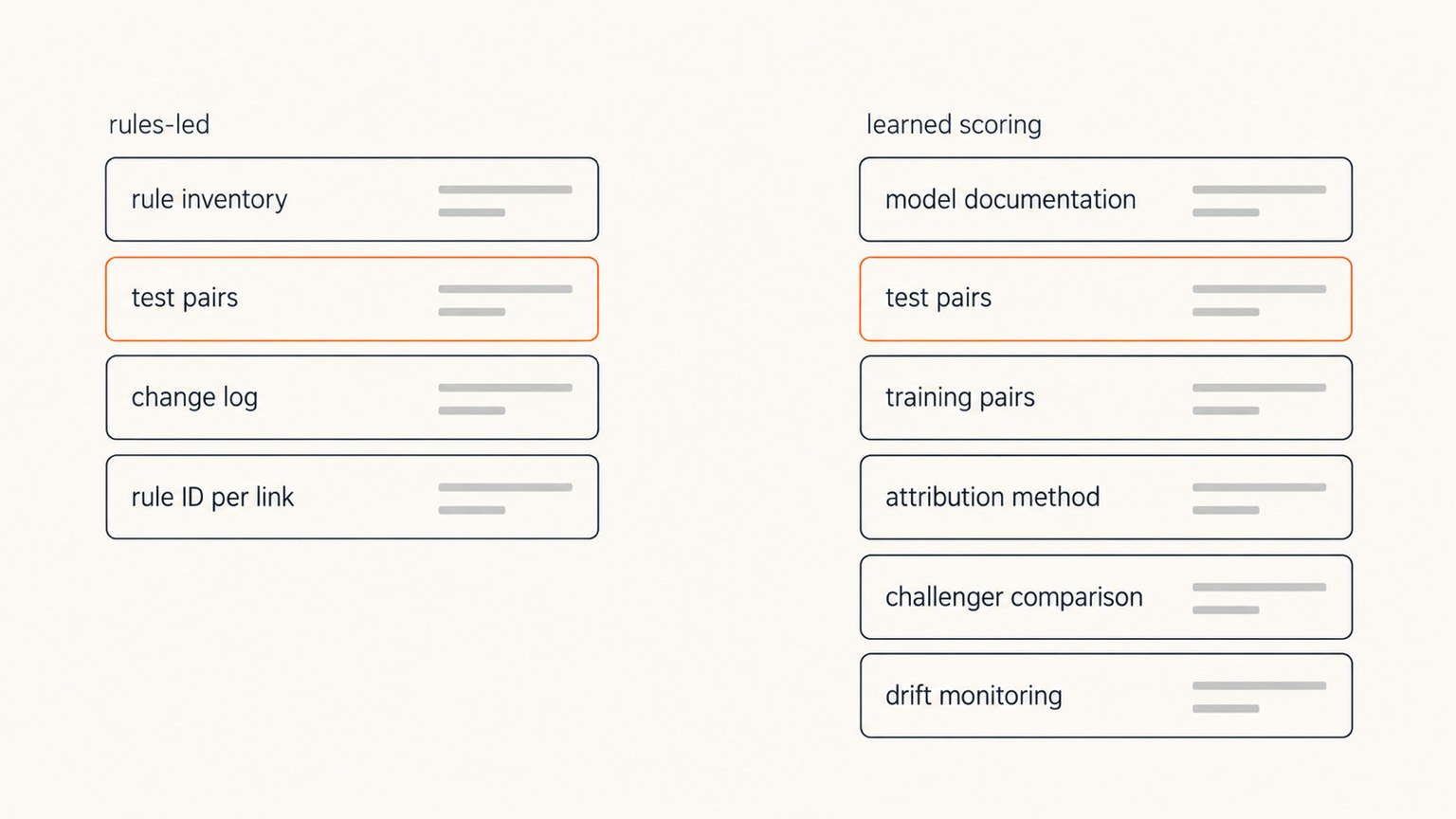
The labelled data row decides most timelines. Both approaches need adjudicated test pairs; only the learned one needs a second, larger training set kept apart from them. Because very few record pairs match, Binette and Steorts note that fully supervised methods need “vast amounts of reliable training data or carefully selected training data”. See our guide to entity resolution accuracy metrics for sizing it.
How much rule writing does a rules-led approach really need?
More than a demo suggests, and less than a bank fears, provided the business is never asked to write fuzzy logic. The process that works is propose, answer, convert: the vendor proposes a first rule set from the bank’s sample, the business answers yes, no or escalate on specific edge cases and says why, and the vendor turns the answers into rules, over at least two rounds. Our article on agreeing matching rules before a PoC walks through the rounds.
The by-product matters for validation: every answered edge case is a labelled pair that shapes a rule and becomes a test case the validator can rerun. The evidence builds up while the rules are written, and the development data is the bank’s own, which closes the vendor-data gap SR 26-2 describes.
Where does machine learning help without owning the decision?
Machine learning helps most where its output is a suggestion that a rule or a person acts on.
- Candidate generation. A learned step chooses which pairs reach comparison. Its errors are missed comparisons, caught by a candidate recall test, not wrong merges.
- Review queue ordering. A score decides which ambiguous case a reviewer sees first; see our guide to review queues for ambiguous matches.
- Rule suggestions. Patterns in reviewer answers propose a rule, which a person accepts and which enters the inventory with its own ID.
These roles change no customer record on their own. SR 26-2 states: “Model purpose, together with model exposure, determines model materiality.” A model that orders a queue may still sit in the inventory, at a lower tier than one that merges customers.
Where does Tilores fit in a rules-led release?
We build a rule-based matching engine with probabilistic scoring available, as our product page sets out: deterministic rules and fuzzy matching draw explainable edges between records.
- Every link we store carries its rule. We store each edge as record A, record B and the rule label, as our rules documentation shows, and our GraphQL API returns an entity’s records and edges, so a validator can sample links and read each rule.
- Changes are tested before release.
submitWithPreviewwithdryRunset to true shows how entities would form without ingesting anything, so a rule change can be compared before and after on held-out pairs. - Conflicts stop merges. Our consistency rules can require an identifier to be unique within an entity. The feature is marked as new, so test it on your edge cases.
- Weak joins can wait for a person. Since our 23 October 2026 release, a weakly matching record can stay apart while its review case lists the candidate entity.
The same rule set runs the proof of concept and production. Our financial services platform logs every query and deletion, and deployment runs from our Managed Cloud on AWS to on premises. With Tilores Studio, you can run our engine locally on up to 100,000 records, free.
What stays with the bank: classifying the rule set under its own policy, validation and approval, threshold and review policy, and every decision that uses the resolved customer, including due diligence, risk ratings, sanctions, PEP and adverse media screening outcomes, and filings. We do not validate on the bank’s behalf, and approval stays with the bank’s committee.
How do the approaches compare on time to approved release?
The last column is a tendency; your data can reverse it.
Criteria that decide time to approved release
| Criterion | What to measure in the PoC | Usually favours |
|---|---|---|
| Rules to write | Rounds until edge cases stop changing the rules | Learned scoring |
| Labelled pairs | Adjudicated pairs needed for training and for testing | Rules-led |
| First result | Days from data receipt to a first scored run | Learned scoring |
| Reason per link | Share of sampled links with a checkable reason | Rules-led |
| Development data | Whether all of it is the bank’s own | Rules-led |
| Change control | Steps to test and release one change | Rules-led |
| Candidate recall | True pairs that reached comparison | Either; test both |
A scenario shows how pack effort becomes calendar time. The figures are assumptions, not measured results: both PoCs end in week 0; the committee meets every 13 weeks, next in week 9; papers close four weeks before, in week 5. The rules-led pack takes four weeks. The learned pack takes seven, adding model documentation, training data lineage, an attribution method and a challenger comparison.
The rules-led pack is ready in week 4 and can be approved in week 9. The learned pack misses the week 5 deadline, so the next papers close in week 18 for week 22: 22 minus 9 is 13 weeks later. Three extra weeks of work become 13 weeks of calendar time, because approval dates are steps. If validators treat the rule set as a model, the gap narrows.
How to measure time to approved release in your PoC
- Agree the clock. Measure from data receipt to the committee meeting at which the release could be approved.
- Hold back test pairs. Set aside adjudicated pairs that no vendor sees during tuning or training.
- Ask for the pack. At the end of the PoC, ask each vendor for the evidence your validators need, and list what is missing.
- Time one change. Make one rule or model change and time how long it takes to test, document and approve.
- Sample the reasons. Pick links at random and ask for the reason behind each one, in words a reviewer can check.
Which approach should your bank choose?
Choose by the strictest explanation requirement among the uses the engine will serve, because one resolved customer usually feeds several systems.
- Links that merge due diligence files, feed sanctions, PEP and adverse media screening against lists such as OpenSanctions, or answer a subject access request: rules-led, with machine learning assisting.
- Investigation leads an analyst reviews before action: mixed, with a learned score ranking leads and rules deciding stored links.
- Marketing-grade deduplication, where a wrong link costs little: learned scoring may well reach production first. That counter-case is real.
Our guide to confidence scores, thresholds and audit trails covers defending each decision band. Measure time to approved release on your own data, and where the link changes a customer record, choose rules-led and let machine learning help.
Frequently asked questions
Does SR 11-7 still apply to US banks?
No. On 17 April 2026 the Federal Reserve, the OCC and the FDIC issued SR 26-2, revised guidance on model risk management, which supersedes SR 11-7 and SR 21-8.
Can a bank start with rules and add machine learning later?
Yes. Learned steps for candidate generation, review ordering or rule suggestions can follow the first release. If a learned score later starts deciding links, expect the validation scope to grow.
Is LLM-based matching a shortcut to production?
Rarely, for links that change customer records. SR 26-2 places generative and agentic AI outside its scope and leaves their governance to the bank’s own practices, which is not a lighter path.
Does Tilores validate the matching on the bank’s behalf?
No. We provide the rule behind every link, dry-run previews of changes and logged queries and deletions as evidence. Model classification, validation, approval and every decision that uses the resolved customer stay with the bank.
Sources
- SR 26-2: Revised Guidance on Model Risk Management, 17 April 2026, Board of Governors of the Federal Reserve System (checked 1 November 2026).
- Revised Guidance on Model Risk Management (attachment to SR 26-2), Federal Reserve, OCC and FDIC (checked 1 November 2026).
- Supervisory Statement SS1/23: Model risk management principles for banks, April 2026 (updating 17 May 2023), Prudential Regulation Authority, Bank of England (checked 1 November 2026).
- SS1/23 Model risk management principles for banks: publication page and version history, Prudential Regulation Authority, Bank of England (checked 1 November 2026).
- Follow-up report on machine learning for IRB models, EBA/REP/2023/28, August 2023, European Banking Authority (checked 1 November 2026).
- Regulation (EU) 2024/1624 (Anti-Money Laundering Regulation), Articles 21 and 76, EUR-Lex, Publications Office of the European Union (checked 1 November 2026).
- Binette and Steorts, (Almost) All of Entity Resolution, Science Advances 8 (2022); arXiv:2008.04443, Duke University (checked 1 November 2026).
- OpenSanctions, OpenSanctions (checked 1 November 2026).
- Rules Configuration, Tilores documentation (checked 1 November 2026).
- GraphQL API Reference, Tilores documentation (checked 1 November 2026).
- Consistency, Tilores documentation (checked 1 November 2026).
- Release Notes, v0.100.0, 23 October 2026, Tilores documentation (checked 1 November 2026).
- Product, Tilores (checked 1 November 2026).
- Entity Resolution for Financial Services, Tilores (checked 1 November 2026).
- Deployment, Tilores (checked 1 November 2026).
- Tilores Studio download, Tilores (checked 1 November 2026).
- Fuzzy Matching Explained: Techniques, Limits, and When It Isn’t Enough, Tilores (checked 1 November 2026).
- Can LLMs be used for Entity Resolution?, Tilores (checked 1 November 2026).
- How a Bank and Its Entity Resolution Vendor Agree on Matching Rules Before a PoC, Tilores (checked 1 November 2026).
- How Should a Bank Measure Entity Resolution Accuracy in 2026?, Tilores (checked 1 November 2026).
- Entity Resolution Review Queues: How to Design Human Decisions for Ambiguous Matches in 2026, Tilores (checked 1 November 2026).
- Explainable Entity Resolution: Confidence Scores, Match Thresholds and Audit Trails (2026), Tilores (checked 1 November 2026).
- A £160K Sanctions Miss: How to Test Entity Resolution on Your Own Data Before You Buy, Schmitdy Gadget, YouTube, 2026.
See what resolved entity data does for your business — and your AI.