Erasure Request vs AML Retention: What a Bank Can Delete, What It Must Keep, and How Duplicate Records Break Both (2026)


TL;DR: A bank erases what no law requires it to keep, retains and restricts what anti-money laundering law names, and deletes that when the period ends. At Tilores, we help it find every record of the person first, because a missed duplicate can change both the sort and the date the clock starts.
Book a Demo · Try Tilores Studio (Free)
On this page
- Which duty wins when an erasure request meets AML retention?
- How should a bank sort a person’s records?
- How does a bank find every record of one person?
- Why does the retention clock belong to the person, not the record?
- What may restricted records still be used for?
- What goes in the evidence pack for each request?
- What procedure should the DPO adopt before the next request?
- Frequently asked questions
- Sources
In December 2024 Sweden’s data protection authority, IMY, reprimanded TF Bank over an access and erasure request it had left unanswered for more than four years. The bank said anti-money laundering law required it to keep the data, and on that point IMY agreed: the Swedish AML Act allowed five years of retention, so keeping the data did not breach Article 17. IMY reprimanded the bank because it never answered. The GDPR required an answer within one month, and the applicant waited four years and three months.
AML retention can justify keeping data, but the bank must still answer on time, and the retention covers only the records the AML duty names. The harder part comes first: a bank cannot sort records it has not found, or date a relationship it only sees in pieces.
Which duty wins when an erasure request meets AML retention?
Neither wins outright, because both duties are narrow. The exception for legal obligations in Article 17(3)(b) GDPR reaches only as far as the processing is necessary for that obligation. Data outside the obligation stays erasable.
The AML duty is just as specific. From 10 July 2027 the EU Anti-Money Laundering Regulation sets it in Article 77: due diligence records, records of suspicion assessments whether or not they led to a report, and the evidence needed to identify transactions, kept for five years from the end of the business relationship. After that, banks must delete the personal data, unless another law requires longer or an authority asks for more time. National rules apply until then:
- United Kingdom: regulation 40 of the Money Laundering Regulations 2017 keeps due diligence and transaction records for five years from the end of the relationship, then requires deletion.
- Germany: section 8 of the GwG keeps records for five years, and for no more than ten. For due diligence taken when a relationship began, the period starts at the end of the calendar year in which the relationship ends; for other records, such as risk assessments and the reasoning behind a suspicion decision, it starts at the end of the calendar year in which they were recorded.
- Other laws: German banks keep booking vouchers for ten years under section 257 of the Commercial Code, which outlasts the AML period for those records.
So a blanket refusal on AML grounds is right for some records and wrong for the rest. The European Data Protection Board’s February 2026 report on the right to erasure lists “Misuse of and legal uncertainty on the exceptions to deny erasure requests” among seven recurring problems found across 764 organisations.
How should a bank sort a person’s records?
Into three groups: erase now, retain but restrict, and delete when the retention period ends. The DPO and the money laundering reporting officer decide each row; this is a working pattern, not legal advice.
A starting position for sorting one person’s records after an erasure request
| Record category | Default sort | What decides it |
|---|---|---|
| Marketing profile and campaign history | Erase now | No legal duty to keep it |
| Analytics copies and model training extracts | Erase now, or anonymise properly | Weak anonymisation does not count as deletion |
| Due diligence file: identity, verification, owners | Retain, restrict, delete after five years | AML record-keeping law; due diligence records: the clock starts when the relationship ends |
| Sanctions and PEP screening results | Retain with the due diligence file | Screening is part of due diligence, and a bank usually files the results with that file. Other legal retention duties may also apply. |
| Transaction records | Retain, restrict, then delete on the longest period | AML five years; accounting law may require ten |
| Suspicion assessments and reports | Retain, restrict, never disclose | AML retention and the ban on tipping off |
| Call recordings and complaint files | Erase, unless a claim is open or another law requires them | The exception for legal claims. Other duties may apply: under MiFID II, recordings of calls about investment orders are kept for five years. |
| Backups | Put beyond use until overwritten | The backup schedule |
Three rows need a word. Screening results against sanctions lists and PEP sources, such as OpenSanctions’ PEP datasets, are part of due diligence, and a bank usually files them with the due diligence file, together with adverse media findings that fed the customer’s risk assessment, so they follow the same clock. The EDPB report found organisations relying on “inefficient anonymisation techniques” in place of deletion, so an analytics copy that can be re-identified is still personal data. And the ICO accepts that data may sit in a backup until it is overwritten, provided the bank puts it “beyond use” in the meantime.
The table only works on records the bank knows about.
New posts on entity resolution, identity data and AI. No spam, unsubscribe any time.
How does a bank find every record of one person?
By resolving the person before sorting anything. A search on the name, email or account number in the request finds what was typed. It misses the dormant savings account under an older spelling, the legacy record with no date of birth, and the warehouse copy. The EDPB report notes that some organisations “face problems while deleting data in older information systems”, and those systems are where the duplicates live.
Errors run both ways. A missed duplicate never reaches the sort, so its data stays. A wrong merge puts another customer’s record in the set, so the bank erases or retains the wrong person’s data, which is a personal data incident in its own right, as we set out in our guide to wrong customer matches.
What we do here, and what stays with the bank
We built Tilores to answer one question: which records belong to this person, and why? From any record ID the request points to, an entityByRecord query on our GraphQL API returns the whole entity: every record in it and every edge between them. We store each edge as record, record and the rule that linked them, so the DPO can see why the legacy savings record joined and reject a weak link before deleting anything. Every record also carries a label for its source system, which tells the bank which system owner acts on each row of the sort.
Our API also helps with the clock. The considerRecords filter on entity queries can show the entity as it stood at an earlier date, so the bank can see when each record joined. When a record has to go, the disassemble mutation removes it and its edges, and if that record was the only link between two parts of an entity, the entity splits, so no false bridge remains. We log every query, export and deletion, and when we delete a record, a webhook can notify each connected source system.
The decisions stay with the bank: the legal basis, the retention periods, what restriction means in its systems, and the relationship end date. Our per-source retention rules suit fixed periods such as marketing data; a clock that starts at the end of a person’s relationship needs the bank’s own end date, worked out across the entity. The same lookup serves subject access requests; our guides to a DPIA before a trial and resolution under GDPR cover the wider controls.
Why does the retention clock belong to the person, not the record?
Because the AML period runs from the end of the business relationship, and a relationship belongs to a person. Read per record, one customer gets several clocks.
Take a worked scenario with stated assumptions. Andreas Müller asks a bank in the UK to erase his data on 3 November 2026. The bank’s AML policy treats all his products as one business relationship. It holds three records:
- a current account under Andreas Müller, closed on 30 June 2025;
- a credit card under the same name, closed in 2019;
- a savings account opened in 2014 on the legacy core under Andreas Mueller, with no date of birth, still open with a small balance.
A per-record schedule gets this wrong both ways. It would have deleted the card’s due diligence file in 2024, five years after the card closed, while the relationship was still live: deletion too early. It dates the current account file to 30 June 2030. And it gives the savings record no end date at all, so that data stays forever, against the storage limitation principle.
Resolve the three records first and the answer changes. The relationship has not ended, because the savings account is open. Say the bank contacts him and closes it on 30 November 2026. The five years for every retained record then run to 30 November 2031: about 17 months more than the per-record date for the current account, and the law requires every month of it, because the relationship ran that long.
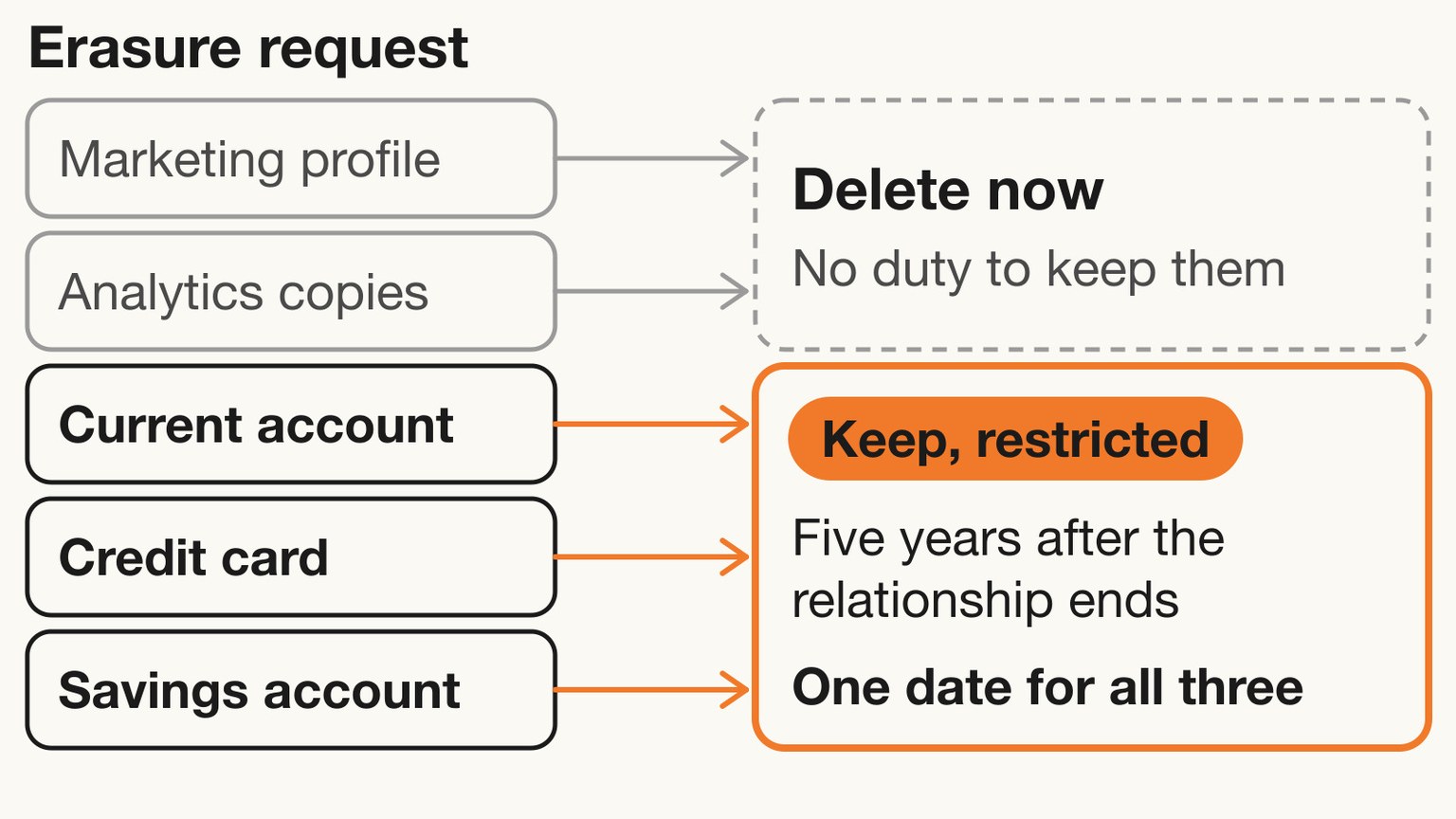
Marketing and analytics data goes now. Assuming the savings account closes on 30 November 2026, the three accounts share one date, 30 November 2031.
Three things override the sort in any bank: a litigation hold, an open complaint covered by the legal-claims exception, and an authority’s request for further retention, which Article 77 allows for up to five more years.
What may restricted records still be used for?
Only the AML purpose. The AMLR says data processed under it may be used only to prevent money laundering and terrorist financing, and Article 76 prohibits processing it for commercial purposes. The UK rule in regulation 41 is similar, though it also allows a use that another law permits or the person agrees to.
In practice, restricted records may feed:
- AML investigations, suspicion reporting and enquiries from the financial intelligence unit;
- answers to supervisors and law enforcement;
- the defence of legal claims.
They may not feed marketing, analytics, credit models or model training. The ICO’s guidance on restriction suggests methods such as “making the data unavailable to users” or moving it to another system. Restricted records stay hidden from most users but complete, because Article 77 requires that retained records are not redacted.
One decision is easy to miss: should a returning customer still match the restricted record? Our view is yes, for AML use only. Under Article 78 a bank must be able to tell its financial intelligence unit whether it has had a relationship with a person in the past five years, which it cannot do if the record no longer links. Our access controls work per source, so the bank can keep retained records in a source that onboarding and AML teams can query and that marketing and analytics consumers cannot.
What goes in the evidence pack for each request?
Enough to show a regulator what the bank found, decided and told the person:
- the request date, how the person’s identity was checked, and the one-month deadline;
- the entity ID and its full record list at the time of the decision, with the edges and rules that linked each record;
- for each category, the decision, the legal basis, the relationship end date and the deletion date;
- who approved, normally the DPO and the money laundering reporting officer;
- the recipients told about the erasure or restriction, as Article 19 requires;
- the deletion log entries and the date of the reply.
The reply says what was erased, what is kept, under which law and until when, and that the person may complain to the supervisory authority. Send it within one month; Article 12(3) allows two more months for complex requests, but the person must hear about the extension within the first month. One thing never goes in the reply: any sign that a suspicion assessment or report exists, which Article 73 forbids.
What procedure should the DPO adopt before the next request?
Seven steps, each using the output of the one before.
- Log the request and start the one-month clock. Check identity first.
- Resolve the person. Find every record from any identifier and check each link before acting on it.
- Compute the relationship end date across all records and products. An open duplicate means the relationship has not ended.
- Sort each record. Erase now, retain and restrict, or schedule deletion, with the legal basis for each.
- Check the overrides. Litigation holds, open complaints, authority retention requests and other retention laws.
- Act. Erase, restrict, set deletion dates, tell recipients.
- Reply and file the evidence pack. Say what was kept, why and until when.
Before the next request, ask engineering three questions. Can one record ID return every record of the same person, with the rule behind each link? Does the relationship end date see every product the person holds? Which copies, extracts, backups and recipients does a deletion reach, and how do we prove it?
See one customer’s full record list on your own data: book a demo or run Tilores Studio free, locally.
Frequently asked questions
Can a bank refuse an erasure request because of anti-money laundering law?
Only for records a retention law names (AML law, and for some records accounting law), and only until that period ends. Everything else must be erased, and the person gets an answer within one month either way. We help by returning every record of the person, so the refusal covers the right records.
Does an erasure request change the AML retention period?
No. For due diligence records, the period runs from the end of the business relationship, whenever the request arrives. Risk and suspicion assessments run from the year they were recorded. If the request leads the bank to close the person’s last product, the five years start from that closing date.
What happens to retained records when the five years end?
The bank deletes them, unless another law requires a longer period or an authority has asked for further retention, which the AMLR caps at five more years. In Germany, section 8 of the GwG requires destruction after ten years at the latest.
Does Tilores decide what a bank must delete?
No. We find every record of the person, show the rule behind each link, remove records on instruction and log every deletion. The legal basis, the retention period and the decision to delete stay with the bank and its DPO.
Sources
- Final decision under the General Data Protection Regulation: TF Bank AB, Swedish Authority for Privacy Protection (IMY), IMY-2023-16160, 19 December 2024, published by the European Data Protection Board.
- Regulation (EU) 2016/679, General Data Protection Regulation, Articles 5, 12, 17, 18 and 19, EUR-Lex.
- Regulation (EU) 2024/1624, Anti-Money Laundering Regulation, Articles 73, 76, 77, 78 and 90, EUR-Lex.
- The Money Laundering, Terrorist Financing and Transfer of Funds Regulations 2017, regulation 40, legislation.gov.uk.
- The Money Laundering, Terrorist Financing and Transfer of Funds Regulations 2017, regulation 41, legislation.gov.uk.
- Geldwäschegesetz, § 8 Aufzeichnungs- und Aufbewahrungspflicht, Federal Ministry of Justice.
- Handelsgesetzbuch, § 257 Aufbewahrung von Unterlagen, Federal Ministry of Justice.
- Implementation of the right to erasure by controllers, Coordinated Enforcement Framework report, European Data Protection Board, adopted 18 February 2026.
- Right to erasure, Information Commissioner’s Office.
- Right to restrict processing, Information Commissioner’s Office.
- Politically Exposed Persons datasets, OpenSanctions.
- API Reference, Tilores documentation.
- Data Privacy and Security, Tilores.
- Data Compliance, Tilores.
- How Does a Bank Answer a Subject Access Request When One Customer Sits in Five Systems? (2026), Tilores.
- Is a Wrong Customer Match a Reportable GDPR Incident, and What Must a Bank Document?, Tilores.
- Does a Bank Need a DPIA Before an Entity Resolution Trial in 2026?, Tilores.
- Real-Time Identity Resolution Under GDPR, Tilores.
See what resolved entity data does for your business — and your AI.