Verification of Payee and Confirmation of Payee: How Should a Bank Decide What Counts as a Name Match in 2026?

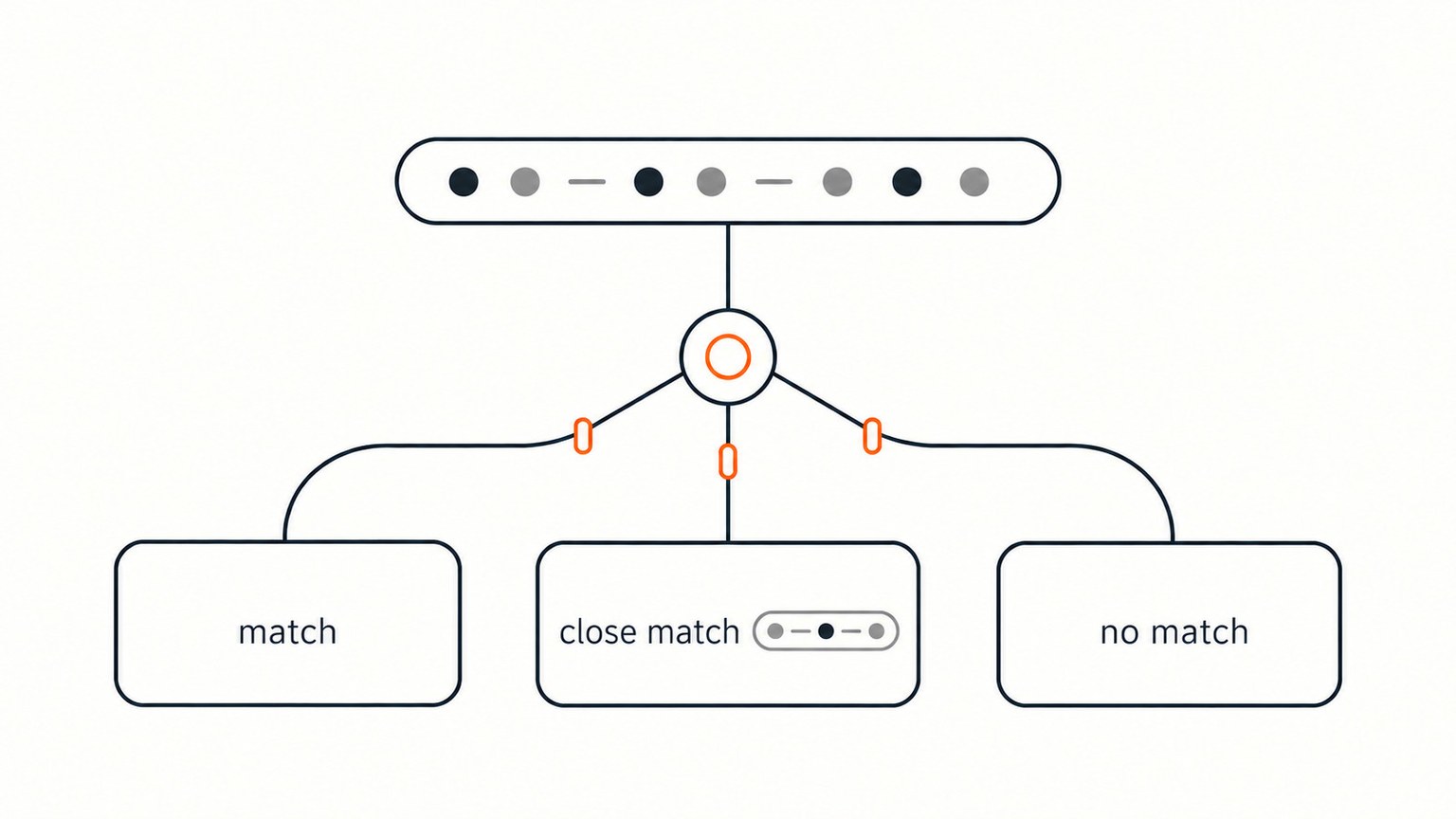
TL;DR: Draw the line as a written policy, not a single similarity score: set match, close match and no match rules for each payee type, test them on your own labelled account-holder names and keep the evidence for every outcome. With Tilores, we run those rules and record which one fired; the scheme response and payment decision stay with the bank.
Book a Demo · Try Tilores Studio (Free)
On this page
- What do Verification of Payee and Confirmation of Payee require in 2026?
- Why does each wrong outcome cost something different?
- How should match, close match and no match differ by payee type?
- What must a matching engine show before a bank trusts it on a live payment?
- How should a bank test its name-matching policy?
- Should a bank build the check, buy it or add a matching engine?
- What else should a payments lead check?
- Sources
A payer types three versions of one name against the same IBAN: “Delaney Aoife”, then “A. M. Delaney”, then “Delaney Garden Design”. The account is a personal account held by Aoife Marie Delaney, the payee’s bank ignores name order for personal names, and no trading name is on file. The answers come back match, close match, no match.
Each answer came from a rule someone at the payee’s bank chose. Since 9 October 2025, euro-area banks have had to give these answers before every euro credit transfer, and UK banks give similar answers under Confirmation of Payee. Payers act on them within seconds.
So the line between match and close match is a policy decision. It needs an owner, a test set and a version history before it needs a score.
What do Verification of Payee and Confirmation of Payee require in 2026?
Both checks compare the name a payer enters with the name the payee’s bank holds for the account, and return one of a small set of answers before the payer authorises. Neither regime prescribes a matching algorithm, and the two regimes are not identical.
What does the EU require?
Regulation (EU) 2024/886 inserted Article 5c into the SEPA Regulation. The payer’s bank must run the check immediately after the payer enters the payee’s details and before the payer can authorise, whatever the channel. On request, the payee’s bank verifies whether the account identifier and the name match. When they almost match, the payer’s bank shows the payee’s name; when they do not match, it warns the payer that the funds might go to an account the named payee does not hold. As at 1 November 2026, banks in euro-area Member States had to comply by 9 October 2025, and those in other Member States must comply by 9 July 2027.
The service is free (Article 5b) and must not prevent the payer from authorising the transfer (Article 5c(5)). For a legal person, the payer can supply an identifier such as an LEI in place of the name (Article 5c(1)(b)). The recitals name the usual causes of an almost match: diacritics, transliteration, and everyday names that differ from those on formal documents.
The EPC Verification Of Payee scheme rulebook turns this into messages. Version 1.0 entered into force on 5 October 2025, and version 1.1 took effect on 20 September 2026. The rulebook definitions describe a Match as “an exact match with the Payment Counterparty data as registered by the Responding PSP”, a Close Match as “almost a match with the payment account holder data as registered by the Responding PSP”, and a No Match as a combination that “does not match with the Payment Counterparty data as registered by the Responding PSP”. The payer’s bank should receive the answer within 5 seconds, preferably 1 second or less. The EPC plans to publish versions 1.2 and 2.0 of the rulebook at the end of November 2026, so recheck these definitions against the new text.
What counts as “almost” is left to the payee’s bank. The EPC matching recommendations state that they do not form part of the rulebook and that the responding bank “bears the full responsibility for the matching outcome and therefore remains entirely free to apply different criteria”. They also allow stricter criteria for company names, “taking into account, for example, a greater probability of fraud attempts with slightly altered legal names”.
What does the UK require?
In the UK, Pay.UK operates Confirmation of Payee and owns its rules and standards. Its public FAQ lists four outcomes: yes, close match (with the actual account name shown), no, and unavailable. A payer to a personal account needs the exact registered name; for a joint account one holder’s name is enough and the order does not change the result; for a business account, the registered business name or a trading name registered to the account works.
The Payment Systems Regulator’s Specific Direction 17 required its Group 1 firms to implement CoP by 31 October 2023 and Group 2 firms by 31 October 2024. The direction was due to expire on 1 November 2026; on 22 October 2026 the PSR removed that expiry date in PS26/2, so it stays in force unless varied or revoked, with a review planned in five years.
The four answers a payer can receive, EU and UK
| What the bank found | EU Verification of Payee (EPC response) | UK Confirmation of Payee (Pay.UK outcome) |
|---|---|---|
| The name agrees | Match | Yes, the details match |
| A small deviation | Close Match, with the registered name | Close match, with the actual account name |
| The name differs | No Match, with a warning | No, the name is wrong |
| No check was possible | Verification check not possible, with a warning | Unavailable |
New posts on entity resolution, identity data and AI. No spam, unsubscribe any time.
Why does each wrong outcome cost something different?
Because the answer space has three live outcomes, a bank can be wrong in three ways, and each error lands on a different person.
What each wrong answer costs
| Wrong answer | What happens next | Who feels it first |
|---|---|---|
| False match | The payer pays with confidence, possibly to a fraudster or the wrong person. | The payer, then both banks |
| False close match | The bank shows a registered name the payer may not be entitled to see. | The account holder |
| False no match | An honest payment is delayed, abandoned or pushed to a phone call. | Payer, payee and the contact centre |
Under Article 5c(8), where a failure to perform the check comes from the payee’s bank, that bank compensates the payer’s bank, so matching choices carry weight beyond customer experience. A loose close-match rule on joint accounts also leaks names: the EPC recommendations ask the responding bank not to disclose other holders’ names.
Hand and Christen show that the F-measure hides a precision and recall weighting that “should be an aspect of the problem and the researcher or user”. For payee checks, the problem changes with the payee type.
How should match, close match and no match differ by payee type?
Each payee type needs its own rules, because personal names, joint accounts, sole traders and companies fail in different ways and carry different costs. One global threshold will be too loose for company names and too strict for transliterated personal names at once.
Personal names vary by order, initials, titles, accents, transliteration and compound surnames. Joint accounts add a holder the payer may not name. Sole traders blur a personal and a trading name. Company names bring legal forms, abbreviations and lookalikes built to impersonate a real supplier. The EPC adds that “the length of the names must also be taken into account”: one edit in a four-letter surname is a bigger change than in a long company name.
The table is a starting policy built on the EPC recommendations, to be tested on the bank’s own data. For UK Confirmation of Payee, accept a trading name registered to the account and ignore joint-name order.
A starting three-outcome policy by payee type, to be tested on the bank’s own data
| Payee type | Match | Close match | No match |
|---|---|---|---|
| Personal, one holder | Given and family name agree after clean-up of case, accents, titles and spacing; name order ignored. | Initial plus family name; two letters transposed; one edit, limited by name length; same-sounding letters; a transliteration variant. | A different family name; given name only; a business or trading name. |
| Joint account | Full name of at least one holder. | Close-match criteria met for one holder; return only that holder’s name. | No holder’s name meets either test. |
| Sole trader | The holder’s personal name, or a trading name the bank has verified and recorded. | Personal-name criteria; a recorded trading name with one small deviation. | A trading name the bank has not recorded. |
| Company | Legal name, or a reliably recorded commercial name, after legal forms are normalised. | Word order changed; an accepted abbreviation; one edit under a tighter limit than personal names. | A different distinctive word; an unrecorded name; an identifier that does not agree. |
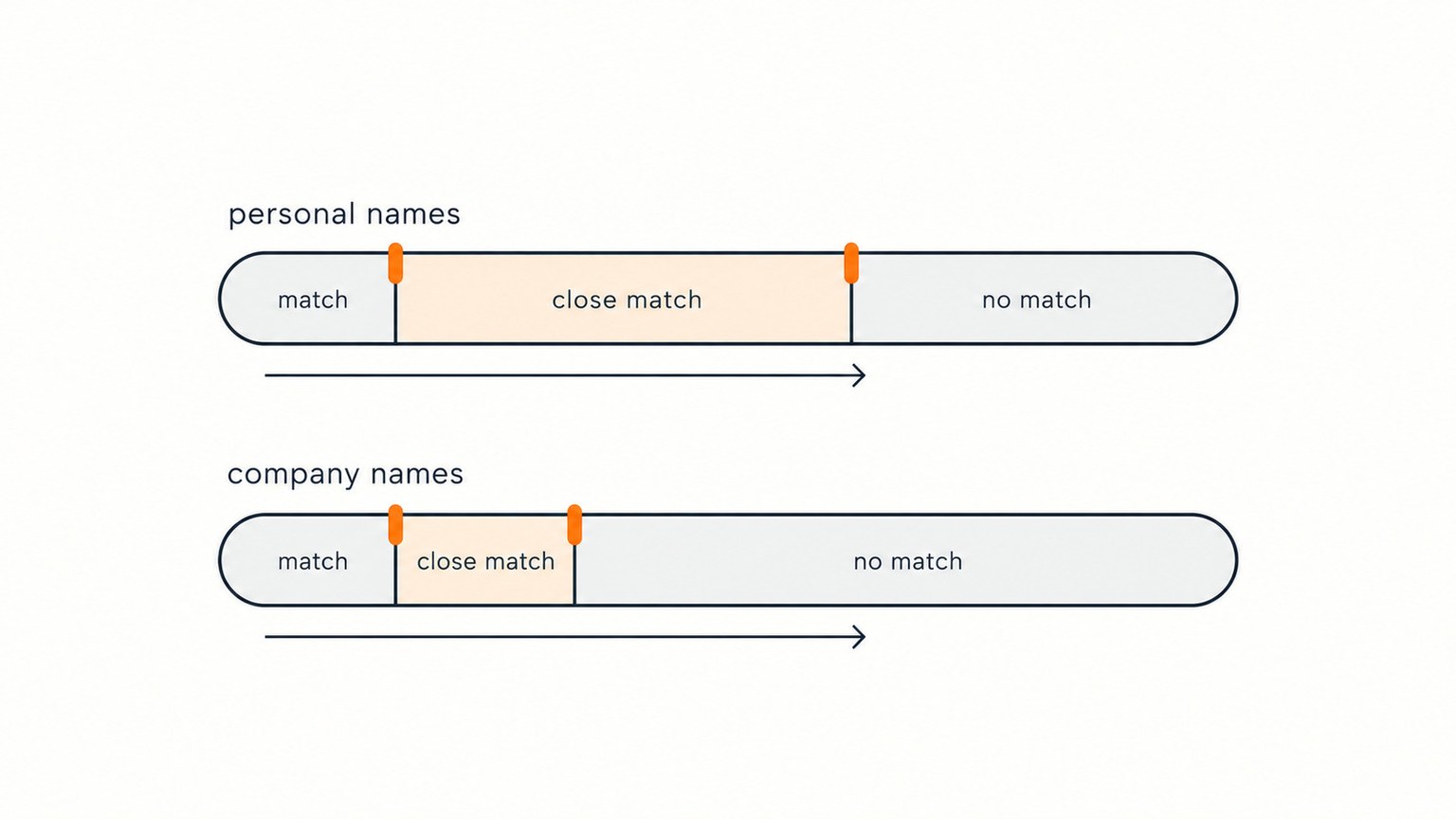
Two choices in that table need a named owner: whether personal-name order is ignored, which the EU guidance leaves open, and how tight the edit limit for company names should be. A supplier name one letter from a real one is a classic invoice-fraud pattern, so company close matches should usually be rarer. Our guide to matching customer names across spelling variants covers the methods behind each cell.
What must a matching engine show before a bank trusts it on a live payment?
For every result, an engine should show which rule fired, the names before and after normalisation, how long the answer took and which configuration version produced it. Without them, a wrong outcome cannot be traced.
- The rule that fired: a rule identifier the bank can map to match, close match or no match in its policy table, and the holder record that produced the hit.
- Normalised and original values: the cleaned name used for comparison, with the original stored beside it, so a reviewer sees “Dr. Aoife Delaney” and “aoife delaney” together.
- A result inside the time budget: matching is only a small part of the 5-second scheme round trip.
- Versioned rule changes: a dry run for proposed changes and a record of which version answered which request.
Where does Tilores fit in a payee name check?
We fit on the payee bank’s side of the check, where the account-holder names live. With Tilores, the bank resolves the names that belong to an account’s holders, such as a registered name, a former name, a joint holder or a verified trading name, across the systems that hold them. Our name and company transformers split titles, given names, surname particles and surnames, transliterate names from other scripts to Latin, and separate a company’s legal form and trade names from the name used for matching. The original value is kept beside the normalised one.
For the check itself, the bank can configure a separate search rule set for each payee type and call our GraphQL search with the typed name and its own reference for the account’s holders. Each result lists the matching records and the rule IDs they satisfied, with a hitScore for ranking. The bank maps those rule IDs to outcomes, for example an exact-name rule to match and an initial-plus-surname rule to close match. Because a hit names the record, the bank can return only that holder’s registered name on a close match. Our dynamic text distance sets allowed edits by name length. Search runs in about 150ms on AWS, or 1ms self-hosted.
A rule change is a release. Our reference lists are pinned by version, transformers declare the version they run, and submitWithPreview with dryRun shows how records would resolve before anything is stored. New rules reach existing records only when they are submitted again. Teams can try rules locally in Tilores Studio on up to 100,000 records.
Our role ends at the matching result and its evidence. The scheme connection, which identifiers the scheme requires, the wording the payer sees, whether a payment proceeds and the liability that follows stay with the bank and its scheme. The same holder names feed the daily sanctions screening required by Article 5d and the bank’s PEP and adverse media checks, which remain separate decisions. Our real-time integration guide shows where the call sits in a bank’s stack, and deployment runs from managed AWS to on-premises.
How should a bank test its name-matching policy?
Test the policy the way it will fail: by payee type, on the bank’s own names, with an adversarial set beside the honest one.
- Sample and label by payee type. Draw name pairs separately for personal, joint, sole-trader and company accounts from the bank’s own records, under its data protection assessment, and have the policy owner label each with the expected outcome and reason.
- Measure each payee type on its own. Report precision and recall for match and for close match per payee type, and add an adversarial set: lookalike company names, one-letter changes, swapped legal forms and very short names.
- Rerun the set before every release. Run each rule change against the full set in a dry run, compare with the last approved version and record the version that goes live.
Expect the close-match rate to be the number the business argues about, so write a target per payee type into the policy. Our guide to measuring entity resolution accuracy covers the metrics.
Should a bank build the check, buy it or add a matching engine?
A bank may buy the check from a payments technology provider. The open question then moves to the bank’s own account-holder names: joint accounts, trading names and legacy formats held in several systems. That data decides the answer whichever service carries the message, and that is where a matching engine earns its place.
Whichever route a bank takes, write the three-outcome policy for each payee type, test it on your own labelled names, and version every change.
What else should a payments lead check?
Does the EPC rulebook prescribe a name-matching algorithm?
No. The EPC rulebook defines the responses, and the separate EPC matching recommendations are guidance that the rulebook itself does not contain. The responding bank bears full responsibility for the outcome and may apply its own criteria, which is why the policy and its evidence sit with the bank.
Can a bank stop a payment because the check returned no match?
Not through the check itself. Article 5c(5) requires that the verification service does not prevent the payer from authorising the transfer. The payer is warned and decides. Any separate fraud control the bank applies is a different decision with its own basis and owner.
What should a close match show when an account has two holders?
Only the registered name of the holder the payer named. The EPC recommendations ask the responding bank to apply data minimisation and not disclose the names of other holders on the account. An engine should therefore report which holder record produced the hit.
Is Tilores certified for Verification of Payee or Confirmation of Payee?
No. We are not a scheme participant and hold no scheme certification. We provide the account-holder name matching layer and its evidence: normalised names with originals kept, the rule behind each result and versioned configuration. The scheme connection and response stay with the bank.
Sources
- Regulation (EU) 2024/886 on instant credit transfers in euro, amending Regulation (EU) No 260/2012, EUR-Lex
- Verification Of Payee (VOP) scheme, European Payments Council
- Verification Of Payee Scheme Rulebook, version 1.1, European Payments Council
- EPC218-23 v1.1 Verification Of Payee Scheme Rulebook (PDF), European Payments Council
- EPC recommendations for the matching processes under the VOP scheme rulebook, European Payments Council
- EPC288-23 v1.0 EPC Recommendations for the Matching Processes under the VOP Scheme Rulebook (PDF), European Payments Council
- Confirmation of Payee, Pay.UK
- Confirmation of Payee FAQs, Pay.UK
- Confirmation of Payee requirements under Specific Direction 17, Payment Systems Regulator
- PS26/2 Specific Direction 17 (Confirmation of Payee): Removing the expiry date, Payment Systems Regulator
- Hand, D. and Christen, P. (2018) A note on using the F-measure for evaluating record linkage algorithms, Statistics and Computing
- Rules Configuration, Tilores documentation
- API Reference, Tilores documentation
- Transformer Reference, Tilores documentation
- Text Comparison, Tilores documentation
- Reference Lists, Tilores documentation
- FAQ, Tilores documentation
- Deployment, Tilores
- Tilores Studio download, Tilores
- A £160K Sanctions Miss: How to Test Entity Resolution on Your Own Data Before You Buy, Schmitdy Gadget, YouTube, 2026
See what resolved entity data does for your business — and your AI.