Money Mule Accounts Under the UK APP Fraud Reimbursement Rules: How Does a Receiving Bank Spot the Same Person Behind Several Accounts? (2026)


TL;DR: A receiving bank spots the same person behind several accounts by resolving every application and every change of details into one customer entity, in real time, before transaction monitoring scores a payment. At Tilores, we resolve those records through our GraphQL API and record the rule behind each link; the fraud decision stays with the bank.
Book a Demo · Try Tilores Studio (Free)
On this page
- What did the APP reimbursement rules change for a receiving bank?
- What do mule accounts look like in a bank’s own data?
- Which details should link accounts, and which should keep them apart?
- When should a receiving bank resolve identity?
- How we resolve applications and changes in Tilores
- What happens when a link is wrong?
- What should a receiving bank’s mule control cover?
- Frequently asked questions
- Sources
When a sending bank reimburses an eligible UK APP scam payment, the receiving bank’s default contribution is half of the applicable amount for that payment. Take a payment of £2,400 from a scam victim. It arrives in an account opened six weeks ago by “J. Okafor” at a flat where a “Babajide Okafor” and a “Chidi Okafor” also opened accounts in the same two months. All three gave one mobile number.
Transaction monitoring sees a new account receiving money from a stranger, which describes thousands of honest customers. It cannot see that two of those three customers are one person, and that the third shares the address and phone but has a different date of birth. That has to be worked out before the payment arrives, which makes resolving the bank’s own customer base a fraud control. Getting it right means deciding what to link, when to link it and how to undo a link that turns out to be wrong.
What did the APP reimbursement rules change for a receiving bank?
Receiving banks now share the cost of reimbursing eligible UK APP scams. In our example, map the receiving account ID to its customer record ID before scoring the £2,400 payment. A real-time entity resolution API can return the linked records and the rule behind each link. Fraud monitoring sees the two accounts held by the same person and keeps the third customer separate.
Since 7 October 2024, the rules cover eligible authorised push payment (APP) scams over Faster Payments or CHAPS between UK accounts. Individuals, microenterprises and charities are covered. The PSR’s consumer guide says firms should normally reimburse victims within five business days. If the sending firm stops the clock while it investigates, it still has 35 business days from the claim to reach a decision.
The cap is £85,000 per claim for both Faster Payments and CHAPS. The sending bank can seek the receiving bank’s contribution only after reimbursing the victim. For our single £2,400 payment, if the sending bank reimburses it in full and no excess or deduction applies, the receiving bank contributes £1,200.
Keep the payment ID and the receiving firm on each claim. The default contribution is half of the lower of what the sending firm paid and what the scheme required, in each case limited to the reimbursable payments that reached that receiving firm. An excess can affect the final figure. Claims staff use the payment records to calculate it.
The sums are large. The PSR’s reimbursement dashboard, updated on 30 July 2026, reports that in the 18 months to 31 March 2026 about 301,500 Faster Payments claims were in scope. Firms reimbursed £316 million, or 88% of the money lost on those claims. An independent review by Frontier Economics, published on 1 July 2026, estimates that the policy cut APP losses by about £73 million a year.
The rules themselves are still moving. The Government plans to fold the PSR into the Financial Conduct Authority, and FCA staff already support PSR work; until that change takes effect, the PSR’s directions apply. Its policy roadmap plans a consultation in December 2026 and a decision in May 2027.
What do mule accounts look like in a bank’s own data?
Start with the account opening records. At Tilores, our GraphQL search can check new applications and changes of details against the bank’s own records as they come in. Pass confirmed links to fraud monitoring before it scores the next payment. An application with a shortened name can still match a previously closed account when the surname, date of birth and mobile agree. A shared phone with a different date of birth is a lead for an investigator. The records stay separate.
In the FCA’s September 2026 survey of 35 firms, reported closures for suspected money mule activity rose from 184,935 in 2023 to 238,396 in 2025. Across the three years, about 92% of the closures were personal accounts, and nearly half of suspected mule accounts were closed within a year of opening. Account age on its own tells you little about who controls the account.
The people behind them fall into three groups a bank will recognise in its own files:
- Recruited mules: real people, often young, who lend or open accounts for a fee. Cifas reported nearly 13,000 money mule cases on the National Fraud Database in the first half of 2026, 70% more than a year earlier. People under 30 were involved in 57% of recorded cases.
- Borrowed or invented identities: stolen details or synthetic identities used to open accounts the real person never sees.
- Repeat applicants: people the bank has already exited, who come back with a new address, a shortened name or a fresh email. A suppression list only catches them if the new application resolves to the old customer.
In the FCA’s tracing work, criminals usually cashed out between the second and fifth mule account, most often at the second. The FCA expects firms to weigh “indicators beyond the initial receiving account, including linked accounts within the institution”. Pass the linked account IDs and the evidence behind a match to fraud monitoring so the team can assess the payment across the customer’s accounts.
New posts on entity resolution, identity data and AI. No spam, unsubscribe any time.
Which details should link accounts, and which should keep them apart?
Link on details that one person carries and a household does not share, and treat shared contact details as a reason to look. Students, house shares and families live at one address, and a parent’s mobile can sit on a child’s account. A rule that merges on address or phone alone would freeze honest customers along with the mules.
Link, keep apart or flag: a starting rule set for mule detection
| Details that agree | Treat as | Why |
|---|---|---|
| Surname, date of birth and mobile, after normalisation | Link if consistent | Three independent details rarely agree by chance |
| Date of birth and email, after normalisation | Link if consistent | Email variants hide a reused inbox |
| Address only | Keep apart | Households, students and house shares share addresses |
| Mobile, but dates of birth differ | Keep apart, flag the shared phone | A shared phone is a reason to look, not to merge |
| Device only | Pass to fraud tools | Device signals belong to device intelligence, not identity |
| Two different National Insurance numbers | Block the link, send to review | One person holds one National Insurance number; a typo at onboarding is more likely than two numbers |
Two kinds of rule do the work. Match rules decide which records join one entity. Consistency rules set a field that must agree across every record in an entity, such as date of birth, so a record that contradicts it stays out however strong the rest looks. Our article on consistency rules for customers with the same name walks through the household case.
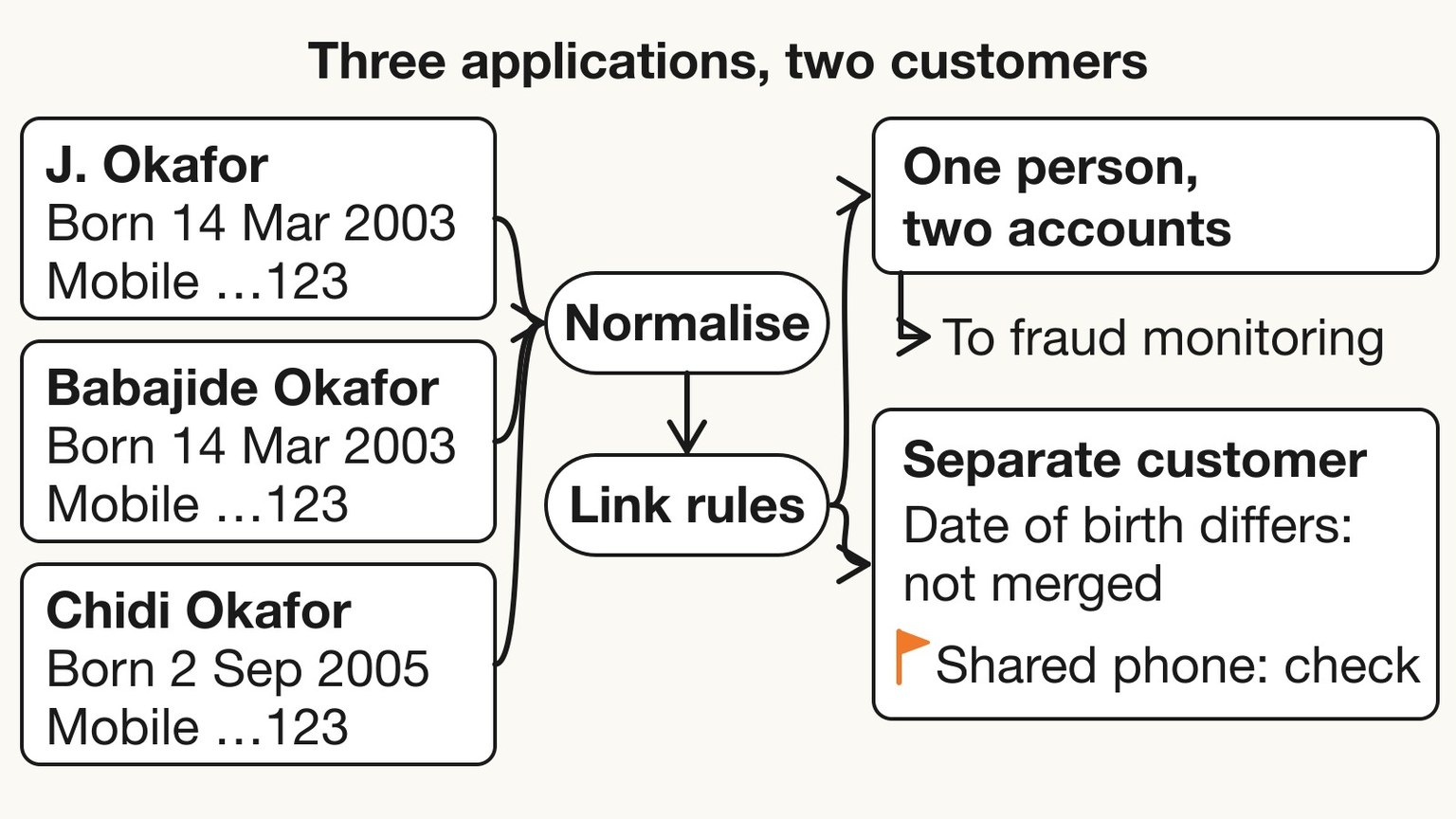
Three applications go in; the link rules join the two with the same date of birth and mobile into one customer for fraud monitoring. The third applicant has a different date of birth, so the rules keep that customer separate and only flag the shared phone.
In the opening example, “J. Okafor” and “Babajide Okafor” share surname, date of birth and mobile, so the bank’s rules make them one person with two accounts opened a month apart. “Chidi Okafor” shares the surname, flat and phone but has a different date of birth, so Chidi stays a separate customer and the shared phone goes to an investigator. The rules do not call anyone a mule. They give the fraud model one person with two new accounts in place of two strangers.
Entity resolution can only find a link when the bank has evidence that connects the records. The FCA’s earlier review of mule controls points to other signals, including device profiling, geolocation and inbound transaction monitoring. Consortium data such as the National Fraud Database can also help investigators.
When should a receiving bank resolve identity?
At application and again at every change of details, because a mule network grows one account at a time and a monthly batch match finds the link after the money has gone. Resolution has to run before transaction monitoring scores the first payment, so the fraud model sees the entity, not the account.
- At application. Search the applicant against existing customers, including exited ones, before the account opens. Our article on payee name matching under Verification of Payee covers the related check on the paying side.
- At every change. A new phone, email or address can join two customers who looked separate at onboarding, or split one that was joined wrongly. Treat each change as a new chance to link.
- Into monitoring. Send each new link, merge and split to the fraud and transaction monitoring systems as it happens, so the next payment is scored against the whole entity.
- To an investigator. A link raises a case. A person decides on restrictions, exits, reports to the National Fraud Database and suspicious activity reports.
That last step matters because the link is evidence, not a verdict. Section 188 of the Economic Crime and Corporate Transparency Act 2023 also protects a firm in the regulated sector from claims of breach of confidence when, under the Act’s conditions, it shares information with another such firm. That helps when the mule’s next account sits at another bank.
How we resolve applications and changes in Tilores
We resolve each application or change as it happens and return the entity with the evidence behind it. Our GraphQL API searches a new applicant against existing records using search rules and returns each candidate entity with the record IDs it found, the ID of the rule that found them and a hit score. Our API answers a search in about 150ms on AWS, which fits inside an onboarding flow.
Searching and linking are separate. Search rules produce hits. Match rules can create edges between records on submission. A bank can run a wide search rule to find candidates and a narrow match rule to join them. Each edge stores the two record IDs and the rule ID, so the reason for a link sits in the data, not in a report written later. Before an application is committed, submitWithPreview with dryRun shows how the entity would look.
When a customer’s details change, the bank submits the record again. With our single-operation update (single_assembly_update) switched on, the record leaves any entity it now contradicts; the setting is off by default today. When entity event streaming is enabled, we publish creates, updates, merges, splits and deletes. Fraud monitoring can use a subscribed stream to keep its view current as it applies each change.
Weak links can wait for a person. When enabled, our review queue puts links that rest on little evidence in front of a reviewer, and the defer setting keeps the records apart until that reviewer decides. For sanctions, PEP and adverse media checks, we resolve a customer list first in our Tilores Studio and then screen each entity against OpenSanctions data; we do not maintain watchlists ourselves. Our engine runs fully managed on AWS or inside the bank’s own environment.
What stays with the bank: the fraud score, the decision to restrict or exit an account, reports to the National Fraud Database and law enforcement, and how the customer is treated. We resolve identity. We do not decide who is a mule.
What happens when a link is wrong?
An innocent customer pays for it, so every link must be explainable, reversible and logged. Suppose a loose rule joins Chidi to the other Okafor entity. Chidi’s account could be frozen during an investigation, the bank could close it, and Chidi’s details could end up on a fraud database. A wrong customer match can also be a personal data incident.
Article 5(1)(d) of the UK GDPR requires personal data to be accurate and inaccurate data to be erased or rectified without delay. The ICO’s accuracy guidance asks firms that keep a record of a mistake to mark it clearly as one. In practice that sets three tests for any link:
- Explainable: an investigator can see which rule joined which records and check the fields that rule uses.
- Reversible: a wrong link can be removed and the entity split, with downstream systems told.
- Logged: the reviewer, the time and the reason are kept with the decision.
Our review verdicts record the actor and the reason, and a removed edge splits the records that are no longer connected. The disassemble mutation removes a wrong edge and can ban the two parts from joining again. If you use the entity event stream, have the fraud system apply the split event so its view drops the false connection. Our article on merges, splits and stable IDs covers what downstream systems should do with them.
What should a receiving bank’s mule control cover?
Four decisions about entity resolution, written down before the next payment lands:
- What to link: the details that make two records one person, the details that only raise a flag, and the fields that must agree, such as date of birth.
- When to resolve: in real time at application, including against exited customers, and at every change of name, address, phone or email.
- Who sees the entity: fraud and transaction monitoring before the first payment is scored, and the investigator who owns the case.
- How a wrong link is undone: who can split an entity, how fast, how the customer is told and how the correction reaches every system that saw the link.
For the account opened by “J. Okafor”, that control means the £2,400 payment is scored against one person with two new accounts and a phone shared with a third, while Chidi Okafor stays a separate customer.
Frequently asked questions
Which entity resolution tools support real-time fraud detection at a receiving bank?
Tools that resolve an applicant or a changed record into an entity within the onboarding or payment flow and pass the result to fraud monitoring. At Tilores we do this through our GraphQL API, at about 150ms per query on AWS, with the rule behind every link stored on the edge.
Should two accounts with the same phone number be merged?
No. For fraud monitoring, a shared phone is a reason to look, because families and house shares share phones. Merge only when details one person carries alone, such as date of birth with surname and mobile, agree, and let a consistency rule block records that contradict them.
Can entity resolution catch a mule network that shares no details?
Only if the bank has evidence that connects its records. Device intelligence, consortium data such as the National Fraud Database and behavioural signals can help investigators find other leads. When new records provide evidence of a link, our real-time search at Tilores can surface a candidate for the next fraud check.
Who decides that an account is a mule account?
The bank. At Tilores we resolve identity, show the evidence and keep the rule behind each link, so every match can be explained and audited. The fraud team decides on restrictions, exits and reports, and keeps a person in the loop for every decision that affects a customer.
Sources
- APP scams: our work to prevent Authorised Push Payment fraud, Payment Systems Regulator.
- APP fraud reimbursement protections, Payment Systems Regulator.
- PS24/7 Faster Payments APP scams reimbursement requirement: confirming the maximum level of reimbursement, Payment Systems Regulator, 2 October 2024.
- APP scams reimbursement dashboard for Q1 2026, Payment Systems Regulator, updated 30 July 2026.
- Payment fraud falls by £73m following PSR reimbursement scheme, Payment Systems Regulator, 1 July 2026.
- Payment Systems Regulator home page (upcoming regulatory changes), Payment Systems Regulator.
- APP scams policy roadmap, Payment Systems Regulator.
- Money mules: mule activity and cashing out findings, Financial Conduct Authority, 23 September 2026.
- Proceeds of fraud: detecting and preventing money mules, Financial Conduct Authority, 19 October 2023, updated 3 December 2025.
- Nearly three in five (59%) fraud-risk cases linked to identity fraud, Cifas data shows, Cifas, August 2026.
- Economic Crime and Corporate Transparency Act 2023, section 188, legislation.gov.uk.
- UK GDPR, Article 5: principles relating to processing of personal data, legislation.gov.uk.
- Principle (d): accuracy, Information Commissioner’s Office.
- Tilores API documentation, Tilores.
- Rules, Tilores.
- Review, Tilores.
- Release notes, Tilores.
- Product, Tilores.
- Screen: Tilores Studio now checks your customer list against OpenSanctions, Tilores.
- Deployment options, Tilores.
- APP scams reimbursement requirement: consolidated policy statement PS25/5, Payment Systems Regulator, May 2025.
- CHAPS: APP scam reimbursement requirement, Bank of England.
See what resolved entity data does for your business — and your AI.